China discovers new lizard that lived 70 mln years ago; its similarity to North American species reveals complex evolution: scholar
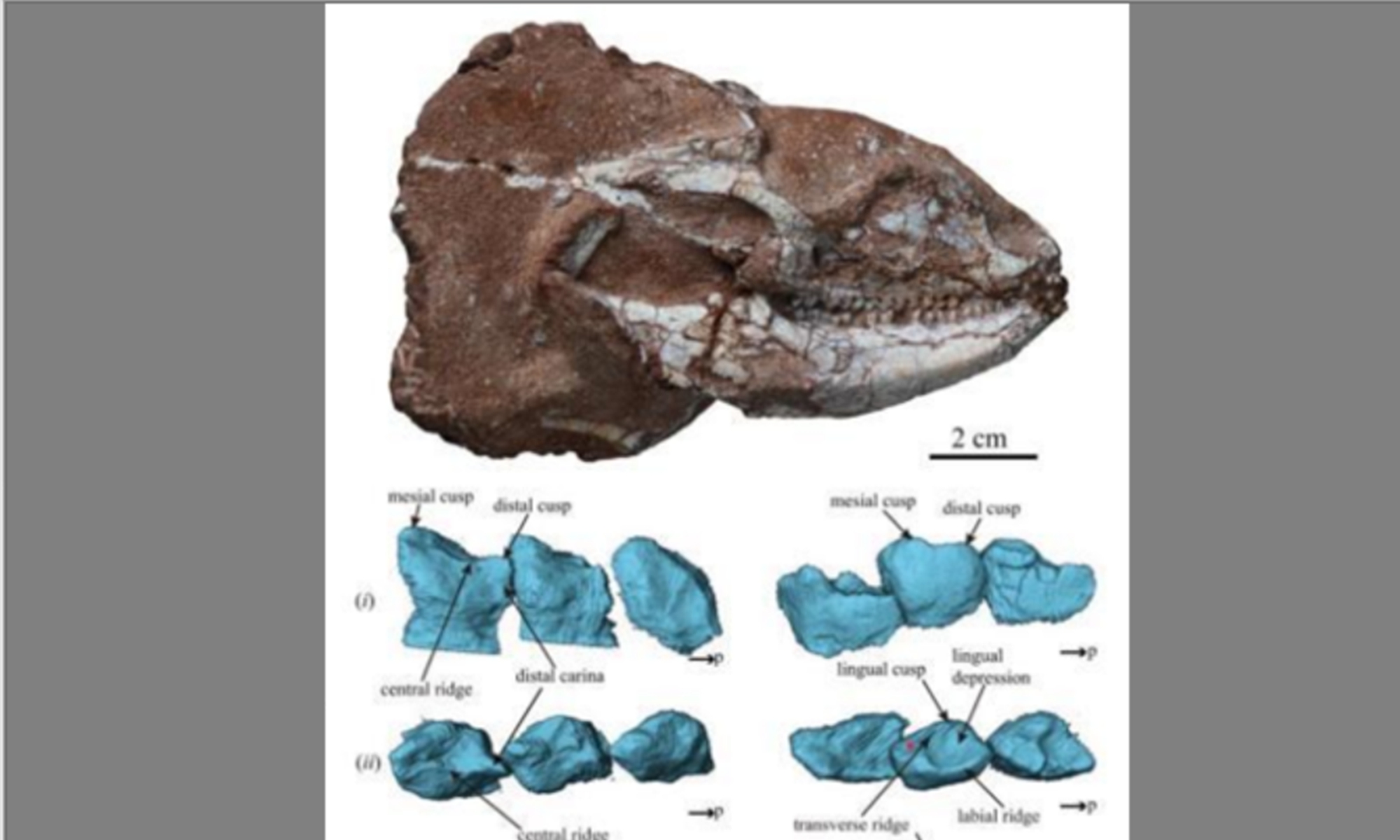
Up: Fossil of the newly discovered Heterodon fangii
Down: Reconstructions of the teeth of the species
Photos: Courtesy of the Institute of Vertebrate Paleontology and Paleoanthropology of the Chinese Academy of Science
Fossils of a large omnivorous multichisel-toothed lizard have been discovered recently in the Late Cretaceous strata dating back more than 70 million years in the Ganzhou Basin of East China's Jiangxi Province. The species has been named Heterodon fangii.
Its generic name Heterodon means "lizard with peculiar teeth," and the species epithet Fangii is dedicated to Fang Jingyun, an academician of the Chinese Academy of Sciences (CAS) and plant ecologist. The discovery and research of this new genus and species fossil have revealed the complexity of the evolutionary history of multichisel-toothed lizards, the Global Times learned from the Institute of Vertebrate Paleontology and Paleoanthropology of CAS.
The research was conducted by researchers from the institute together with Yunnan University and UK's University College London, and has been published in Royal Society Open Science run by Britain's Royal Society.
Researchers conducted a 3D reconstruction of the teeth of Heterodon fangii using high-resolution micro-computed tomography technology. The results showed that this species had anterior teeth adapted for seizing prey and posterior teeth capable of shearing and grinding food. From this, it is inferred that the species was able to process both plant and animal matter for food.
Dong Liping, an associate research fellow at the CAS institute, told the Global Times that such dental characteristics are unique from multichisel-toothed lizards discovered in Asia, therefore this not only fills the gap in the omnivorous ecological niche of Asian multichisel-toothed lizards, but also provides crucial empirical evidence for researching biodiversity and ecosystem evolution at the end of the Cretaceous period.
Such characteristics were more similar to some species found in North America than those in Asia. Since the phylogenetic relationships among genera and species within the multichisel-toothed lizard clade remain unclear, this similarity may indicate either a complex phylogenetic relationship between Asian and North American species, or the independent evolution of such complex dental morphologies across different continents, according to Dong.
Either situation indicated that the evolution of multichisel-toothed lizard is more complicated than previously thought, Dong said.
Multichisel-toothed lizards are a group of lizards that lived during the Late Cretaceous period, roughly from 100.5 million years ago to 66 million years ago. The clade had a rich diversity of genera and species and a wide distribution, while also exhibiting remarkable morphological diversity in body size and physical characteristics. Asia is one of the regions with the greatest diversity of these lizards. At the end of the Cretaceous period, this prosperous clade became extinct along with dinosaurs, pterosaurs and other taxa.
RELATED ARTICLES