The worrying trend of US AI militarization underscores the urgency of ‘tech for good’
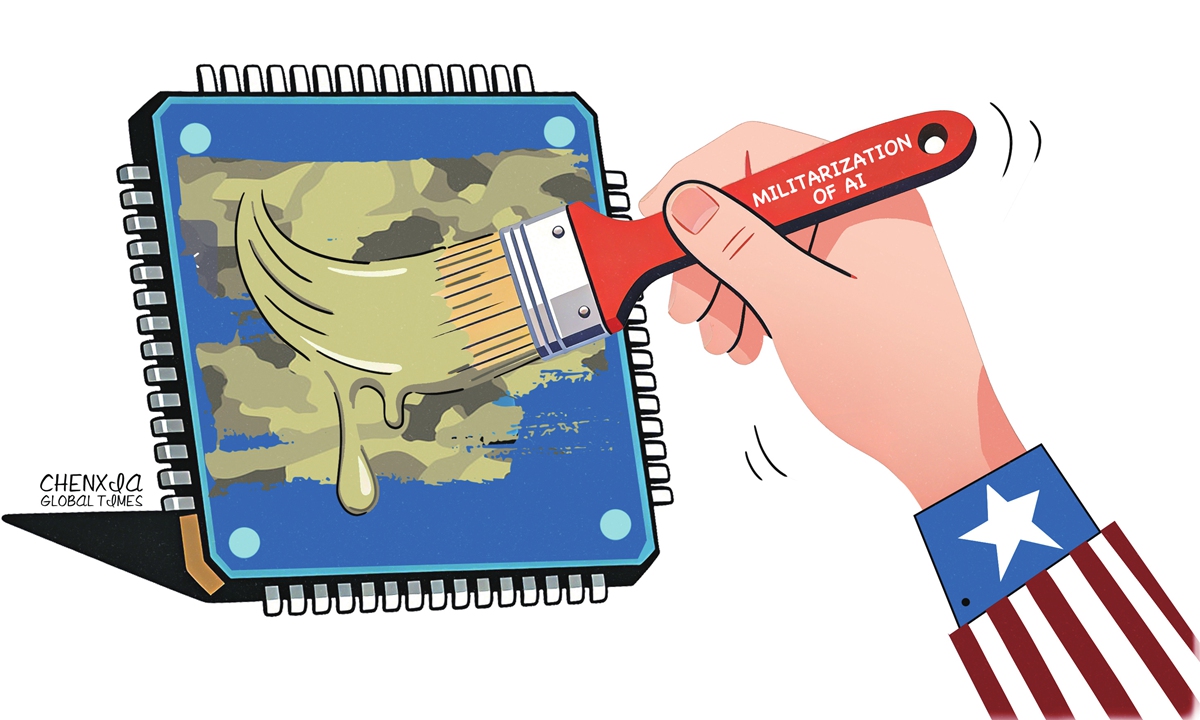
Illustration: Chen Xia/GT
Where are we headed when AI is weaponized as a tool for military strikes and AI companies are asked to serve geopolitical and military objectives?
According to the Wall Street Journal and Axios on Sunday, the US military used Claude, Anthropic's AI model, in its illegal coordinated airstrikes against Iran, for intelligence purposes, as well as to help select targets and carry out battlefield simulations.
This is not an isolated case. Claude was also reportedly used in the US illegal raid in Venezuela.
And reports indicate that the US Department of War was in talks with leading AI companies about partnerships to conduct automated reconnaissance of China's power grids, utilities and sensitive networks with AI-powered cyber tools to identify flaws that could be exploited in any conflict.
Although there is no definitive conclusion regarding the extent of AI's involvement in the US military operations against Iran or whether the conflict has entered a new stage of "algorithmic warfare" due to AI, the signs of its militarization are evident. This underscores a dangerous trend: The US is accelerating the militarization of AI. It seeks to embed AI directly into geopolitical conflicts and confrontational scenarios, transforming it from a technical tool intended for public benefit into an instrument of power politics.
Meanwhile, major tech companies are increasingly being drawn into political and military agendas, raising the risks of misuse and loss of control. These developments undoubtedly cast a significant shadow over global AI security governance.
"The US is attempting to leverage its AI technologies to maintain its absolute military superiority and hegemonic position," Song Zhongping, a military expert, told the Global Times on Tuesday. "Its unreasonable or unchecked military use will significantly intensify asymmetry, further amplifying the risks of AI as a 'double-edged sword' and disrupting the current geopolitical landscape."
The growing trend of US AI militarization may also trigger a chain reaction: growing difficulties in arms control, declining military transparency, and intensified competition as more countries rush to invest in AI military research and development. The ultimate danger is a potential slide toward an uncontrollable "AI arms race," posing a long-term threat to global security.
In this context, ensuring "tech for good" is particularly important. The original purpose of AI is to benefit humanity; it should not be reduced to a tool of hegemonic rivalry or transformed into a weapon that undermines other countries' sovereignty or threatens international peace. However, the US has employed AI in unlawful military strikes and infrastructure sabotage, endangering the sovereignty and territorial security of other nations - actions that constitute serious violations of AI ethics.
For a long time, the international community has called for the establishment of inclusive, multilateral, and binding AI governance rules to curb the abuse of technology, especially to prevent uncontrolled militarization. Yet the US has demonstrated through its actions that, in pursuit of military advantage and geopolitical interests, it can arbitrarily turn AI into a weapon of geopolitical competition. As Li Yan, director of the Institute of Sci-Tech and Cyber Security Studies at the China Institutes of Contemporary International Relations, noted, when hegemony can easily violate ethical boundaries, the greatest risk in the future development of AI may not be the unpredictable technology itself, but rather the irresponsible applications currently in use.
Ensuring the responsible use of AI in the military domain is crucial for the shared future of humankind and represents a defining challenge of our time. As a major AI power, China has advocated for upholding the principles of "tech for good" with a people-centered approach. Through multilateral platforms such as the United Nations, China has submitted position papers on regulating military applications of AI and strengthening AI ethical governance.
AI must not become a tool of fear and destabilization on a global scale. In the face of risks of technological loss of control, ethical erosion, and strategic imbalance, the international community must act together to promote a global governance framework for AI, prevent technological abuse, curb unilateral adventurism, and establish an inviolable security red line for the shared future of humanity.
RELATED ARTICLES