Technology contributes more than 64 percent to China's agricultural output growth: political advisor
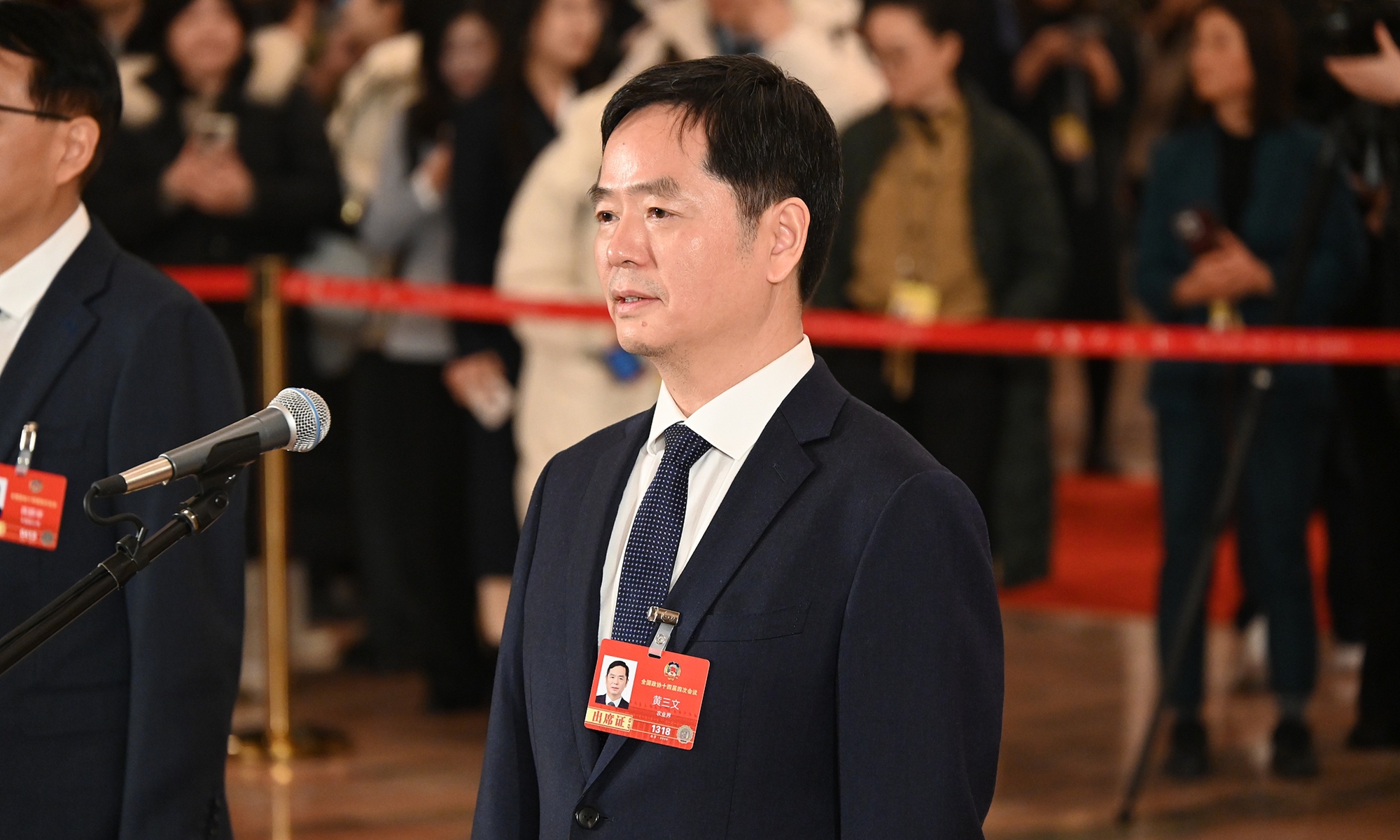
Huang Sanwen, a member of the 14th National Committee of the Chinese People's Political Consultative Conference (CPPCC), an academician of the Chinese Academy of Sciences, as well as President of the Chinese Academy of Agricultural Sciences speaks during a question-and-answer session at the Members' Corridor group interview of the fourth session of the 14th National Committee of the CPPCC held at the Great Hall of the People in Beijing on March, 4, 2026. Photo: VCG
Science and technology contribute to more than 64 percent of China's agricultural output growth, particularly in key areas like the seed industry and mechanization, a Chinese academician in agricultural expertise said during a question-and-answer session at the Members' Corridor group interview of the fourth session of the 14th National Committee of the Chinese People's Political Consultative Conference (CPPCC) held at the Great Hall of the People in Beijing on Wednesday.
Thanks to continued breakthroughs in agricultural technology, China has achieved stable grain production at a high level, with the bumper harvest hard-won, added Huang Sanwen, a member of the 14th National Committee of the CPPCC, an academician of the Chinese Academy of Sciences, as well as President of the Chinese Academy of Agricultural Sciences.
In the group interview, Huang mentioned a data, which said that China's grain output reached 1.43 trillion jin in 2025, an increase of 90.75 billion jin compared with 15 years ago.
Data show that improvements in yield per unit area accounted for more than 90 percent of the increase in grain production, providing clear evidence of the pivotal role agricultural technology plays in supporting grain output, according to Huang.
Huang said China has always regarded ensuring food security for the Chinese people as a top priority. Currently, science and technology contribute more than 64 percent to China's agricultural output growth. China's advances in agricultural science and technology are particularly evident in the seed industry and mechanization, Huang said.
He mentioned that during the 14th Five-Year Plan period (2021-25), major agricultural science and technology initiatives - such as the revitalization of the seed industry and efforts to address shortcomings in agricultural machinery and equipment - were accelerated.
These initiatives have driven major breakthroughs in fundamental theories in the agricultural sector, enabled the successful development of multiple key technologies, and facilitated the application of a large number of advanced and practical agricultural technology products in the fields, the academician said.
He said at present, more than 95 percent of the planting area of China's crops is covered by domestically bred varieties. Market shares of domestically sourced seeds for vegetables, livestock and poultry, and aquatic products have reached 91 percent, 80 percent and 86 percent respectively, meaning that China's grain, vegetables and meat are now largely produced using "Chinese seeds." Upgraded agricultural machinery has also empowered grain production.
The comprehensive mechanization rate for plowing, planting and harvesting of crops nationwide has reached 76.7 percent. The wider application of new tools such as drones has made farming easier and more efficient for farmers, further unleashing agricultural productivity, Huang said.
RELATED ARTICLES