Illustration: Liu Rui/GT
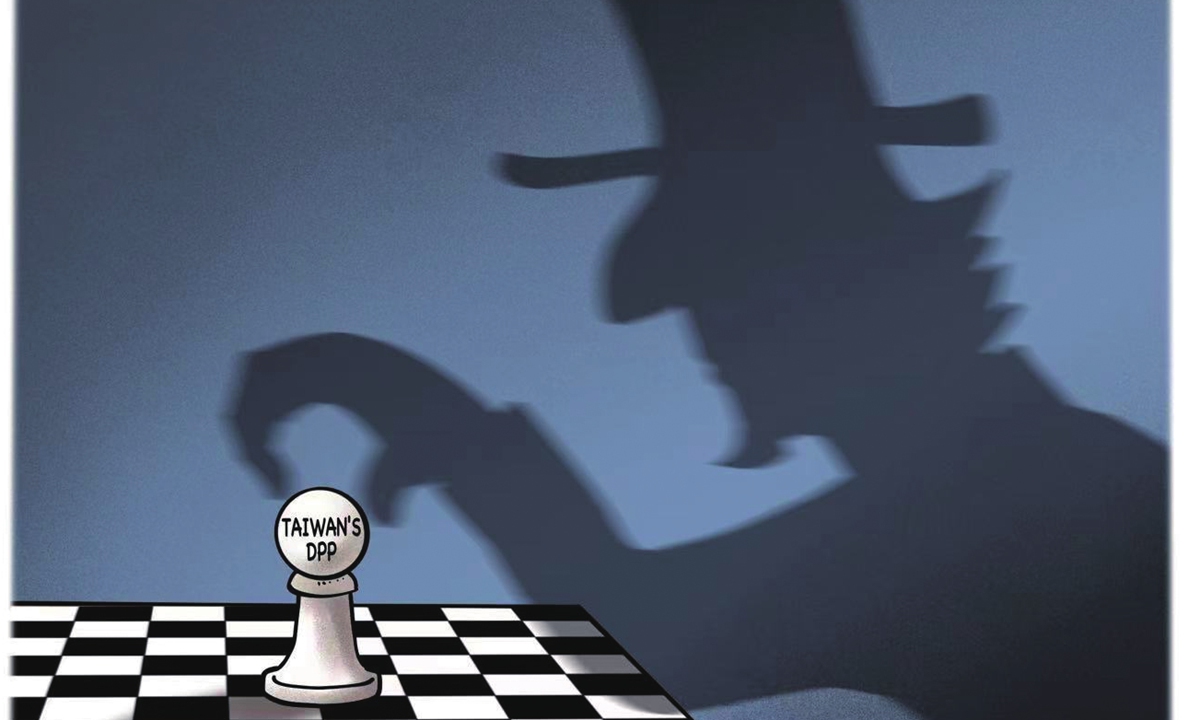
In the eyes of the US, Taiwan island has always been treated as a geopolitical pawn - its fate bargained and traded on the chessboard of great power politics, never as a player in its own right. This reality manifests the true anxiety of Taiwan's Democratic Progressive Party (DPP).
In an interview with a Japanese media outlet published on Wednesday, Lin Chia-lung, head of Taiwan island's so-called "foreign affairs" department, called on the island to be embedded into so-called Indo-Pacific security frameworks, particularly with partner countries along the "first island chain," so as to create a stronger US-led regional defense architecture to deter China.
Not coincidentally, Chen Kuan-ting, a DPP lawmaker, was quoted in a Reuters article a day earlier as revealing the hope that the US strikes on Iran could end soon so that "resources can be promptly shifted back to Asia."
These advocacies from DPP politicians sound more like desperate petitioning begging for US protection. Their anxious and fretful sentiment - rushing to grant interviews with foreign media, pleading to be integrated into US-led defense frameworks, and nervously watching Washington's every move in the Middle East - exposes the profound embarrassment of DPP authorities that bet the island's entire fate on the US and its allies.
Zhang Hua, a research fellow at the Institute of Taiwan Studies under the Chinese Academy of Social Sciences, told the Global Times on Wednesday that this is not the first time that DPP politicians have tried to extend their messages to the US and its allies via foreign media.
"By granting interviews to Japanese media, the DPP authorities are sending a signal to the Japanese government in an attempt to enhance cooperation with Japan and most importantly, the US," said Zhang.
Zhang noted that the likelihood of Taiwan joining US-led security frameworks is extremely low, for three fundamental reasons.
First, no member of US-led minilateral groupings - whether Japan or the Philippines - would be willing to bear the risks of great power confrontation on behalf of Taiwan island. While these countries may engage in rhetorical posturing, their strategic calculus prioritizes national interests over symbolic solidarity.
Second, any attempt to formally incorporate Taiwan island into US-led military frameworks would constitute a direct challenge to China, a sovereign state with both the resolve and the capability to defend its territorial integrity.
At its core, the impossibility stems from a single immutable truth: a pawn can never become a player. In other words, a pawn cannot set the agenda; it can only react to it. For the US, Taiwan's utility lies in being a controllable hedgehog, not a lit fuse that could ignite a conflagration consuming its handlers. Washington needs Taiwan island as an instrument, not an equal; a tool to be wielded, not a trigger to be pulled.
This may help explain the recent US decision to delay the announcement of a multibillion-dollar arms sales package to Taiwan island ahead of President Donald Trump's reported trip to China in early April.
Once again, it underscores that Taiwan is nothing more than a bargaining chip in the US calculation of its own strategic interests. Consequently, while the US remains deeply engaged in the Middle East - seeking to preserve strategic control and assert its hegemony in the region - Taiwan is left to stew in its own anxiety, helplessly watching from the sidelines.
The DPP authorities should understand that every US action - whether in the Middle East or the Asia-Pacific - is driven by one overriding imperative: the preservation of the US global hegemony, not a willingness to shed blood for "allies" in distant lands.
Allies and partners can be abandoned by the US whenever necessary, and Taiwan is no exception. The anxiety over abandonment by the US is a torment that always haunts the DPP authorities.
Being forever dependent means being forever uncertain and terrified. When Taiwan island places its security on the US, that security it pursues is nothing more than a mirage. The true sense of security only comes from the peaceful development of cross-Straits ties.
RELATED ARTICLES