Maritime transport needs to become stronger by becoming bigger, smarter, greener: CPPCC National Committee member
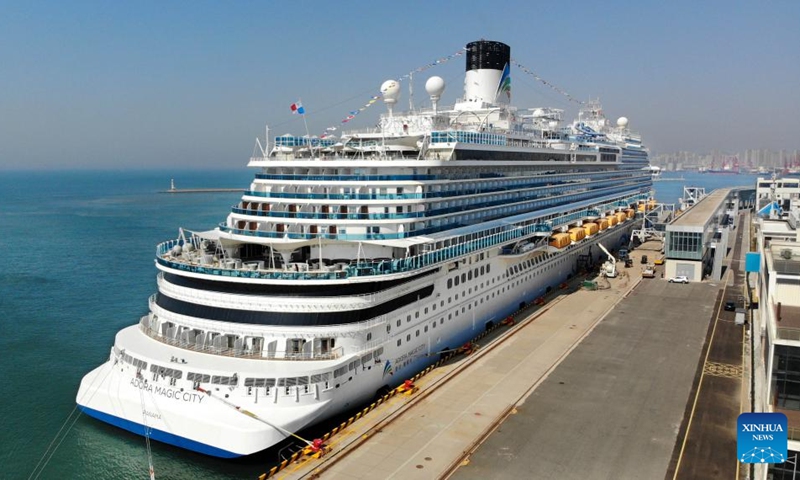
An aerial drone photo taken on April 6, 2025 shows Adora Magic City berthing at the Qingdao International Cruise Terminal in Qingdao, east China's Shandong Province. (Xinhua/Li Ziheng)
Li Ying, a member of the 14th National Committee of the Chinese People's Political Consultative Conference (CPPCC), said on Wednesday that to enhance China's comprehensive strength in maritime transport, the core lies in making it "bigger, smarter, and greener."
Li made the remarks when attending a group interview ahead of the opening meeting of the fourth session of the 14th CPPCC National Committee at the Great Hall of the People in Beijing on Wednesday.
Li, also a professor at the Navigation College of Dalian Maritime University, said that maritime transport plays a dominant role in international trade, handling 80 percent of global cargo volume, noting that economic development and national strength cannot be achieved without the support of maritime shipping.
In the dimension of "bigger" development, China already possesses the world's largest maritime fleet in terms of scale, with large-scale and high-end features becoming prominent characteristics of maritime equipment development, Li said.
Li shared her field research experience at the Shulanghu terminal in East China's Zhejiang Province. The container ships docked there, with a capacity of 20,000 20-foot equivalent units, can carry in a single trip enough cargo to satisfy the annual needs of a city of 5 million people. Ultra-large container vessels approaching 400 meters in length are now in service on domestic coastal routes, according to Li.
At the same time, China's first domestically built large cruise ship, Adora Magic City, has been completed and put into service. This marks China's shipbuilding industry successfully claiming the "three bright pearls" of aircraft carriers, large liquefied natural gas carriers, and large cruise ships, achieving a comprehensive breakthrough in high-end vessel types and solidly laying the equipment foundation for maritime transport development, said Li.
"Smarter" development represents the core focus of China's intelligent upgrade in maritime shipping. According to Li, the country is vigorously promoting the intelligent development of navigation support systems. By equipping vessels with perception devices and building collaborative management systems, ships are effectively given "eyes" and a "brain."
Perception devices serve as the "eyes," precisely capturing real-time information about sea conditions such as winds, waves, and obstructing vessels. The collaborative management system acts as the "brain," accurately calculating routes and predicting arrival times.
This upgrade enables real-time linkage between ship and shore information, with route plans recommended at the push of a button. It also automates the repetitive manual tasks previously performed by seafarers, making long-distance ocean voyages more relaxed and safer, said Li.
"Greener" development serves as a crucial lever for the high-quality advancement of China's maritime transport, and the construction of green ports and green ships is accelerating, Li noted. Currently, eight ports — including Tianjin Port and Qingdao Port — are conducting near-zero-carbon pilot projects, where terminal operations have shifted to green electricity-driven systems, replacing traditional fuel-driven ones and achieving carbon reduction at the energy source.
In the shipbuilding sector, the green transition has yielded remarkable results. China's new orders for green ships now have 70 percent of the international market. Moreover, methanol dual-fuel vessels are already in commercial operation, while ammonia-fueled and pure electric ships are under construction. Green and low-carbon features have become a new hallmark of China's maritime equipment, Li said.
Li added that more maritime research achievements will be applied to shipping routes and terminals. The development of digital and intelligent shipping corridors will further enhance the safety and resilience of maritime operations, while smart ships will drive the shipping sector toward the goal of smooth and efficient flow of goods. She expressed confidence that China's major maritime transport corridors will continue to improve and welcomed participation from all sectors in the maritime field to jointly contribute to building a strong maritime nation.
RELATED ARTICLES