Spanish PM delivers strong rebuttal to Trump’s reported full trade embargo threat
Trade must not be instrumentalized or weaponized: Chinese FM
By and Li Yu Published: Mar 04, 2026 11:19 PM

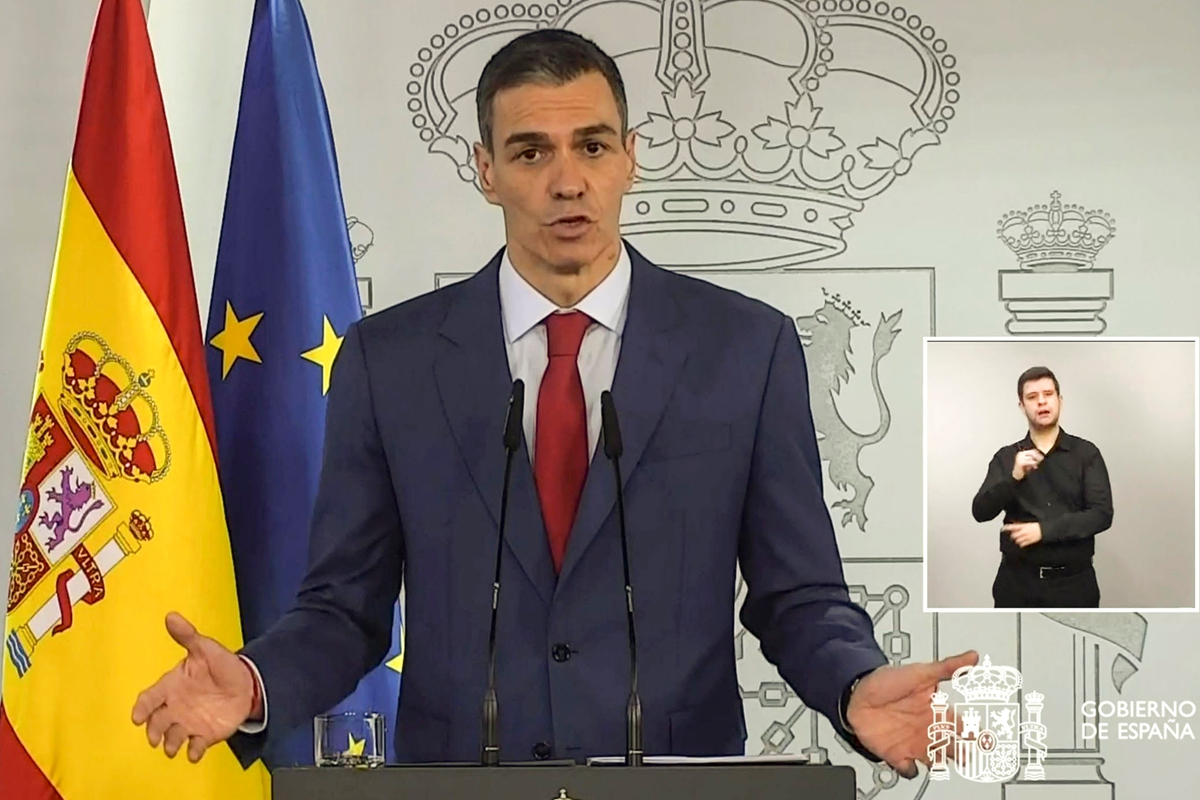
A handout screen grab taken from a video and made available by the Moncloa Presidential Palace shows Spanish Prime Minister Pedro Sanchez speaking during an institutional statement at the Moncloa Palace in Madrid, Spain on March 4, 2026. Photo: VCG
As the joint US-Israeli military operation against Iran enters its fifth day, tensions between Washington and Madrid have drawn wider attention. US President Donald Trump has reportedly threatened to impose a full trade embargo on Spain after it refused to allow the US to use its military bases for strikes on Iran. In response, the Spanish government urged Washington to respect international law and bilateral agreements with the European Union.Netizens flooded international social media to voice support for Spanish Prime Minister Pedro Sanchez, hailing him as "the first European leader" to openly denounce US military strikes on Iran. They backed Spain for standing up to what they described as unilateral military action instead of blindly following Washington. Some observers, meanwhile, believe that Spain's stance on the recent strikes on Iran is largely driven by domestic political consideration.
On Tuesday, a reporter raised the incident at the daily press conference of Chinese Foreign Ministry to ask China's comment. In response, spokesperson Mao Ning stated that the US-Israeli military actions against Iran violate international law, and that trade should not be instrumentalized or weaponized.
Escalated clash
Trump on Tuesday threatened to halt all trade with Spain, citing its lack of support for the US-Israeli military campaign against Iran and its resistance to raising NATO defense spending.
"We're going to cut off all trade with Spain," Trump told reporters during an Oval Office meeting with German Chancellor Friedrich Merz. "We don't want anything to do with Spain," he added, according to the Associated Press (AP).
Trump also claimed that despite Spain's objections, "we could use their base if we want. We could just fly in and use it. Nobody's going to tell us not to use it, but we don't have to."
Surprisingly, during the same Oval Office meeting, Trump shifted to the question of Iran's post-conflict leadership, where he openly claimed that "someone from within" the Iranian regime might be the best choice to take power once the campaign is completed. However, he added wryly that "most of the people we had in mind are dead," according to another AP report.
Within less than a day, Pedro Sánchez delivered a strong rebuttal on Wednesday to Trump's threat to sever trade. In a 10-minute televised address, he reflected on various conflicts, stating, "The government's position can be summed up in three words: No to war." He added, "The question is not if we are on the side of the ayatollahs - nobody is. The question is whether we are in favour of peace and international legality," the BBC reported.
"We will not be complicit in something that is bad for the world and that is also contrary to our values and interests, simply out of fear of reprisals from someone," he said in the speech.
On the red carpet of the 40th Goya Awards ceremony held on February 28 —the same day as the joint US-Israel military operation — he denounced the action to reporters, asking: "How is it possible to intervene as they are doing today, bombing hospitals and schools unilaterally, without going through the UN Security Council, without a previous debate, without having explained the arguments and reasons for doing so?"
In an X post on February 28, Sánchez rejected the unilateral US‑Israeli military action, calling it an escalation that fuels instability. He also condemned the Iranian regime and the Revolutionary Guard, warning against another devastating war in the Middle East. He demanded immediate de‑escalation, respect for international law, and a return to dialogue for a lasting political solution. On March 2, he reiterated those calls in another X post, stressing that "Spain will be there. And Europe must be there."
In recent years, Spain has taken a relatively independent approach in its dealings with Washington, making it largely unsurprising for Sanchez, a left-wing leader, to make such remarks, Cui Hongjian, a professor at the Academy of Regional and Global Governance at Beijing Foreign Studies University, told the Global Times.
Some European leaders refrained from direct criticism of the US and Israel, and instead blamed Iran for the escalation. Sanchez's remarks, however, are a reminder that Europe should not instinctively align with Washington and should assess the issue based on international law and the fundamental principles of international relations, said Cui, noting that such remarks echoed sentiments that many Europeans hold, but who have been reluctant to express publicly, earning him considerable support and praise.
As of press time on Tuesday, Sanchez's two posts had garnered 4.8 million and 2.5 million views respectively, and have sparked heated debate online.
The account Party of European Socialists wrote a post on X on Wednesday to express support for Sanchez and Spain, "We will not be intimidated by acceptable threats… Standing up for international law, multilateralism, and Europe's strategic autonomy is our shared duty - and we will stand firm."
While Josep Borrell Fontelles, former EU High Representative and vice-president of the European Commission, also wrote on X that "all my support to the Government of Spain in its condemnation of the US, Israel for violating international law, and for not authorizing the use of the joint Spanish-US military bases. It is an affirmation of the principles upon which the EU is built and of national sovereignty."
Eoghan Gilmartin, an Irish journalist covering Spanish and European politics, reposted Sanchez's remarks on February 28, writing on X that "at least one voice of sanity at the European Council. This should be the bare minimum for EU diplomacy." In another post, he added that Sanchez should not be the only EU leader willing to say what he called the obvious: "We are witnessing a violation of international law."
While some voices speculated that Sánchez's remarks were driven by domestic political considerations and could weaken Western solidarity. In an article published on March 3, Politico.eu noted that Sanchez "emerges as chief EU critic of Trump's strikes on Iran." While it also noted that Sanchez's stand on the war plays well in a country where Trump is widely disliked.
While in a separate report, Politico.eu noted that during an address on national television Tuesday night, French President Emmanuel Macron said the US-Israeli strikes on Iran were conducted "outside of international law" and that Paris "cannot approve of them." Though Macron laid the blame for the current conflagration in the Middle East squarely on Iran, his criticisms could land him in hot water with Washington, said the report. Macron also said that France was sending its aircraft carrier Charles de Gaulle to the Mediterranean and working to build a coalition that would help secure maritime traffic imperiled by the escalating crisis in the Middle East, Reuters reported.
Cui noted that Sanchez's remarks reflect a broader trend: From Canadian Prime Minister Mark Carney's comments at Davos, to debates at the Munich Security Conference, and the current dispute, growing signs show some Western leaders are increasingly assessing issues through national interests and pragmatic considerations, rather than instinctively aligning with the US or invoking broad "Western values."
RELATED ARTICLES