Shenzhen shows how China’s governance has done it right
By Published: Mar 05, 2026 12:18 AM
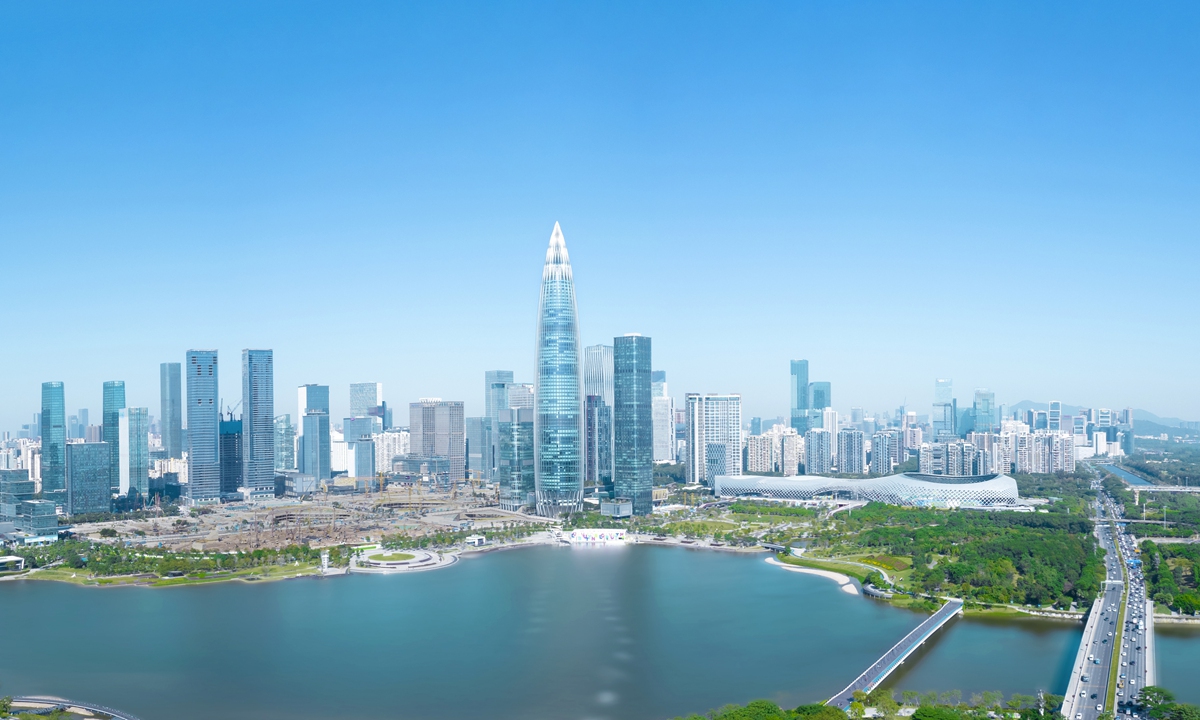
Skyline of Qianhai area in Shenzhen, South China's Guangdong Province Photo: VCG
As China's two sessions - the annual meetings of its top legislature and political advisory body - unfold, I joined the bustling crowds stepping onto a narrow thoroughfare barely 250 meters long and four meters wide.
This is Chung Ying Street, literally "Chinese-British Street," located in the border town of Sha Tau Kok. The weather-beaten boundary stones running down its center silently cleave the land in two: One side is Shenzhen, the other Hong Kong.
We often tell international audiences that the two sessions offer a crucial window into China. But what exactly are we observing? As China's reforms deepen, understanding the nuances of its state governance through these meetings is becoming increasingly vital.
I pondered this while strolling past the dazzling array of duty-free shops along the street. More than four decades have passed, and these storefronts seem largely unchanged, save for slightly thinner crowds. Yet, the stark contrast between the two sides quickly drew my thoughts back to the subject of governance.
In a quiet corner of the Chung Ying Street Historical Museum, I paused before an unassuming display of statistics from 1977. At the time, the per capita annual income in Luofang Village on the Shenzhen side was a meager 134 yuan ($19.42). Just across the river, the people in the "Hong Kong Luofang" were earning HK$13,000 ($1,664.15) a year.
Almost a hundredfold difference. This was not a dry economic metric; it was a chasm between life and death. In that era, the neon lights and skyscrapers of Hong Kong were an unattainable sci-fi utopia for the villagers on the mainland.
Stepping back onto the flagstones of Chung Ying Street and looking at the shops with virtually no physical barriers between them, my mind drifted to the spring of 1979. Confronted with a massive wealth gap and a wave of border-jumpers, China's veteran reformers did not double down on blockades. Instead, they made a historic pivot: If the impoverished masses were desperate for change, local governments should be allowed to open up and pursue development on their own terms.
This was the genesis of openness. Right here near Sha Tau Kok, Shenzhen's earliest joint-venture factories were born. Foreign capital, equipment and management expertise washed over that invisible border like a tide, merging with a labor force hungry to change its destiny. Amid the roar of machinery, export-oriented workshops sprang up like mushrooms.
If one had compared Chung Ying Street back then, Hong Kong would have remained the gold standard of governance. It boasted a mature legal system, a free market and status as a premier international port. However, had Shenzhen's governance stalled at mere decentralization, it would never have achieved its current ascendancy
Looking up as I walked further into Shenzhen, I could see the massive cranes of Yantian Port operating in the distance, and beyond them, the awe-inspiring skyscraper skyline along the coast.
In 2024, Hong Kong's GDP stood at 2.9 trillion yuan, while Shenzhen soared to 3.68 trillion yuan - a staggering lead of 780 billion yuan. Is this merely an economic triumph? My travels between the two cities have convinced me that beneath the shifting skylines lies a divergence in governance. The accumulation of wealth is merely an outcome. The true invisible hand dictating this trajectory is the evolution of government capability.
As Shenzhen completed its initial capital accumulation through the market economy, the government's role quietly shifted from a mere delegate to a forward-looking planner and rule-maker.
When low-end manufacturing reached a dead end, the government took the initiative, zoning high-tech parks and steering enterprises toward IT and telecommunications. When land resources reached their limit, it aggressively drove urban renewal, slicing through gridlock with formidable administrative efficiency. When environmental capacity neared its limit, Shenzhen invested heavily in ecological restoration, becoming the first megacity in the world to transition to a fully electric bus and taxi fleet. This layered progression reflects a highly robust, self-evolving governance model.
History has left a profound revelation here: Civic competition might look like a race of GDP, skyscrapers and multinational headquarters, but behind this visible prosperity lies the audacity of government planning, the efficiency of administrative execution and the capacity for self-correction during crises.
It is the invisible gap in governance capabilities that ultimately determines a city's visible fate. This is the breathtaking story this short, 250-meter street has silently told over the past 40 years - and precisely the lens we need to observe China's two sessions today.
The author is a senior editor with the People's Daily and currently a senior fellow with the Chongyang Institute for Financial Studies at Renmin University of China. dinggang@globaltimes.com.cn. Follow him on X @dinggangchina
RELATED ARTICLES