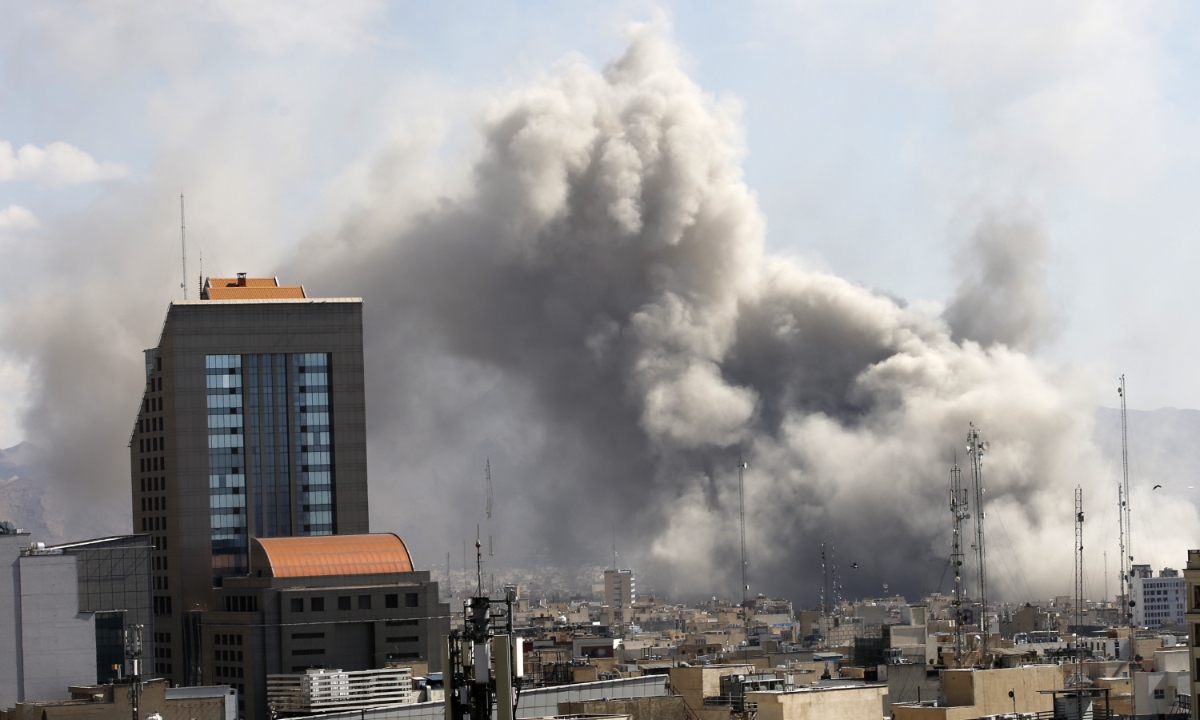
Plumes of smoke rise over the residential areas of the Iranian capital following airstrikes amid ongoing US-Israeli attacks as multiple explosions are heard across the city in Tehran, Iran, on March 01, 2026. Photo: VCG
The world has seen enough. The US, often acting in concert with its allies, has unleashed levels of violence across the globe that verge on the unparalleled, and it has given no indication that it intends to stop. The destruction of Gaza, the kidnapping of Venezuelan President Nicolás Maduro, the oil embargo on Cuba and the most recent aggression against Iran have made one thing unmistakably clear: This is not a series of isolated crises. It is a coherent project of world domination.Some in Europe have chosen their side. In the aftermath of the illegal US-Israeli strikes on Iran, several Western leaders have collectively inverted the roles of aggressor and victim. European Commission President Ursula von der Leyen has condemned "Iran's unjustified attacks." EU High Representative for Foreign Affairs and Security Policy Kaja Kallas emphasised that the "Iranian regime" poses a "serious threat to global security," and German Chancellor Friedrich Merz said it was "not the moment to lecture our partners and allies" while criticizing Tehran.
Across the Atlantic, Canadian Prime Minister Mark Carney said he supports the US-Israeli strikes against Iran, but does so "with regret." One may wonder: Has the much-publicized rhetoric about a "waking up" and realignment of the West, including Carney admitting in Davos that the so-called rules-based order was little more than a façade of which "the strongest would exempt themselves when convenient," proven hollow? So far, it seems that there has been no rupture, no reckoning, no strategic rethink. Even with a cautious attitude, the collective West remains in lockstep behind US imperial agendas.
There is no need to speculate about those agendas. US Secretary of State Marco Rubio implied at the Munich Security Conference that permitting decolonization had been a mistake and that Washington intends to reverse that course, with European backing. The European response was not discomfort or dissent, but standing ovations. While Western leaders are uncomfortable with US threats to themselves, they are in perfect agreement that they can together rule the Global South, as reflected in Macron's private texts to US President Donald Trump, assuring him they "are totally in line on Syria" and "can do great things on Iran." The direction is explicit. The aim is the brutal "recolonization" of the Global South and the dismantling of any power capable of resisting it. Venezuela, Cuba and Iran are early targets.
Even though the bluntness with which Washington nowadays pursues its objectives may be disturbing, it offers a rare kind of clarity. It is better to know exactly what you are up against: a country that rejects international law and the principles of the UN Charter - a reality that must shape any strategy.
What is needed is stronger coordination and confidence among developing nations. Since the end of the Cold War, the Group of 77 and China, along with other emerging economies, have gained greater economic, financial and strategic weight, and the distribution of global power has evolved considerably. China's economic power has transformed global trade and finance. Economies such as Indonesia, Vietnam, Brazil and Mexico have grown in scale and confidence. The Global South today is far more interconnected and institutionally capable than in the 1990s. It should engage the international system with corresponding confidence and cohesion.
While it may be tempting to follow the US playbook by imposing sanctions, boycotting cultural exports and artists, disqualifying athletes, and revoking visas, such escalation carries significant risks and costs, almost always borne by the Global South itself.
The challenge, therefore, is to avoid mirroring confrontation while making it unmistakably clear to Washington that its current course and hegemonic strategy cannot continue and will ultimately fail.
A key part of this approach lies in strengthening policy coordination among emerging economies, expanding alternative financial and trade arrangements, and deepening South-South cooperation. By enhancing collective resilience - for example, China's commitment to building 92 solar parks and installing 10,000 photovoltaic systems in Cuba that will help the country achieve energy independence - developing nations can shift the balance of influence without necessarily resorting to destabilizing measures. The goal is not further polarization, but the gradual construction of a more equitable and genuinely multipolar international order.
This may well be the decisive struggle between US hegemony and a genuinely multipolar world. Antonio Gramsci famously wrote that "the old world is dying and the new world struggles to be born, and that this is the time of monsters." If the Global South fails to confront the monsters of hegemony effectively, the new world may never emerge. And the monsters, unchecked, may drag all of us down with them.
The author is an advisor at the European Parliament. opinion@globaltimes.com.cn
RELATED ARTICLES