AidData report rebuts Western smears as China’s port investment fills infrastructure gaps
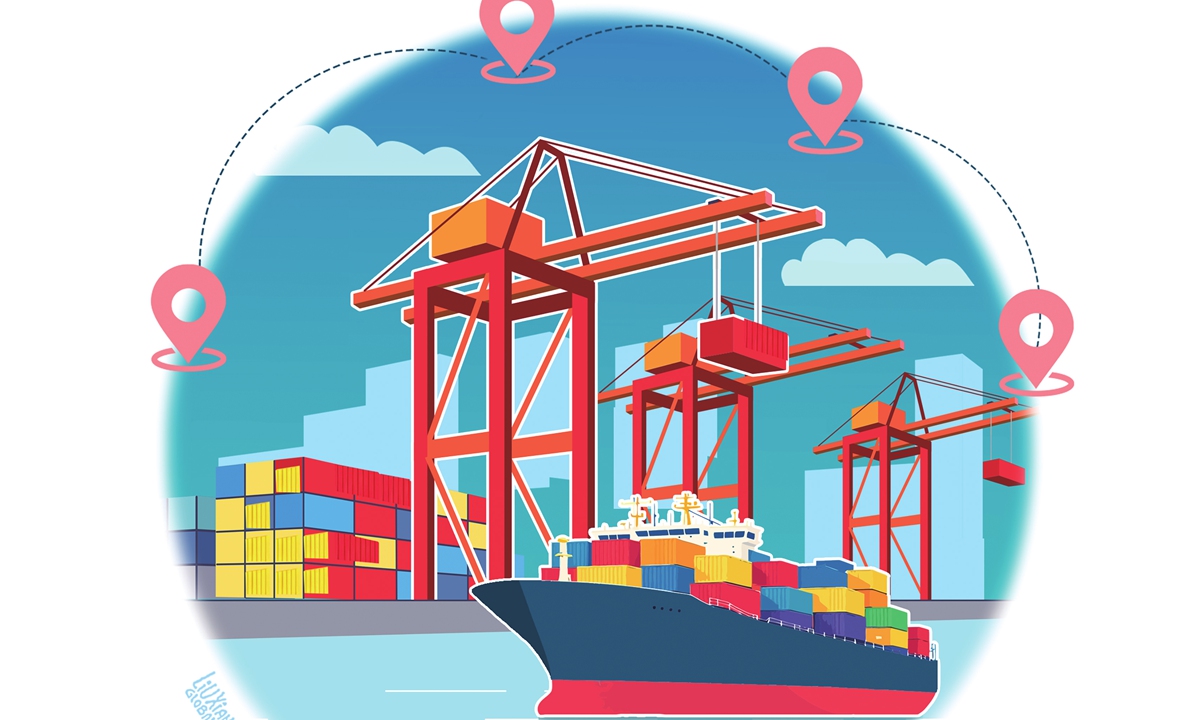
Illustration: Liu Xiangya/GT
A report released Wednesday by AidData, a research lab at the College of William & Mary, said that "ports are recognized as a key form of connective infrastructure that are foundational for national economic development. Chinese financing for overseas ports has helped fill a major infrastructure gap, during a time when financing from other providers was either in short supply or nearly non-existent."
The report notes that "China's nearly ubiquitous presence in the world's top ports means that the US cannot insulate itself from Chinese supply chains, in either peacetime or conflict." It also shows that over the past 25 years China has invested about $23.9 billion in 363 seaports-related projects and activities at 168 ports around the globe.
From Peru's Chancay Port and Australia's Darwin Port to the recent Panama port issue, Chinese companies' involvement in port operations and cooperation has consistently faced comprehensive, multi-layered exclusion and suppression from some Western forces. This suppression involves both blatant hegemonic interference and covert smear campaigns and political manipulation.
The report's conclusion shows that in an era of economic globalization, supply chains are already deeply intertwined and the interests of countries are closely interconnected. Attempts to artificially "cut off" such links are unrealistic. It is also a strong rebuttal to the smears by the US and some Western countries against China's extensive port cooperation.
Ports serve as key nodes in global supply chains, much like the "blood vessels" of the economic system, connecting the flow of goods, capital and industrial chains. "China's active participation in international port construction and operation is essentially a manifestation of its deep integration into the global economic system and its efforts to facilitate international trade," Li Haidong, a professor at the China Foreign Affairs University, told the Global Times.
According to public information, China's port cooperation now spans countries across Africa, Asia, Oceania, Europe, and Americas. High-standard construction or operation has been carried out at flagship projects such as Gwadar Port, Kyaukpyu Port, Lekki Port, Hambantota International Port, Chancay Port and the Piraeus Port. These overseas projects have not only improved local port facilities, but also provided strong support for regional economic development centered around the ports.
"China has never viewed ports as tools to seek hegemony or leverage over other countries. Certain badmouthing is promoted by some Western think tanks as part of ideological demonization of China. Their intention is to smear China's substantive contributions to the global economy and to draw certain countries onto the track of the US' overall strategic competition with China," Li said.
The controversy surrounding China's overseas port development essentially reflects a clash between two different approaches. One is based on the shared need for trade development and regards infrastructure cooperation as a public endeavor to promote connectivity and common development. The other tends to view all economic activities through the lens of geopolitical competition. At a time when global trade depends on stable and open logistics networks, attempts to obstruct cooperation through ideological confrontation and strategic rivalry not only undermine the development autonomy of regional countries but also run counter to the broader trend of open cooperation in globalization.
RELATED ARTICLES