China today stands as one of the most open and secure countries in the world: Russia expert
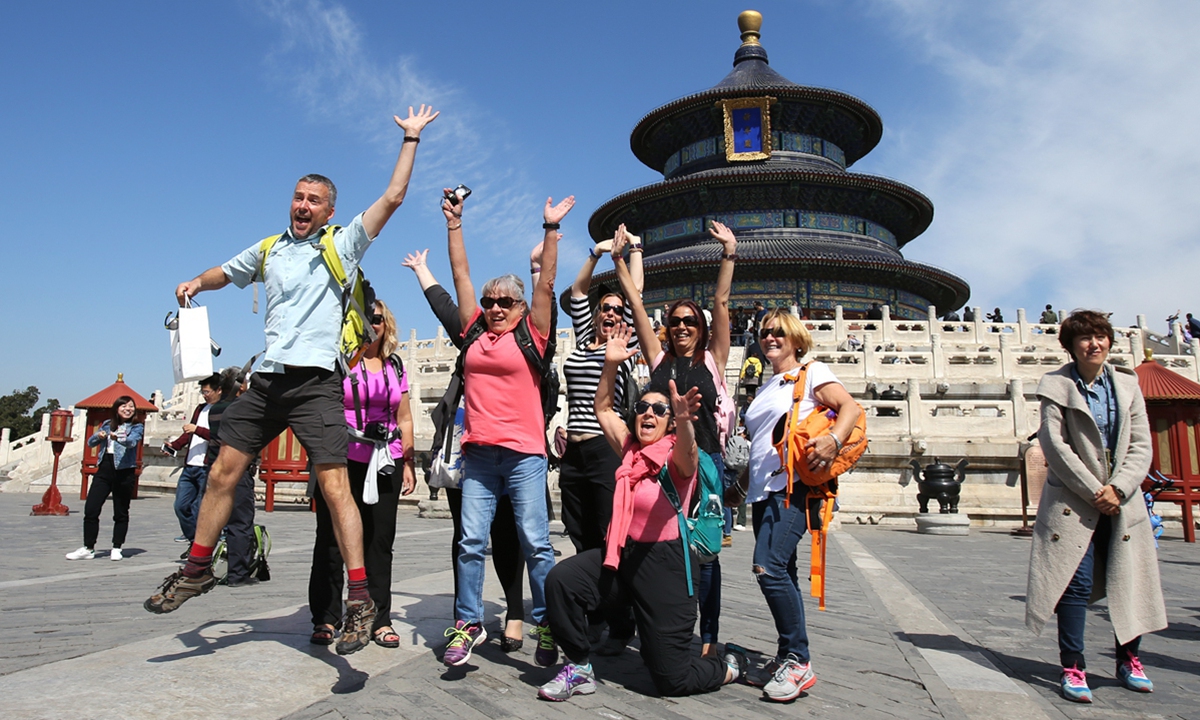
Foreign tourists enjoy themselves at Tiantan, a UNESCO World Heritage Site built in 1420, in Beijing. Photo: VCG
Editor's Note:
As China convenes the 2026 two sessions - the annual meetings of China's top legislature and top political advisory body - China is expected to send strong and fresh signals on pushing high-quality development, leveraging greater policy and reform support to ensure steady economic growth and social progress.
In the "Understanding signals at two sessions" series, the Global Times (GT) invites internationally renowned scholars, policy observers and business leaders to interpret the key signals from the two sessions regarding China's domestic roadmap, covering advancements in whole-process people's democracy, high-quality development, high-level opening-up, major-country diplomacy and the improvement of people's wellbeing.
In the third piece of the series, Global Times reporter Zhang Ao interviewed Evgeny Grachikov (Grachikov), an associate professor at the Department of Theory and History of International Relations of Peoples' Friendship University of Russia, to discuss China's opening-up, as well as how it has shaped global economic cooperation and fostered a model of win-win development.
GT: How do you evaluate China's efforts to provide the world with predictable stability through its own opening-up? And does this endeavor constitute a unique, non-hegemonic form of global public goods provision?
Grachikov: China's 15th Five-Year Plan (2026-30) includes a dedicated chapter on "Promoting High-Standard Opening Up and Creating New Horizons for Mutually Beneficial Cooperation." This underscores China's resolve to ensure implementation across all administrative and legislative bodies at the provincial, municipal and county levels, as international cooperation now spans virtually almost every corner of the country.
From my extensive travels across many Chinese cities, I can say with confidence that China today stands as one of the most open and secure countries in the world. And thanks to China's visa-free entry policy for Russian citizens, many Russians have already seized the opportunity to visit China and experience firsthand its splendid culture, profound traditions and exquisite cuisine.
China's efforts to ensure predictable global stability through its institutional opening-up foster confidence in the predictability of its actions on the international stage. This vision reflects a distinctive, non-hegemonic approach to contributing global public goods. I have no doubt that China will continue to advance its high-standard opening-up to the world, which will surely contribute to building a community with a shared future for humanity.
GT: Compared to some Western nations promoting "decoupling," "small yard, high fence," why does China have the resolve to stay committed to opening-up and sharing opportunities with the world?
Grachikov: China has been a major trading partner of more than 150 countries and regions, and the country's "circle of friends" in foreign trade is getting larger. Confident in its own strength, it has constantly opened its domestic market to its partners. Facing decoupling policies and tariff barriers from the US, China continues to grow steadily and forge ahead with confidence.
The fact is that beyond the collective West, a vast global landscape of the non-West is coming together, growing stronger and forging ahead, increasingly setting the global agenda and shaping the main trends of global development today.
GT: In your view, what inspiration has China's opening-up policy offered to the world?
Grachikov: China's openness demonstrates to the world that it faces the future with firm confidence and marches forward without hesitation. People both in the West and the East can see this strength, which is not merely material, but above all spiritual.
China's policy of reform and opening-up went through several stages of internal development, determined by the goals and objectives of China's economic development. In the 15th Five-Year Plan (2026-30), the Chinese economy is transitioning to high-quality development driven by technologies such as biomanufacturing, with a focus on industries of the future.
This transition calls for broader international cooperation, as well as the attraction of foreign investment, advanced technologies and professional specialists, including those from friendly countries, particularly Russia. This plan offers China a strategic opportunity to strengthen scientific, technical, trade and economic ties with the rest of the world.
GT: What is the global significance of China's 2026 "two sessions"?
Grachikov: As a major power, China's domestic developments reverberate across the world through diplomatic, political, economic and cultural linkages. For many Global South nations, China stands as a successful model of economic and social transformation, while upholding consistent and principle-based positions on the global stage.
The "two sessions" reaffirm China's dedication to building a fair and equitable global governance system, in which China will serve as a leading and responsible major power.
RELATED ARTICLES