Bluer skies, greener waters, healthier people: Healthy China as the NPC deputies see it
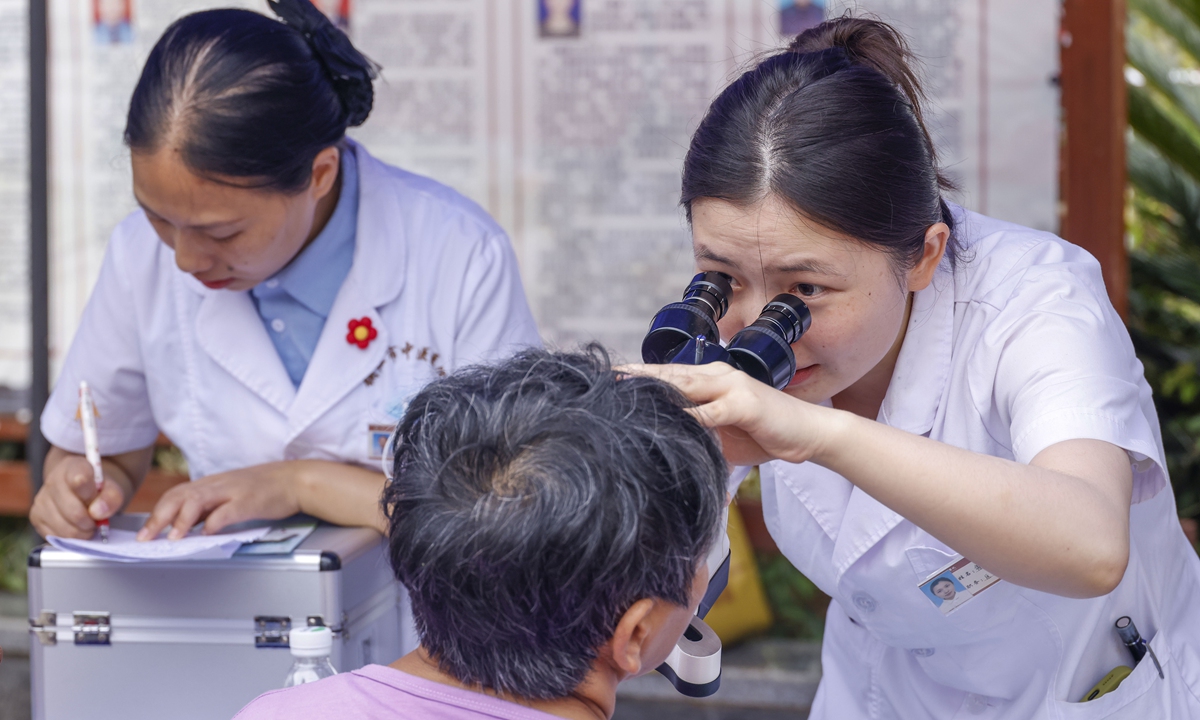
A doctor checks a resident's eyesight in Tongren, Southwest China's Guizhou Province. Photo: VCG
Editor's Note:
Building a Healthy China by 2035 is a strategic decision made by the Communist Party of China (CPC), and the 15th Five-Year Plan period is critical to achieving this goal, Chinese President Xi Jinping said on Friday, emphasizing the need for coordinated planning and accelerated implementation, the Xinhua News Agency reported.
Xi, also general secretary of the CPC Central Committee and chairman of the Central Military Commission, made the remarks while attending a joint group meeting during the fourth session of the 14th National Committee of the Chinese People's Political Consultative Conference (CPPCC), the top political advisory body, Xinhua reported.
Building a Healthy China is a systematic project, Xi remarked. In the face of the people's growing and diverse healthcare needs, it is imperative to focus on major priorities and center closely on the tasks that benefit a wide range of people and have a significant impact on the overall situation. Human power and other resources should be concentrated, and effective measures be taken to improve the public health system, build up a quality and efficient medical service system, and promote healthy and positive lifestyles, so as to continuously achieve new progress, Xinhua reported.
China has established the world's largest healthcare system, with medical and healthcare systems covering both urban and rural residents have been put in place. The average life expectancy of the Chinese reached 79.25 years in 2025.
During the 14th Five Year Plan period (2021-25), the country advanced the Healthy China in a systematic way and continued to raise the overall health level of the population. The sky is bluer, the water is greener, and people around us are living longer and healthier lives. The steady improvement in people's well-being has helped safeguard both the physical and the mental health of the public.
"The blue sky is also adding to our health."
In the mid of his busy work, he often looks up at the sky. After 30 years working in sanitation, Zhang Jinhai, a deputy to the National People's Congress (NPC) and an employee at the Wetland City Development Promotion Center in Dongying, East China's Shandong Province, has developed this habit.
Over the decades, as a sanitation worker, Zhang has been among the first to see the city at dawn and the first to notice changes in the sky. His mobile phone holds many photos of the sky that he snapped along the way. From once gray and hazy, to gradually becoming clearer, and now to a deep, pristine blue, these sky photos offer a vivid record of the changing air quality in Dongying.
More than simply witnessing these changes, Zhang has long hoped to help create the changes himself. When he first started the job, he experienced firsthand the hardships faced by sanitation workers: The brooms were heavy, dust often rose during sweeping, and efficiency was low. The dust not only polluted the environment but also affected people's health.
Drawing on electrical repair skills he learned on his own, he bought components and repeatedly worked on designs, taking them apart, reassembling and testing them again and again.
In the end, he invented a retractable broom designed specifically for sanitation work. The tool directly reduces secondary dust during road cleaning, contributing to improved air quality and helping safeguard the respiratory health of residents in Dongying.
As a NPC deputy, Zhang keeps a "blue sky ledger" in his work notes, recording each and every step of environmental improvement in Dongying.
In 2025, the city's average PM 2.5 concentration was 27 micrograms per cubic meter, a year-on-year improvement of 15.6 percent, the highest in the province; there were 290 days of good air quality, up 30 days from the previous year; and there were zero heavily polluted days, down three days year-on-year.
"These are just numbers on paper, but in people's daily lives, it means more days when windows can be opened, more clothes can be dried outdoors, and fresh air can be breathed on morning walks," Zhang said, noting that these seemingly simple details reflect the most direct benefit of a better living environment on residents' health.
The continued improvement of the environment has brought tangible health benefits. Zhang revealed that in 2024, the average life expectancy in Dongying had reached 81.94 years. "These are not just dry statistics - they are the best evidence that in recent years the city has placed the health of its people at the heart of its work and implemented measures in a careful and thorough way," Zhang said. "The blue sky is also adding to our health."
Stories like this unfold right around Zhang.
Recently, Pang Xingyi from Zaoli village, Daozhuang township in Dongying, celebrated his 89th birthday. In his daily life, he often goes out for walks or plays chess, witnessing firsthand the gradual changes in his living environment. "Over the years, the village roads have been paved smoothly, and sanitation has been well maintained. Going out feels refreshing, and living here is comfortable," Pang said.
Living amid fresh air and a clean environment, Pang spoke with hope for the future: "I want to enjoy my later years in this increasingly beautiful village. I must take good care of myself and pass on this blessing."
In response to the people's growing expectations for a healthy life, Zhang offered his own reflections and advice: "We must preserve the ecological foundation of blue skies and clear waters, strengthen the health defense provided by our medical and healthcare systems, and ensure that the health benefits for the public are greater, so that people feel more fulfilled, happier, and safer."
"With cleaner water, everyone feels physically and mentally refreshed."
With just over 20 words and two photos, Wang Runmei's post went viral, receiving more than 150 likes. Both photos show the scenery near Yingze Bridge in Taiyuan, North China's Shanxi Province - one taken five years ago, and the other taken recently.
Before heading to Beijing for this year's two sessions, Wang, a deputy director and Party branch secretary of the Second Division of Road Drainage Support at the Taiyuan Municipal Public Facilities Construction and Management Center and head of Drainage Group Three, posted these two photos on her WeChat Moments, captioning them: "Five years ago vs today. Heading to Beijing, bringing along the changes of this bridge and this river!"
Yingze Bridge spans the Fenhe River and has now become a popular city landmark for taking photos. Wang has worked in municipal administration in Taiyuan for more than 30 years, overseeing the maintenance of Yingze Bridge. Each day she commutes from west to east across the Fenhe River, snapping many photos along the way.
"I've watched the river's water grow clearer and its banks turn greener. With cleaner water, everyone feels physically and mentally refreshed," she said, taking out her phone and flipping through her photo album to show the reporters.
The visible changes are the result of a tough battle. During the 14th Five-Year Plan period, Taiyuan took unprecedented measures to shut down and eliminate outdated production capacity, while coordinating efforts to manage mountains, water, air, and urban development. By 2025, all six nationally monitored river sections achieved excellent water quality, and the city's air quality also saw a significant improvement.
As a NPC deputy, Wang has long focused on the city's stormwater and sewage separation issues and has repeatedly submitted related proposals. During the 14th Five-Year Plan period, Taiyuan vigorously promoted the separation of stormwater and sewage in built-up areas and the renovation of drainage networks.
To date, more than 110 kilometers of combined sewer networks have been upgraded, and over 3,000 combined sewer connection points have been corrected. After the renovations, an average of 79,800 cubic meters of sewage per dry day has been diverted from the stormwater system to the sewage system for proper treatment, fundamentally reversing the problem of combined sewage overflow and establishing an ecological protection barrier at the source for the Yellow River basin.
Taiyuan residents' lives revolve around the Fenhe River. Improvements in the ecological environment have directly translated into tangible health benefits for the public. Over the past two years, more than 40 scenic spots have been developed along the riverbanks, including Yanqiu Park. Sports facilities such as beach volleyball courts, football fields, and green walking trails have also been built. In the early morning and in the evening, many residents come to exercise, turning the Fenhe River into a convenient fitness destination right at their doorstep.
"In the past, we were used to wearing masks whenever we went out. Now that the environment has improved, and Taiyuan has even been named a 'China climate-friendly city,' people enjoy going out to breathe fresh air whenever they have time," Wang said. She enjoys walking along the Fenhe River with her family to relax.
Now, 165 bird species inhabit and forage in the Fenhe River wetlands in Taiyuan. In spring, black-headed gulls arrive on schedule.
"I've played a part in making the Fenhe River's water cleaner…" Wang said. "My suggestions over the years were not in vain."
In 2024, the average life expectancy of Taiyuan residents reached 80.81 years, an increase of 1.87 years compared with 2019.
"Not just Taiyuan - many places in Shanxi have seen environmental improvements. Friends in Linfen city say the air there has also gotten better, and now blue skies are no longer a rare sight," Wang said with a smile.
Before coming to Beijing this time, she had specially printed two photos of Taiyuan to bring with her. "With the ecological environment improving, people are genuinely enjoying the benefits. I want to share this joy and pride," she said, her bright eyes shining with pride.
"There are more and more long-lived residents in the village."
Having served as the village doctor for 14 years, Yang Jinjun has not only safeguarded the health of his fellow villagers but also witnessed the increasing convenience of medical care for the Miao ethnic community.
He is a NPC deputy and the village doctor of Dashui village, Chengbu Miao autonomous county, Central China's Hunan Province. During the 14th Five-Year Plan period, the construction of closely integrated county-level medical communities was fully promoted, and the "last mile" of public health prevention and control was increasingly accessible. As a guardian of villagers' health, Yang is now able to play a greater role and feels a stronger sense of accomplishment.
In the past, the village had no health clinic, and villagers had to endure minor illnesses on their own. If a condition worsened, they had to cross two mountains to reach the township health center 20 kilometers away, and some who waited too long ended up with serious illnesses.
Today, the village clinic is fully equipped with common medicines, making healthcare much more accessible. Most conditions, including respiratory infections, diabetes, and high blood pressure, can now be diagnosed and treated locally.
"More and more villagers are living to an old age," Yang said. The village now has more than 20 residents over 80. The rise in longevity is closely linked to improvements in primary healthcare. "I've compiled health records for over 600 villagers. Over the years, I've conducted regular follow-ups and managed chronic diseases, helping them maintain their health," he noted.
A village resident, Qin Lianglu, used to suffer frequent headaches, dizziness, and chest tightness. Worried about his condition, his family brought him to the village clinic. After having examined him, Yang found that Qin had high blood pressure and elevated blood sugar. He advised Qin's family on dietary management: "Eat more vegetables, avoid fruit, focus on whole grains instead of refined rice or flour, and have small, frequent meals." Today, at 86, Qin's blood sugar is normal. He remains energetic and walks steadily.
Over the years, township health centers have added specialized departments such as psychiatry, gynecology, and pediatrics, and can now perform tests like electrocardiograms and ultrasounds, greatly improving convenience for villagers, according to Yang. With the development of closely integrated county-level medical communities, referrals have also become easier.
When villager Tang Wengui suffered a mild stroke, his family called Yang. Upon arriving at Tang's home, Yang found that his blood pressure was high and his lips were turning purple. He advised the family to transfer him immediately to the county people's hospital. Thanks to the smooth referral system, Tang received timely treatment, and his health is now stable.
How can villagers' health be further improved?
From the perspective of a village doctor, Yang said he advocates promoting the construction of county-level medical subcenters and using the medical community system to share and jointly use equipment. If realized, the most direct benefit for the village's elderly would be that heart disease and chronic obstructive pulmonary disease could be treated at the township health center itself - saving time, effort, and resources, and ultimately giving families greater peace of mind.
"I also hope that in the future, remote medical consultations can be used to implement tiered diagnosis and treatment, allowing data to travel more while villagers travel less," said Yang.
Take a fracture. Yang said that if remote consultations are in place, an injured villager could have an X-ray at the township health center, and experts at a provincial hospital could provide a remote diagnosis. Just thinking about it makes things seem so much more convenient," Yang said enthusiastically.
He also called for measures such as targeted training, preferential promotion, and improved compensation to attract medical professionals to work in rural areas.
"I hope that in the future, more villages will have health clinics and county-level medical subcenters will be increasingly well developed. It is like adding bricks and tiles to a building. In the end, it will come together to form the beautiful picture of a Healthy China," Yang said.
This article is originally published in the special edition for the two sessions of People's Daily.
RELATED ARTICLES