Photo: Deep Space Exploration Lab
Chinese scientists have achieved a major breakthrough in mapping the Moon's chemical composition by building an AI-based model using the measured data from the first sample collected on the Moon's far side by the Chang'e-6 mission. The model, for the first time, integrates ground-truth information from the Moon's far side into a global chemical composition map, offering new insights into the Moon's asymmetry and the evolution of the South Pole-Aitken Basin, the Science and Technology Daily reported on Sunday, citing the Deep Space Exploration Lab.
The research results, achieved by a joint research team of scientists from Tongji University, Shanghai Institute of Technical Physics, Chinese Academy of Sciences, Shandong University, and the Deep Space Exploration Lab, were recently published as a cover article in the third issue of the international academic journal Nature Sensors.
The research team developed an intelligent inversion framework for lunar chemical composition based on the measured data from the first samples collected on the Moon's far side by the Chang'e-6 mission, combined with high-resolution visible, near-infrared multispectral imaging data from lunar orbit.
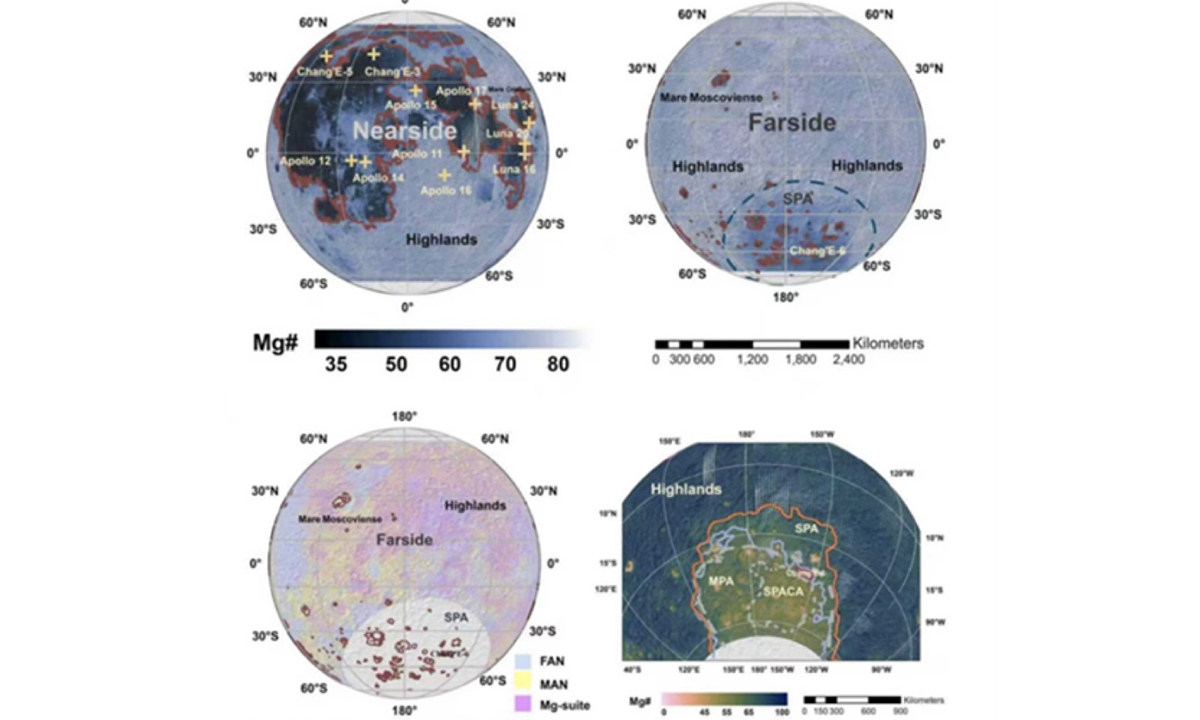
The AI precisely reconstructed the distribution of the oxides of six major elements across the Moon - iron, titanium, aluminum, magnesium, calcium and silicon - as well as the magnesium index, even under conditions of limited samples.
The study clearly maps the elemental distribution characteristics of three major geochemical regions on the Moon's surface including the lunar mare, the highlands, and the South Pole-Aitken Basin.
For the first time, the study quantitatively reveals that the exposure proportion of magnesian anorthosite and the magnesian rock suite in the far-side lunar highlands is significantly higher than on the lunar near side, providing new empirical evidence for the hypothesis of asymmetric crystallization and differentiation of the lunar magma ocean.
Meanwhile, the study precisely delineates the boundary between the magnesian pyroxene ring and the iron-rich anomaly zone in the South Pole-Aitken Basin, confirming that the basin-forming impact exposed a broader range of deep-seated magnesium-rich materials.
The study advances human knowledge of the Moon's structure and the evolution of the South Pole-Aitken Basin, while providing precise chemical data for future lunar landings, resource exploration, and deep-space mission planning. The achievement represents a key advance in China's lunar science, providing a foundation for the continued advancement of China's lunar exploration program.
Global Times
RELATED ARTICLES