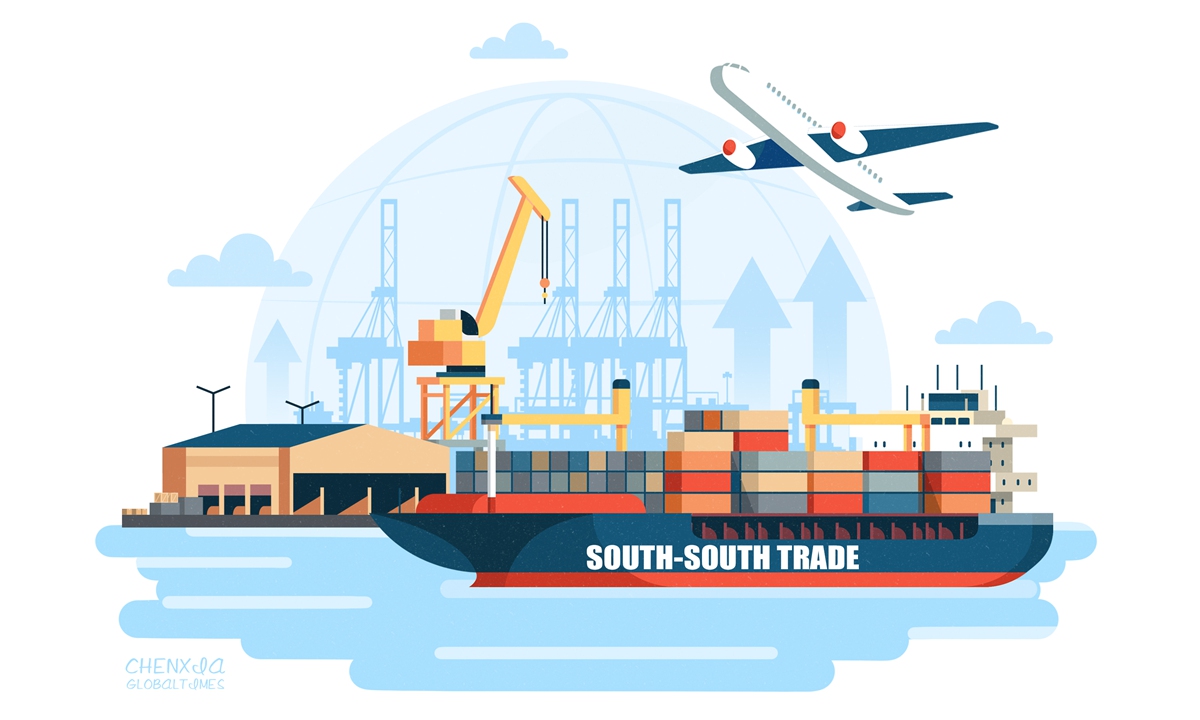
Illustration: Chen Xia/GT
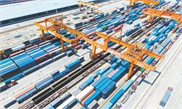
On a Saturday morning in early March, trucks streamed through the gates of the Yiwu Bonded Logistics Center. According to a report released by Yiwu Fabu, the city's official social media account, on Sunday, the center reached a new milestone days earlier when the value of goods entering the zone exceeded 300 million yuan ($43.5 million) in a single day for the first time.This rapid development forms part of a broader trend. Media reports show that, from January to October 2025, first-line imports handled by the center rose 57.3 percent year-on-year.
Viewed in isolation, the performance of a single logistics facility may seem like a local story. Yet activity at the micro level offers insight into broader currents happening in global trade. As protectionist pressures and geopolitical tensions cause uncertainty into established trading routes, demand from the world's developing economies is playing an increasing role in sustaining cross-border commerce.
Recent observations by the World Trade Organization (WTO) reinforce this perspective. As reported by the Xinhua News Agency on Saturday, WTO Director-General Ngozi Okonjo-Iweala noted that South-South trade is becoming an important driver of global commerce. The report added that more than half of the developing countries' exports now flow to other developing economies.
That number - 50 percent - stands out as a meaningful reference point.
It points to the fact that an increasing share of global trade now occurs outside the traditional North-South routes. Against the backdrop of ongoing protectionist pressures in some major Western economies, this pattern suggests that the world's developing economies are trading with one another more frequently. Several factors behind this gradual adjustment in supply chains merit closer attention.
First, rising demand in the emerging developing economies is creating considerable potential for South-South trade. As income levels increase across a growing number of the developing countries, the consumption capacity of Global South economies is expanding, supporting sustained growth in demand for goods and services. Many of these economies still have substantial scope for per capita income growth, indicating larger room for further consumption expansion.
Amid rising protectionism in some advanced economies, growing market demand from the world's developing economies is becoming increasingly important for global trade. Markets across the Global South, which account for around 70 percent of the world's population, are expanding rapidly. According to media reports, merchandise trade among the developing countries has grown 4.6 times since 2000, far outpacing growth witnessed in developed economies.
Second, amid the ongoing restructuring of global value chains, trade in intermediate goods among the developing countries is becoming increasingly dynamic. In recent years, although some Western economies have promoted the "reshoring" of their supply chains, the global value chain has not simply contracted; rather, it has grown more complex and multi-nodal. This evolution is creating opportunities for the developing economies to expand trade in intermediate goods and related finished products.
The developing countries are gradually forming closer industrial and supply chain linkages, which in turn support their trade growth.
For instance, in the first quarter of 2025, China's exports to ASEAN countries of flat panel display modules, auto parts, and lithium batteries rose by more than 20 percent year-on-year. At the same time, China's imports from ASEAN of parts for automatic data processing equipment, printed circuits and textile raw materials continued to grow.
Third, improvements in connectivity have helped reduce trade costs. In recent years, upgrades to infrastructure and logistics networks have lowered transaction costs for South-South trade. In particular, the Belt and Road Initiative has promoted the development of ports, railways, logistics, and digital infrastructure.
For example, the "Chancay-Shanghai" shipping route, opened in late 2024, cut sea transit times between China and Peru from 35 to 40 days to just 23 days, reducing logistics costs by more than 20 percent, according to media reports.
These factors, together with other emerging developments, have helped South-South trade keep gaining pace. The shift is often subtle, visible through micro-level stories such as the bustling import activity at the Yiwu Bonded Logistics Center. Individually, each example may seem minor, but collectively they point to a broader trend that merits attention.
Against rising protectionism seen in some major developed economies, the growing role of the developing countries in global trade is increasingly visible. North-South trade remains important, but a growing body of data reveals greater opportunities within the Global South. With more than half of the developing countries' exports now flowing to other developing economies, efforts to deepen cooperation, broaden market access, and strengthen regional supply chains are gaining relevance, helping bolster more resilient economic growth across the Global South.
The author is a reporter with the Global Times. bizopinion@globaltimes.com.cn
RELATED ARTICLES