Countries react to international oil prices spike; China to take necessary measures to protect energy security: FM
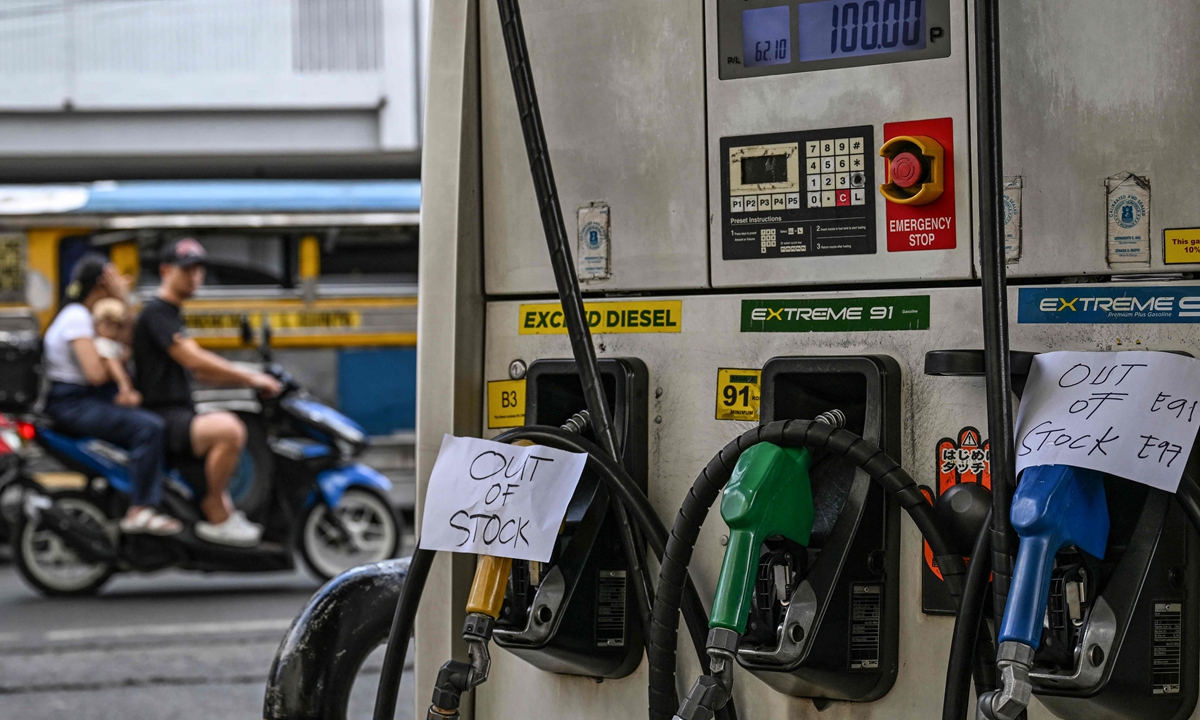
Signs reading 'out of stock' are displayed at a gas station amid rising petrol prices in Manila on March 9, 2026. The price for a barrel of Brent crude, the global oil benchmark, surged as much as 29 percent to $119.50 per barrel early on the same day. Photo: VCG
Global oil prices surged to near $120 per barrel on Monday, their highest levels since mid-2022, as the US-Israel strikes on Iran enter the second week, engulfing key oil-producing countries and vital transit routes across the Persian Gulf, especially the Strait of Hormuz, threatening both output and the flow of crude oil and natural gas, media reported on Monday. Multiple countries, major importers in particular, reacted to the oil prices spike with intended solutions.
The price for a barrel of Brent crude, the global oil benchmark, surged as much as 29 percent to $119.50 per barrel early on Monday but later was trading at $107.80 per barrel, according to the Associated Press.
It was the first time in almost four years that the Brent cost more than $100 a barrel. Oil is now about 50 percent more expensive than it was before the US and Israel began attacking Iran on February 28, according to the New York Times.
WTI surged 31.4 percent to $119.48 a barrel earlier on Monday, Reuters reported.
According to the AP, oil prices on Monday moderated after the Financial Times reported that G7 finance ministers will discuss on Monday a joint release of oil from emergency reserves coordinated by the International Energy Agency.
In response to a question about whether China will participate in discussions among G7 countries that have been meeting with the IEA to discuss a possible release of oil from global emergency oil reserves, Guo Jiakun, a spokesperson for the Foreign Ministry, said at a regular press conference on Monday that "I'd refer you to competent authorities for anything specific."
"Energy security is of vital importance to the world economy. All parties have the responsibility to ensure stable and unimpeded energy supply. China will do what is necessary to protect its energy security," said Guo.
The National Development and Reform Commission (NDRC), China's top economic planner, will raise domestic oil prices from midnight on Monday, with domestic retail prices for gasoline increasing by 695 yuan ($100.50) per ton and diesel prices up 670 yuan per ton, CCTV News reported on Monday.
International oil prices surged significantly during this refined oil pricing adjustment cycle due to the ongoing escalation of the US- Iran conflict, said the NDRC.
According to China's refined oil pricing mechanism, the NDRC will adjust domestic gasoline and diesel prices based on a comparison between the average price of the previous 10 working days as of Monday and the average price of the 10 working days prior to the last adjustment on February 24.
Apart from G7's reported discussion on oil release from emergency reserves, Japan on Sunday instructed a national oil reserve storage site to prepare for a possible release of crude oil, Reuters reported, citing a senior Japanese parliament member.
South Korea announced that the government has decided to urgently import more than 6 million barrels of crude oil from the United Arab Emirates (UAE), the Chosun Daily reported.
Previously, some oil producers announced to cut output. For example, Kuwait, the fifth-largest oil producer in OPEC, said on Saturday that it is cutting oil production due to "threats against safe passage of ships through the Strait of Hormuz," CNBC reported.
The UAE, OPEC's third-largest oil producer, announced that it was carefully managing offshore production levels to meet storage requirements, while production at major oil fields in southern Iraq has dropped by 70 percent, media reported.
Yang Delong, chief economist at Shenzhen-based First Seafront Fund, told the Global Times on Monday that Gulf countries are major global oil producers. Any attack on the region could disrupt the balance between supply and demand in the international crude oil market, causing oil prices to surge sharply.
"This would directly drive up production costs in downstream industries such as petrochemicals that rely on oil as a raw material, significantly squeezing profit margins in oil-intensive sectors like international aviation due to higher operating costs," said Yang.
Should the situation deteriorate further, volatility in crude oil, gold and silver prices, as well as downward pressure on global stock markets, will intensify, Yang noted.
Apart from energy prices, the IMF also estimated that every sustained 10 percent rise in oil prices results in a 0.4 percent rise in inflation and a 0.15 percent reduction in global economic growth.
RELATED ARTICLES