Khamenei’s son appointed Iran’s new supreme leader amid tensions, surging oil prices
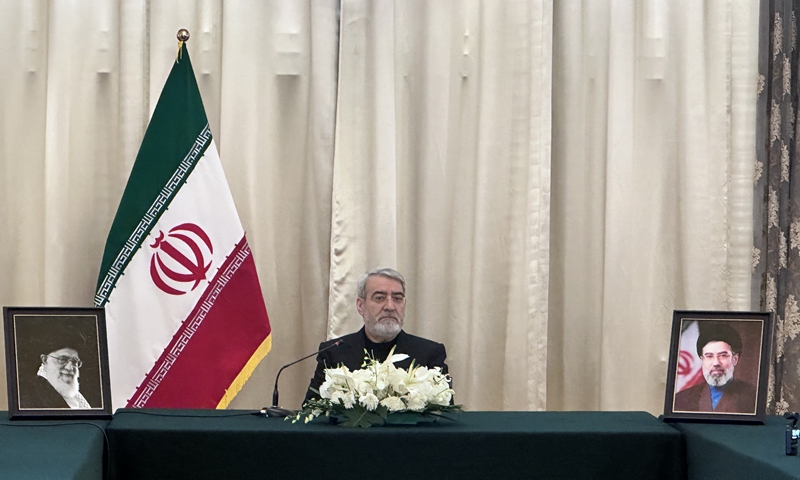
Iranian Ambassador to China Abdolreza Rahmani Fazli meets the press at the Iranian Embassy in Beijing on March 9, 2026. Photo: Shen Sheng/GT
Two framed photographs stood on the table - photo of the late Supreme Leader Ayatollah Ali Khamenei on one side and photo of his successor, Mojtaba Khamenei, the late leader's second son, on the other - as Iranian Ambassador to China Abdolreza Rahmani Fazli met the press at the Iranian Embassy in Beijing on Monday.
Fazli said on Monday that Mojtaba Khamenei has been selected as the new leader among several candidates, and he now meets all the qualifications required for the leader as stipulated in the Iranian Constitution, China News Service reported.
The joint US-Israeli military operation against Iran entered its 10th day on Monday. Earlier, Iran's Assembly of Experts had chosen Mojtaba Khamenei as Irian's new supreme leader, the Tehran Times reported. The appointment came despite earlier remarks by US President Donald Trump, who reportedly claimed Ali Khamenei's son as "unacceptable," according to media reports.
At Monday's regular press conference of the Chinese Foreign Ministry, when asked about China's response to Iran's newly appointed leader, spokesperson Guo Jiakun said "we have noted relevant reports. It is a decision made by the Iranian side in accordance with the country's Constitution."
When asked about remarks by Trump about the new leader that "he might not last long," Guo said China opposes interference in other countries' internal affairs under any pretext. Iran's sovereignty, security and territorial integrity should be respected. China calls for an immediate end to the military operations, return to dialogue and negotiations as soon as possible, and no further escalation of tensions.
Russian President Vladimir Putin on Monday congratulated Mojtaba Khamenei on his appointment as Iran's new supreme leader, saying he was confident Khamenei would continue his father's work "with honor" and unite the Iranian people "in the face of severe trials," the Kremlin said, per Al Jazeera.
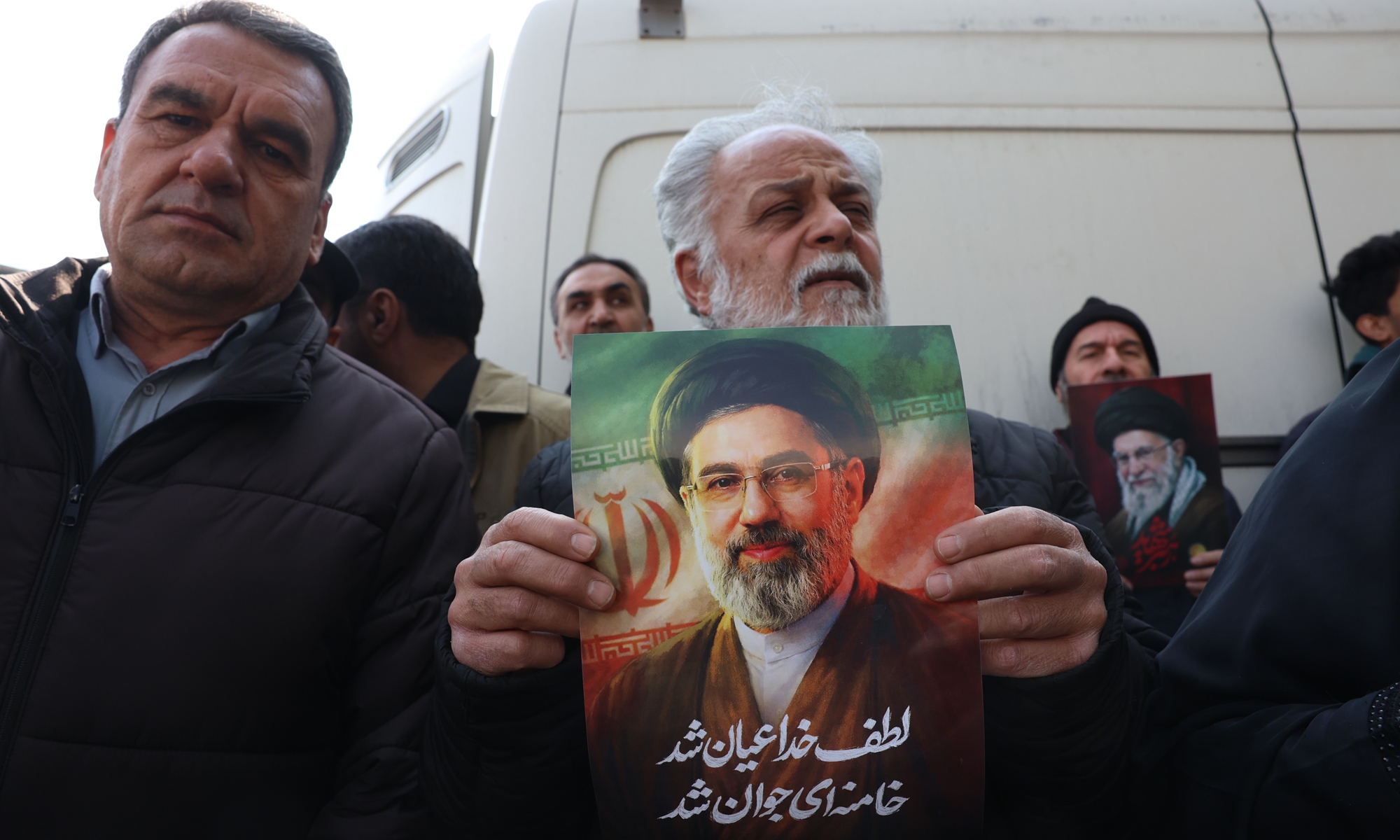
Iranians gather at Enqelab Square to show support for the newly appointed Supreme Leader Ayatollah Mojtaba Khamenei in Tehran, Iran on March 9, 2026. Photo: VCG
Power transferIran's Assembly of Experts appointed Mojtaba Khamenei as the new supreme leader and the decision was described as having secured "strong" votes, with an urgent call for the national unity behind him. The station broadcast scenes of people celebrating in parts of Tehran, according to a report from the Associated Press (AP).
The 56-year-old will serve as commander-in-chief of the military and powerful paramilitary Revolutionary Guard. There has been only one other transfer of power in the office of supreme leader since the Islamic Revolution almost a half-century ago, per AP.
An Al Jazeera report noted that "the younger Khamenei's ascension is a clear sign that more hardline factions in Iran's establishment retain power, and could indicate that the government has little desire to agree to a deal or negotiations in the short term."
The appointment of Mojtaba Khamenei's ascension highlights Tehran's unity under current circumstances. A longtime figure in the Supreme Leader's office with influence over the Basij militia, Mojtaba Khamenei is viewed by many insiders as a pragmatic leader capable of maintaining stability during a highly sensitive transition. Also, as the US-Israeli targeted strikes had taken his father, mother and wife, sympathy within Iran's political establishment toward Mojtaba Khamenei has grown, further consolidating support for him, Sun Degang, director of the Center for Middle East Studies at Fudan University, told the Global Times.
Mojtaba Khamenei's mother, wife, and one of his sisters were killed in the strikes that killed his father, but Mojtaba Khamenei was reportedly not present and has so far survived the intense bombing of Iran, per Al Jazeera.
Iran's political system operates through a triangular power structure composed of the clerical establishment, the military — especially the IRGC — and the political bureaucracy. These factions have largely reached a consensus that Mojtaba Khamenei is the most suitable figure to take over the position, said Sun, noting that despite continued threats from the US and Israel that any new Iranian leader could face similar targeted attacks, Mojtaba Khamenei's willingness to step forward and assume the role is interpreted by supporters as a sign of political resolve and responsibility at a moment of national crisis.
According to Al Jazeera, after the announcement of the appointment on Sunday, key leaders, Iran's IRGC, and the armed forces were quick to pledge their backing to the new leader. Ali Larijani, secretary of the Supreme National Security Council, who has been tasked with steering Iran's security strategy since the US and Israel joint military operation, called for unity around the new supreme leader. Parliament Speaker Mohammad Bagher Ghalibaf welcomed the choice, saying that following the new supreme leader was a "religious and national duty."
Iran fired missiles at Israel early Monday under its new supreme leader, Mojtaba Khamenei, according to CBS 19News.
Wider response
During a phone interview with The Times of Israel shortly after the announcement of Iran's new supreme leader, President Trump declined to comment on the appointment, saying only, "We'll see what happens." According to the Israeli outlet, Trump said he'll make final call to end operation "at right time" and it would be a "mutual" decision made together with Israeli Prime Minister Benjamin Netanyahu.
While in an interview with Axios last week, Trump claimed that "Khamenei's son is unacceptable to me. We want someone that will bring harmony and peace to Iran." "They are wasting their time. Khamenei's son is a lightweight. I have to be involved in the appointment, like with Delcy [Rodriguez] in Venezuela," Trump was quoted as saying. He also claimed that he refuses to accept a new Iranian leader who would continue Khamenei's policies, which he said would force the US back to war "in five years."
Israel's military said early Monday that its air force had begun an "additional wave" of strikes against unspecified "regime infrastructure" in central Iran. Israel has said that anyone named to the role of supreme leader would become a target for assassination, according to Deutsche Welle.
Despite opposition from the US, Iran has selected the late supreme leader's son as the country's new supreme leader, a move that underscores the deep and likely irreconcilable tensions between Washington and Tehran. The decision may further harden the new leader's resolve in confronting the US and Israel, said Sun.
Sun said that in the immediate period following the announcement of Iran's new leader, Tehran may still rely on asymmetric strategies, including maintaining control of the Strait of Hormuz. Such moves could drive up global oil prices, increase economic pressure, draw greater international attention to the Gulf crisis, and place additional pressure on Washington and its allies to de-escalate.
As the war continues, Chinese Foreign Minister Wang Yi on Monday held phone conversations respectively with Kuwaiti Foreign Minister Jarrah Jaber Al-Ahmad Al-Sabah on the situation in the Middle East and Bahraini Foreign Minister Abdullatif bin Rashid Al Zayani over the current situation in the Gulf region.
A Reuters report on Monday noted that the prospect that the disruption to global energy supplies - already one of the most severe in history - could last longer than previously expected sent oil prices surging in record leaps and global stock markets plunging into a nosedive.
According to CNS, when asked about traffic security of Strait of Hormuz on Monday, Ambassador Fazli responded with a question: If the world is deeply concerned about the security of energy transportation, a vital question must first be asked, "Which major international organization has authorized the US to launch strikes against Iran?"
RELATED ARTICLES