China-EU trade surges 19.9% in Jan-Feb, underscoring resilience and complementarity amid global turmoil: Chinese expert
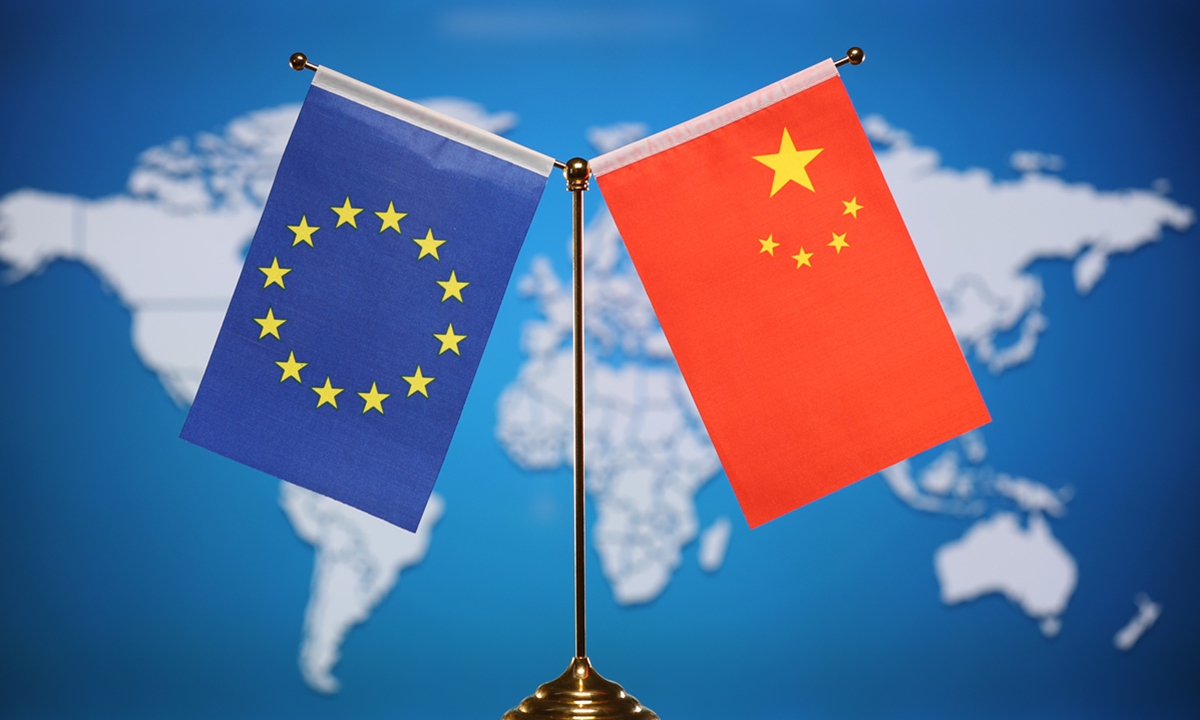
China EU Photo:VCG
In the first two months of the year, China's foreign trade with EU surged 19.9 percent year-on-year to reach 998.94 billion yuan ($144.54 billion), outpacing the 18.3 percent growth rate of China's total foreign trade during the same period, data from China's General Administration of Customs (GAC) showed on Tuesday.
Chinese experts said that the figures demonstrated the resilience and strong complementarity of bilateral economic and trade relations in a turbulent global environment, and called on the EU to continue to strengthen pragmatic cooperation with China so as to advance the stable and healthy development of bilateral relationship.
According to the GAC, in the first two months of this year, China's trade with Germany rose 16.8 percent year-on-year, that with France up 27.4 percent, and Italy, increasing 24.9 percent.
China-EU trade has maintained steady growth last year, and the robust performance in the first two months of this year extends this ongoing upward trajectory, said Jian Junbo, director of the Center for China-Europe Relations at Fudan University's Institute of International Studies.
According to Chinese customs statistics, China's imports and exports with the EU totaled 5.93 trillion yuan in 2025, up 6 percent year-on-year, accounting for 13 percent of China's total foreign trade value.
Jian told the Global Times on Tuesday that the January-February data has delivered a much-needed boost to China-EU economic and trade ties, indicating that — barring major external disruptions — bilateral trade is likely to sustain steady growth for the full year.
Rapid growth in China-EU trade in the first two months also demonstrated the deep industrial complementarity between the two sides and the resilience of underlying market demand, Li Yong, an executive council member of the China Society for WTO Studies, told the Global Times on Tuesday.
Li said that this growth embodies the mutually beneficial and win-win nature of China-EU trade, especially in the green development. "China's competitive products, such as automobiles and batteries, align well with Europe's green transition needs, while supplying intermediate goods and technological support can help enhance the competitiveness of European domestic products, thus achieving mutual benefits for both sides," the expert noted.
Jian also noted in the face of rising unilateralism in the external environment, China and the EU have strengthened equal consultation and pragmatic cooperation.
In January, China's Ministry of Commerce (MOFCOM) announced that China and the EU have agreed on price undertaking guidance for Chinese battery electric vehicles (EVs) makers.
In addition, a number of European leaders, including French President Emmanuel Macron, Irish Prime Minister Micheal Martin and German Chancellor Friedrich Merz, have visited China recently.
"EU member states such as Germany and France have maintained a pragmatic approach toward cooperation with China, driven by objective economic and trade needs. This has in turn created a relatively favorable environment for future bilateral cooperation," Jian said.
Jian also noted that trade barriers still exist between China and the EU.
On March 4, the EU released Industrial Accelerator Act (IAA), which sets out restrictive provisions for foreign investment in four sectors - batteries, electric vehicles, photovoltaics and critical raw materials. A spokesperson from MOFCOM on March 6 expressed serious concern over the EU's bill, saying certain restrictive provisions could constitute significant investment barriers and institutional discrimination, and vowing to firmly safeguard the legitimate rights and interests of Chinese companies.
Practice has proved that protectionism does not enhance competitiveness, while openness and cooperation remain the right path for development, the spokesperson said, noting that China and the EU are important economic and trade partners with broad shared interests and positive cooperation outcomes in addressing climate change and advancing the green transition.
"Cooperation is driven by economic complementarity and mutual interests, while competition results from structural shifts and geopolitical-economic pressures," Jian said, noting that through frank dialogues and exchanges, both sides can achieve "competitive coexistence" — deepening practical cooperation while managing differences to achieve mutual benefit and win-win results.
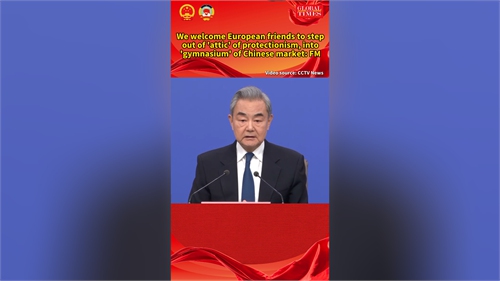
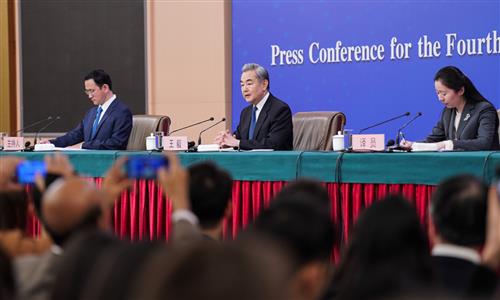
At the press conference on March 8, 2026, Member of the Political Bureau of the CPC Central Committee and Foreign Minister Wang Yi spoke of China-Europe relations.
Wang noted, since last year, relations between China and European countries have been regaining strength. Two-way trade topped $1 trillion, over 2 million European tourists traveled to China under visa-free policies, and, European leaders paid a number of visits. Interactions are more active. A host of new cooperation agreements have been reached. Facts have shown that China-Europe relations draw stability from shared interests and certainty from mutually beneficial partnerships.
Wang stressed that in trade and economic ties, China and Europe are mutually complementary. A dynamic balance is entirely within reach amid growing ties. As testified by the facts in China-Europe cooperation, interdependence is not a risk; intertwined interests are not threats; and openness and cooperation will not weaken economic security; but building walls and barriers will only lead to self-isolation. We are glad to see European friends stepping out of the "small attic" of protectionism and walking into the "fitness club" of the Chinese market to build their strength and competitiveness.
RELATED ARTICLES