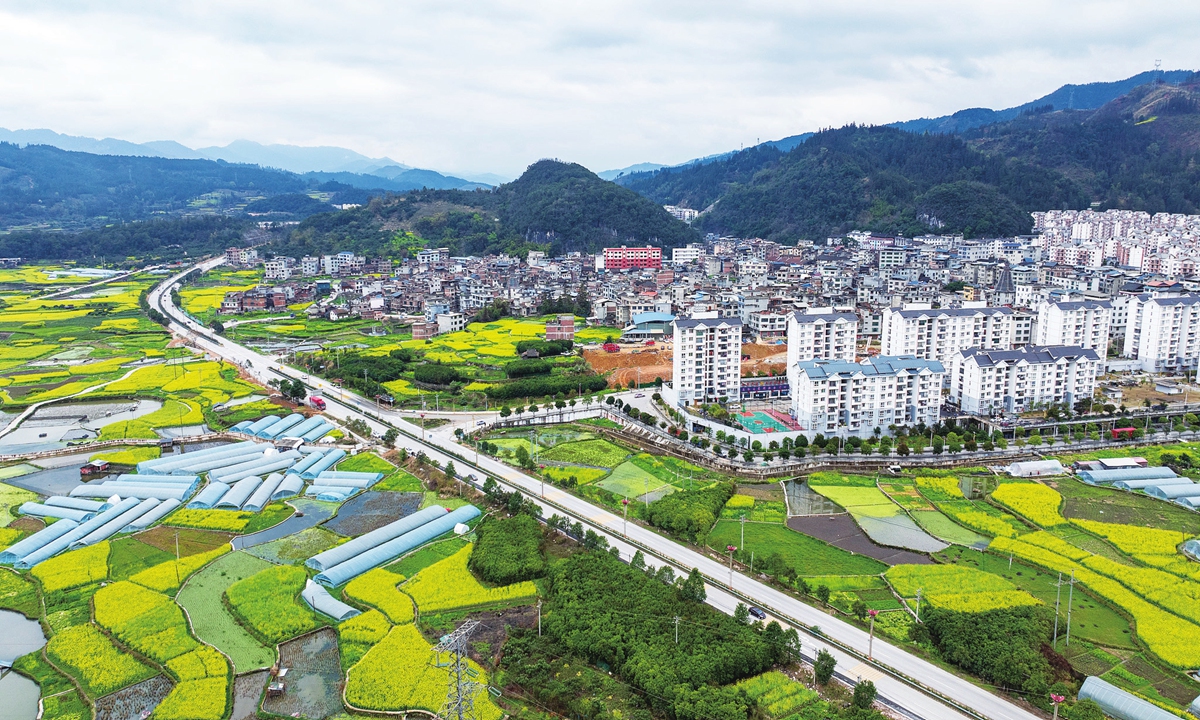
An aerial view of Congjiang County, Southwest China's Guizhou Province. Photo: VCG
Editor's Note:As China convenes the 2026 two sessions - the annual meetings of China's top legislature and top political advisory body - China is expected to send strong and fresh signals on pushing high-quality development, leveraging greater policy and reform support to ensure steady economic growth and social progress.
In the "Understanding signals at two sessions" series, the Global Times (GT) invites internationally renowned scholars, policy observers and business leaders to interpret the key signals from the two sessions regarding China's domestic roadmap, covering advancements in whole-process people's democracy, high-quality development, high-level opening-up, major-country diplomacy and the improvement of people's wellbeing.
In the fifth piece of the series, Global Times reporter Su Yaxuan interviewed Endalkachew Sime (Sime), former state minister of planning and development of Ethiopia. He shared his views on China's livelihood policies, the people-centered development philosophy, and how China's experience may offer insights for developing countries seeking more inclusive and sustainable development.
GT: China's two sessions are not only a key political event on the domestic agenda but also draw widespread attention from the international community. What key signals do you believe the international community can observe from them?
Sime: This year's two sessions arrive at a moment when such reference points are urgently needed across the Global South and even beyond. As a former state minister responsible for monitoring national development performance, China's plans for people's livelihood during the two sessions, as well as the livelihood-related aspects being designed for the 15th Five-Year Plan (2026-30) period, have particularly caught my attention.
China's emphasis on institutionalized planning creates stability that contrasts with the project-to-project volatility often associated with traditional development assistance. The 15th Five-Year Plan recommendations have already signaled this commitment through their framing of development as meeting people's aspirations for a better life, a formulation that resonates with my own work on national development planning where we grappled with embedding long-term welfare objectives into operational government programs.
GT: The 2026 Report on the Work of the Government states: "Taking stronger measures to ensure and improve the people's wellbeing." How do you understand the profound impact of placing people's livelihoods at the core of a country's development?
Sime: This question strikes at the heart of my dual identity as development economist and former state minister responsible for monitoring national development performance. Sustainability through domestic resource mobilization represents a critical linkage. China's livelihood-focused model enhances sustainability through productivity-led taxation expansion and import dependency reduction. My research on value chains showed how localized supply chain development reduces foreign exchange pressure, a principle China applied through its own import substitution industrialization. The agricultural technology centers China has established across developing regions generate tax base expansion without rate increases while simultaneously addressing food security.
Viability requires integrated ecosystem development encompassing worker housing, clinics and schools alongside production facilities. The two sessions' emphasis on common prosperity provides philosophical grounding for this integrated approach, recognizing that industrialization without social reproduction infrastructure generates external costs that undermine long-term viability.
GT: The Recommendations of the Central Committee of the Communist Party of China for Formulating the 15th Five-Year Plan for National Economic and Social Development emphasized "Meeting the people's aspirations for a better life is the immutable goal of Chinese modernization." In your view, how should China's people-centered development approach be understood?
Sime: My past work facilitating public-private dialogue at the chambers of commerce often encountered the limitations of ad hoc consultation, whereas China's two sessions processes theoretically incorporate more systematic grass root inputs. The digital infrastructure development I observed enables real-time policy feedback loops that were unimaginable when I began my career in market research two decades ago.
My tenure in planning coincided with efforts to balance infrastructure investment with social service delivery, and I came to appreciate that well-being improvements require more than aggregate growth metrics. China's poverty alleviation model demonstrates how agricultural productivity gains can fund industrialization while simultaneously improving rural welfare. The "small-and-beautiful" livelihood projects that have proliferated across regions represent what I term developmental granularity, interventions visible and tangible at the household level rather than concentrated in enclaves disconnected from surrounding communities.
GT: In a previous interview with the Global Times, you mentioned that China provides a development model for the Global South. You also stated that Ethiopia's current 10-Year Development Plan is primarily a people-centered development blueprint. For developing countries like Ethiopia, what are the most valuable lessons from China's development path?
Sime: One of the most valuable lessons from China's development path, whether in people's livelihood or other areas, is institutionalized planning continuity. My experience in planning revealed how development volatility under political transitions can disrupt long-term investment horizons. China's two sessions institutionalize planning through the Five-Year Plans and systematic review mechanisms.
Furthermore, China's two sessions reveal intentional sequencing that my fieldwork confirmed in practice: Infrastructure development generates connectivity that industrial parks leverage for market access, while parallel scholarship and training programs ensure that infrastructure operates with developing local expertise. The 15th Five-Year Plan's emphasis on new quality productive forces suggests continued evolution toward knowledge-intensive industrialization.
The third lesson addresses private sector enablement with strategic direction. China's two sessions demonstrate structured public-private consultation through representation and sector-specific industrial policy differentiation. China's institutionalization of such sector-specific interventions offers a model for consideration.
The fourth lesson centers on sovereignty-respecting knowledge transfer. Developing country experience informs Chinese policy as much as Chinese models inform Global South development. For national planning, this suggests contextualized adoption rather than wholesale transfer.
I would recommend that developing nations propose two sessions-style annual development review forums at regional levels. Such forums could regularize the exchange of implementation experiences, creating space for the mutual learning that is essential for effective South-South cooperation.
GT: "Becoming Chinese" has recently become a trending topic on Western social media, with an increasing number of foreigners adopting a Chinese lifestyle. What is your thought on such a trend?
Sime: The social media trend reflects what I term developmental soft power, the attractiveness of systems that deliver tangible welfare improvements. However, my critical perspective as a development economist distinguishes this appeal from uncritical emulation. My advice to students from the Global South considering engagement with China is to study the invisible infrastructure of planning coordination and institutional linkages rather than focusing exclusively on the visible infrastructure of railways and buildings.
RELATED ARTICLES