ARTS / CULTURE & LEISURE
Physical bookstores irreplaceable environment that shapes the soul
By and Kang Chunhua Published: Mar 10, 2026 09:27 PM

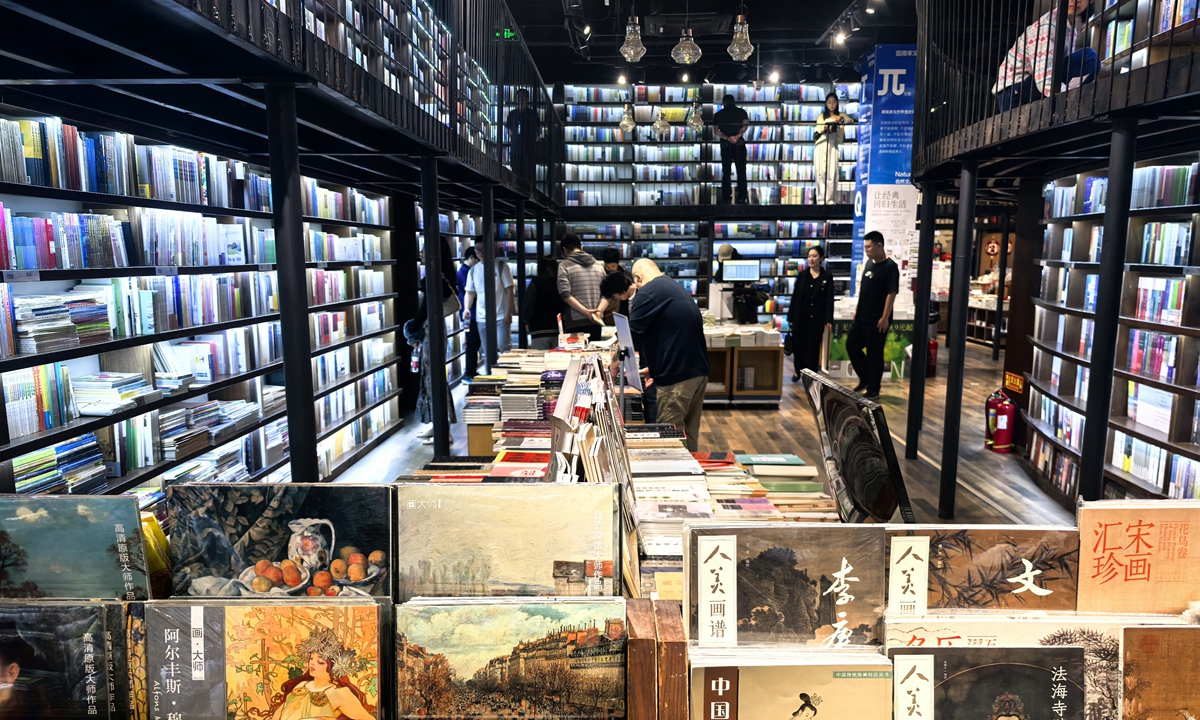
Readers immerse themselves in books at a bookstore in Beijing on October 9, 2025, Beijing. Photo: VCG
Chinese author Chen Yan still remembers the days when he worked in Xi'an, capital city of Northwest China's Shaanxi Province, near a historic street called Duanlümen. Walking along the city wall, he would pass by a street lined with nearly 20 bookstores. After lunch, he would stroll over, browse the new arrivals, flip through a few pages, and sometimes take a book home. But today, only one brick-and-mortar bookstore remains. "Physical bookstores are disappearing at an alarming rate. But in our society, there are still people who read seriously, searching for the book they most want to read," he told the Global Times at this year's "two sessions."This nostalgia carries an urgent warning. On February 1, the Regulation on the Promotion of Nationwide Reading came into effect across China. As the nation prepares for a wave of reading activities in April 2026 for China's first national reading week, a fundamental question emerges: How can physical bookstores survive, and thrive in their mission to nurture a "nation of readers"?
Chen Yan, a member of the 14th National Committee of the Chinese People's Political Consultative Conference and vice chairman of the China Writers Association, has spent the past year investigating this question. His findings paint a stark picture of cultural erosion happening quietly across the country.
In numerous small and medium-sized cities, Chen discovered that beyond the state-owned Xinhua Bookstores, small independent bookshops are rare.
"Some counties cover large areas with populations in the tens or hundreds of thousands, yet you can walk several streets without finding even a small bookstore. It always feels like something's missing."
The digital revolution has transformed how people access knowledge. Online book purchases offer convenience and discounts; e-readers hold entire libraries. Yet reading has never been merely about acquiring information; it shapes how people think, nourishes people's spirits, and ultimately determines a nation's future trajectory.
Chen articulates this with simple clarity: "People are products of their environment. The environment shapes the soul. To be nurtured by reading, one must be immersed in a reading environment."
He drew an analogy: "We feel hungry in restaurants, and thirsty in tea houses. In bookstores, we naturally want to browse and discover. This instinctive response to physical spaces cannot be replicated on screens."
A bookstore's value rivals that of libraries, museums, theaters, or cinemas. The warm glow of lamps, the scent of paper, the quiet presence of fellow readers, these elements create what cultural critics call a "cultural magnetic field." Cultural development requires corresponding cultural environments, Chen insisted.
Between private studies and public libraries, bookstores scattered around city streets, within residential communities, and near campuses form the essential capillaries of a national reading ecology. They are lighter, closer to daily life, more accessible than formal institutions. They create vibrant sites for knowledge transmission, cultural exchanges, and spiritual encounters.
Chen envisions bookstores as flexible platforms for reading activities tailored to local conditions: classic recitation sessions, lectures by renowned experts, new book recommendations, second-hand book fairs and youth reading clubs. "Perhaps you're sipping coffee, daydreaming, when someone in the bookstore begins lecturing on Dream of the Red Chamber, Journey to the West, War and Peace, or A Brief History of Time. You catch a few sentences, become drawn in, and return to the ocean of books."
This occasional discovery, stumbling upon knowledge you never sought, is a bookstore's unique magic. Reading interest requires "petri dishes," Chen argued, and bookshops are precisely that as they transform concentrated national reading campaigns into everyday habits in ordinary life.

Illustration: Chen Xia/GT
Some bookstores are innovating successfully, expanding into cultural products and transforming reading into new forms of cultural consumption. Chen applauded these efforts but warned against losing sight of what makes a bookstore a real bookstore."If physical bookstores stop selling books, can they still be called 'bookstores?'" he asked. "If physical bookstores disappear completely, the very concept of books will blur and fade. A nation of readers needs visible symbols. Libraries and bookstores are precisely such symbols."
Many local governments are now exploring support schemes for bookstores. Chen considers this farsighted cultural policy. "Promoting national reading cannot remain an empty slogan or superficial excitement," he argued. "It needs concrete handles. Physical bookstores are excellent handles. Appropriate subsidies can make both for their existence and their activities promoting reading sustainable."
Yet subsidies must target the right people, those with genuine cultural commitment. Starting a bookstore usually means the owner possesses cultural sensibility and love for reading. Government support should empower this group, enabling them to serve public cultural functions: recommending quality books, hosting public lectures, organizing activities reflecting local characteristics.
Ultimately, Chen pointed out that protecting bookstores is no mere slogan. It requires clear thinking, specific methods, and implementable measures. A bookstore should become the calling card of a county, a street, and a township. Polishing this card matters enormously and pays practical dividends.
RELATED ARTICLES