IN-DEPTH / IN-DEPTH
Archives Tell Truth: Original diaries and confessions in local records lay bare systematic war crimes of Japan’s invasion of China
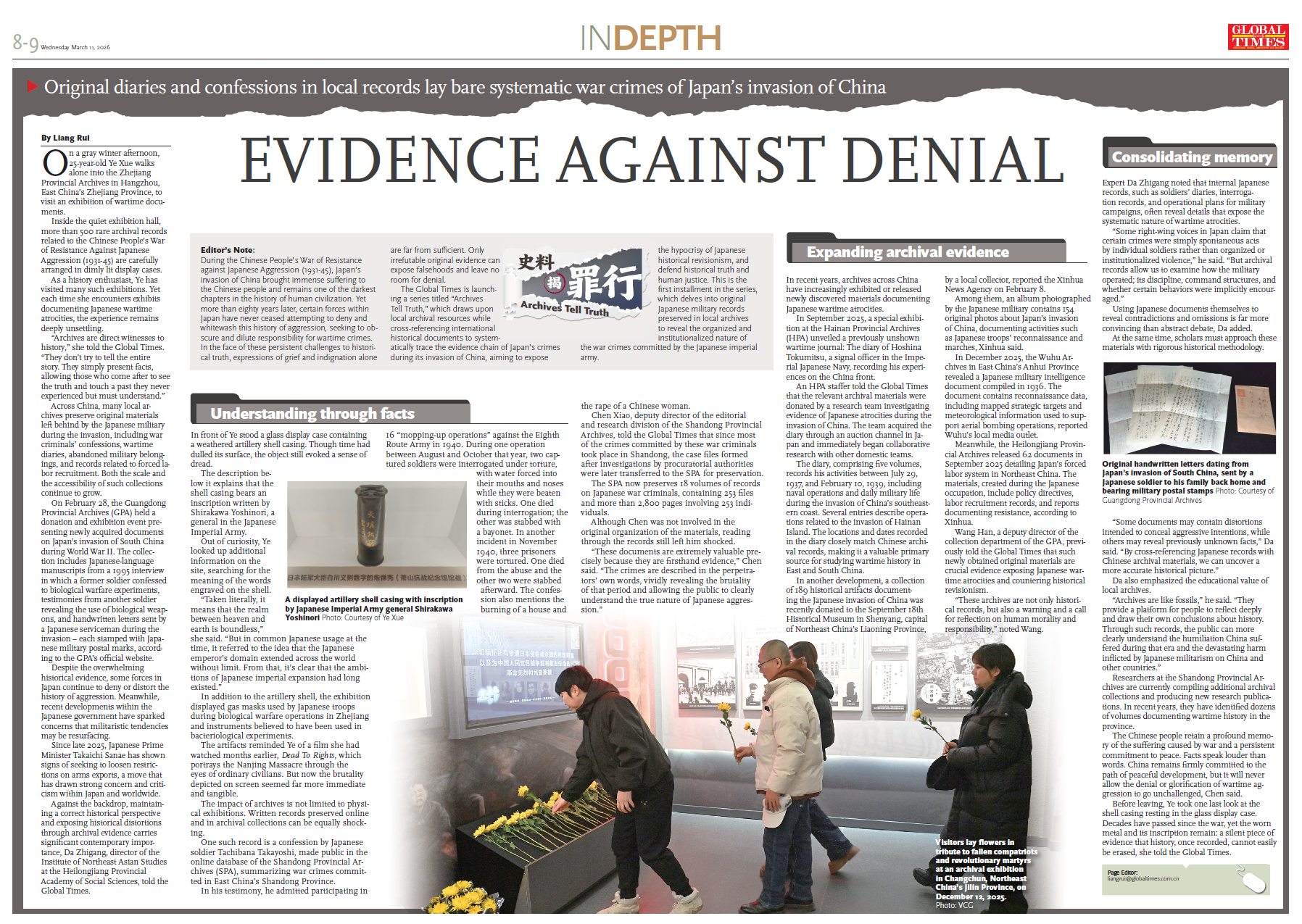
Evidence against denial
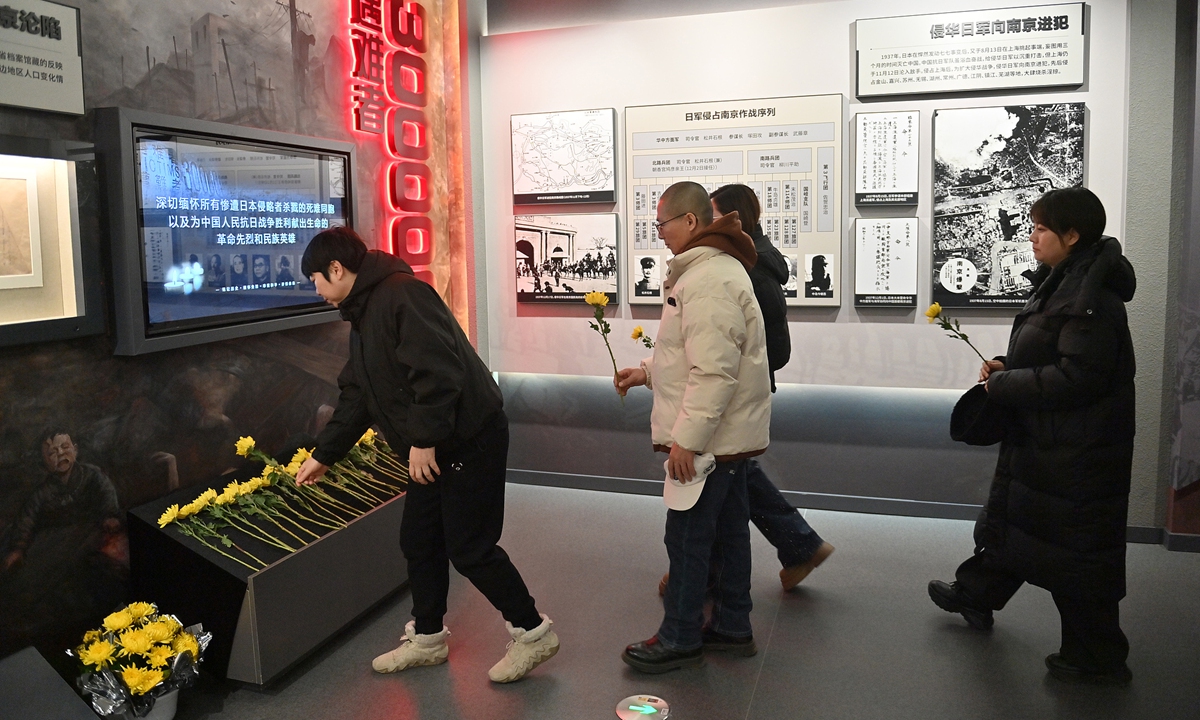
Visitors lay flowers in tribute to fallen compatriots and revolutionary martyrs at an archival exhibition in Changchun, Northeast China's Jilin Province, on December 12, 2025. Photo: VCG
Editor's Note:
During the Chinese People's War of Resistance against Japanese Aggression (1931-45), Japan's invasion of China brought immense suffering to the Chinese people and remains one of the darkest chapters in the history of human civilization. Yet more than eighty years later, certain forces within Japan have never ceased attempting to deny and whitewash this history of aggression, seeking to obscure and dilute responsibility for wartime crimes. In the face of these persistent challenges to historical truth, expressions of grief and indignation alone are far from sufficient. Only irrefutable original evidence can expose falsehoods and leave no room for denial.
The Global Times is launching a series titled "Archives Tell Truth," which draws upon local archival resources while cross-referencing international historical documents to systematically trace the evidence chain of Japan's crimes during its invasion of China, aiming to expose the hypocrisy of Japanese historical revisionism, and defend historical truth and human justice. This is the first installment in the series, which delves into original Japanese military records preserved in local archives to reveal the organized and institutionalized nature of the war crimes committed by the Japanese imperial army.
On a gray winter afternoon, 25-year-old Ye Xue walks alone into the Zhejiang Provincial Archives in Hangzhou, East China's Zhejiang Province, to visit an exhibition of wartime documents.
Inside the quiet exhibition hall, more than 500 rare archival records related to the Chinese People's War of Resistance Against Japanese Aggression (1931-45) are carefully arranged in dimly lit display cases.
As a history enthusiast, Ye has visited many such exhibitions. Yet each time she encounters exhibits documenting Japanese wartime atrocities, the experience remains deeply unsettling.
"Archives are direct witnesses to history," she told the Global Times. "They don't try to tell the entire story. They simply present facts, allowing those who come after to see the truth and touch a past they never experienced but must understand."
Across China, many local archives preserve original materials left behind by the Japanese military during the invasion, including war criminals' confessions, wartime diaries, abandoned military belongings, and records related to forced labor recruitment. Both the scale and the accessibility of such collections continue to grow.
On February 28, the Guangdong Provincial Archives (GPA) held a donation and exhibition event presenting newly acquired documents on Japan's invasion of South China during World War II. The collection includes Japanese-language manuscripts from a 1995 interview in which a former soldier confessed to biological warfare experiments, testimonies from another soldier revealing the use of biological weapons, and handwritten letters sent by a Japanese serviceman during the invasion - each stamped with Japanese military postal marks, according to the GPA's official website.
Despite the overwhelming historical evidence, some forces in Japan continue to deny or distort the history of aggression. Meanwhile, recent developments within the Japanese government have sparked concerns that militaristic tendencies may be resurfacing.
Since late 2025, Japanese Prime Minister Takaichi Sanae has shown signs of seeking to loosen restrictions on arms exports, a move that has drawn strong concern and criticism within Japan and worldwide.
Against the backdrop, maintaining a correct historical perspective and exposing historical distortions through archival evidence carries significant contemporary importance, Da Zhigang, director of the Institute of Northeast Asian Studies at the Heilongjiang Provincial Academy of Social Sciences, told the Global Times.
Understanding through facts
In front of Ye stood a glass display case containing a weathered artillery shell casing. Though time had dulled its surface, the object still evoked a sense of dread.
The description below it explains that the shell casing bears an inscription written by Shirakawa Yoshinori, a general in the Japanese Imperial Army.
Out of curiosity, Ye looked up additional information on the site, searching for the meaning of the words engraved on the shell.
"Taken literally, it means that the realm between heaven and earth is boundless," she said. "But in common Japanese usage at the time, it referred to the idea that the Japanese emperor's domain extended across the world without limit. From that, it's clear that the ambitions of Japanese imperial expansion had long existed."
In addition to the artillery shell, the exhibition displayed gas masks used by Japanese troops during biological warfare operations in Zhejiang and instruments believed to have been used in bacteriological experiments.
The artifacts reminded Ye of a film she had watched months earlier, Dead To Rights, which portrays the Nanjing Massacre through the eyes of ordinary civilians. But now the brutality depicted on screen seemed far more immediate and tangible.
The impact of archives is not limited to physical exhibitions. Written records preserved online and in archival collections can be equally shocking.
One such record is a confession by Japanese soldier Tachibana Takayoshi, made public in the online database of the Shandong Provincial Archives (SPA), summarizing war crimes committed in East China's Shandong Province.
In his testimony, he admitted participating in 16 "mopping-up operations" against the Eighth Route Army in 1940. During one operation between August and October that year, two captured soldiers were interrogated under torture, with water forced into their mouths and noses while they were beaten with sticks. One died during interrogation; the other was stabbed with a bayonet. In another incident in November 1940, three prisoners were tortured. One died from the abuse and the other two were stabbed afterward. The confession also mentions the burning of a house and the rape of a Chinese woman.
Chen Xiao, deputy director of the editorial and research division of the Shandong Provincial Archives, told the Global Times that since most of the crimes committed by these war criminals took place in Shandong, the case files formed after investigations by procuratorial authorities were later transferred to the SPA for preservation.
The SPA now preserves 18 volumes of records on Japanese war criminals, containing 253 files and more than 2,800 pages involving 253 individuals.
Although Chen was not involved in the original organization of the materials, reading through the records still left him shocked.
"These documents are extremely valuable precisely because they are firsthand evidence," Chen said. "The crimes are described in the perpetrators' own words, vividly revealing the brutality of that period and allowing the public to clearly understand the true nature of Japanese aggression."
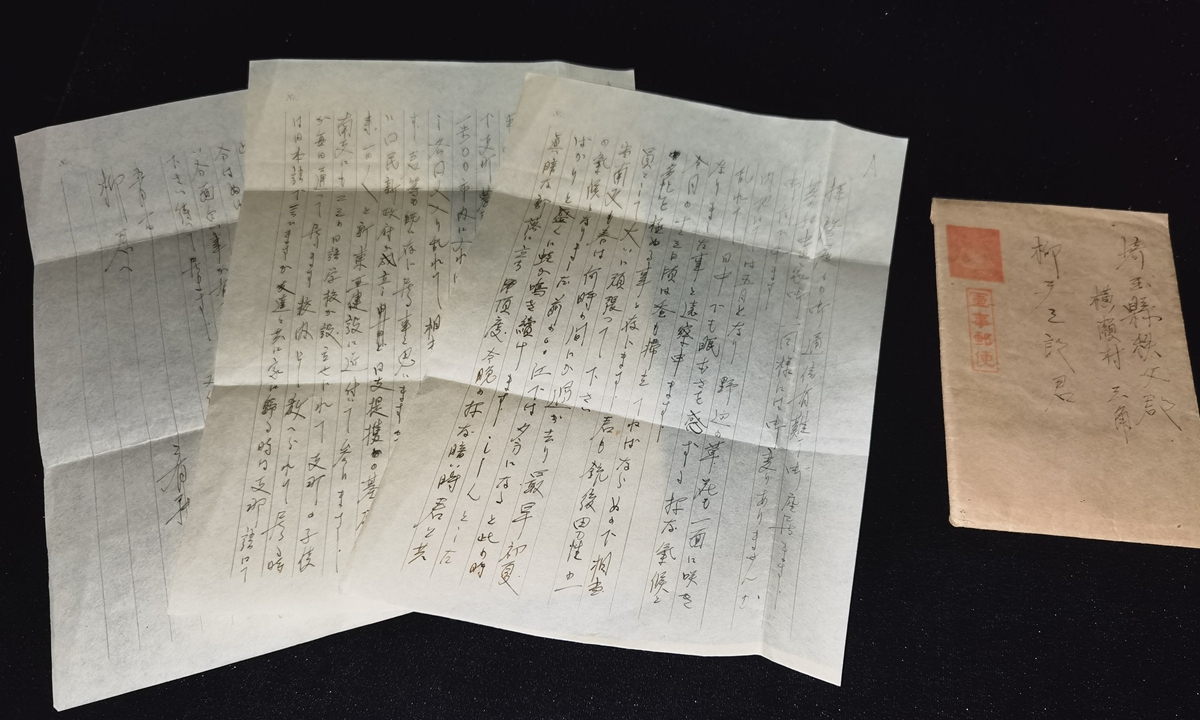
Original handwritten letters dating from Japan's invasion of South China, sent by a Japanese soldier to his family back home and bearing military postal stamps Photos: Courtesy of Guangdong Provincial Archives
Expanding archival evidence
In recent years, archives across China have increasingly exhibited or released newly discovered materials documenting Japanese wartime atrocities.
In September 2025, a special exhibition at the Hainan Provincial Archives (HPA) unveiled a previously unshown wartime journal: The diary of Hoshina Tokumitsu, a signal officer in the Imperial Japanese Navy, recording his experiences on the China front.
An HPA staffer told the Global Times that the relevant archival materials were donated by a research team investigating evidence of Japanese atrocities during the invasion of China. The team acquired the diary through an auction channel in Japan and immediately began collaborative research with other domestic teams.
The diary, comprising five volumes, records his activities between July 29, 1937, and February 10, 1939, including naval operations and daily military life during the invasion of China's southeastern coast. Several entries describe operations related to the invasion of Hainan Island. The locations and dates recorded in the diary closely match Chinese archival records, making it a valuable primary source for studying wartime history in East and South China.
In another development, a collection of 189 historical artifacts documenting the Japanese invasion of China was recently donated to the September 18th Historical Museum in Shenyang, capital of Northeast China's Liaoning Province, by a local collector, reported the Xinhua News Agency on February 8.
Among them, an album photographed by the Japanese military contains 154 original photos about Japan's invasion of China, documenting activities such as Japanese troops' reconnaissance and marches, Xinhua said.
In December 2025, the Wuhu Archives in East China's Anhui Province revealed a Japanese military intelligence document compiled in 1936. The document contains reconnaissance data, including mapped strategic targets and meteorological information used to support aerial bombing operations, reported Wuhu's local media outlet.
Meanwhile, the Heilongjiang Provincial Archives released 62 documents in September 2025 detailing Japan's forced labor system in Northeast China. The materials, created during the Japanese occupation, include policy directives, labor recruitment records, and reports documenting resistance, according to Xinhua.
Wang Han, a deputy director of the collection department of the GPA, previously told the Global Times that such newly obtained original materials are crucial evidence exposing Japanese wartime atrocities and countering historical revisionism.
"These archives are not only historical records, but also a warning and a call for reflection on human morality and responsibility," noted Wang.
Consolidating memory
Expert Da Zhigang noted that internal Japanese records, such as soldiers' diaries, interrogation records, and operational plans for military campaigns, often reveal details that expose the systematic nature of wartime atrocities.
"Some right-wing voices in Japan claim that certain crimes were simply spontaneous acts by individual soldiers rather than organized or institutionalized violence," he said. "But archival records allow us to examine how the military operated; its discipline, command structures, and whether certain behaviors were implicitly encouraged."
Using Japanese documents themselves to reveal contradictions and omissions is far more convincing than abstract debate, Da added.
At the same time, scholars must approach these materials with rigorous historical methodology.
"Some documents may contain distortions intended to conceal aggressive intentions, while others may reveal previously unknown facts," Da said. "By cross-referencing Japanese records with Chinese archival materials, we can uncover a more accurate historical picture."
Da also emphasized the educational value of local archives.
"Archives are like fossils," he said. "They provide a platform for people to reflect deeply and draw their own conclusions about history. Through such records, the public can more clearly understand the humiliation China suffered during that era and the devastating harm inflicted by Japanese militarism on China and other countries."
Researchers at the Shandong Provincial Archives are currently compiling additional archival collections and producing new research publications. In recent years, they have identified dozens of volumes documenting wartime history in the province.
The Chinese people retain a profound memory of the suffering caused by war and a persistent commitment to peace. Facts speak louder than words. China remains firmly committed to the path of peaceful development, but it will never allow the denial or glorification of wartime aggression to go unchallenged, Chen said.
Before leaving, Ye took one last look at the shell casing resting in the glass display case. Decades have passed since the war, yet the worn metal and its inscription remain: a silent piece of evidence that history, once recorded, cannot easily be erased, she told the Global Times.
Evidence against denial
RELATED ARTICLES