NPC deputy calls for high-level talent recruitment for Xinjiang
By Published: Mar 10, 2026 11:19 PM

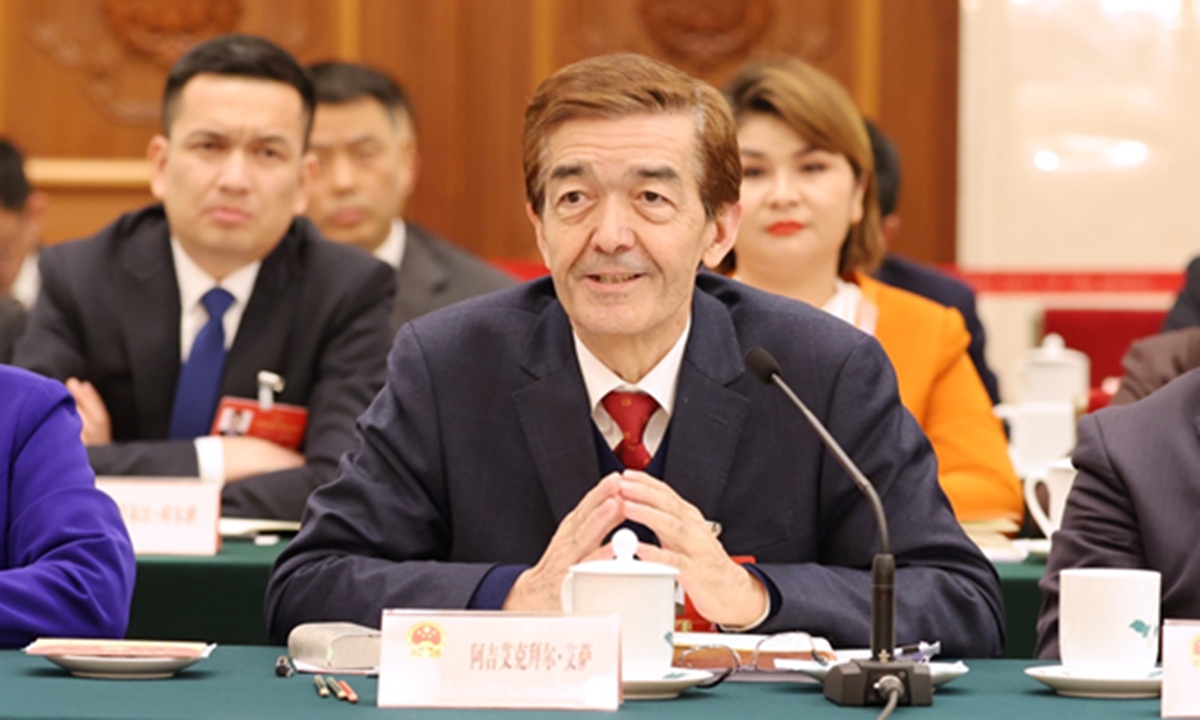
Haji Akber Aisa, a deputy to the 14th National People's Congress and an academician of the Chinese Academy of Engineering, speaks at a plenary session of the Xinjiang delegation at the 2026 "two sessions" in Beijing on March 6, 2026. Photo: Courtesy of Haji Akber Aisa
During this year's "two sessions," Haji Akber Aisa, a deputy to the 14th National People's Congress and an academician of the Chinese Academy of Engineering, told the Global Times that he hopes the country will assist Xinjiang with policies for attracting high-level talent.
From the perspective of national strategy, Xinjiang is a core area of the Belt and Road Initiative, with the growth rate of its foreign trade imports and exports ranking among the highest in the country. The region faces the vast markets of Central Asia and West Asia. Whether it is serving the Healthy China initiative or building a leading hub for medical education and healthcare in western China, a high-level faculty team is essential, the deputy said.
"At present, due to objective factors such as geographic location and differences in economic and social development, the problem of 'difficulty in attracting talent and difficulty in retaining talent' remains prominent," he said.
Many people think of Xinjiang as a "desert" for scientific research, but in fact, it is quite the opposite—Xinjiang is fertile "soil" for scientific exploration, especially in the field of study: traditional Chinese medicine and ethnic medicine, Haji Akber Aisa told the Global Times.
For example, the region's advantages are very distinctive. First, the region enjoys unique natural endowments: according to the Fourth National Survey of Chinese Medicinal Resources, Xinjiang possesses 2,471 types of medicinal resources. Thanks to abundant sunlight and large temperature differences between day and night, these plants have significantly higher levels of active compounds—a true gift from nature, he said.
Meanwhile, Xinjiang has a rich and diverse cultural heritage. As a multi-ethnic region, it is home to traditional medical systems such as Uygur medicine, Kazakh medicine, and Mongolian medicine, each with a long history and a wealth of folk remedies and clinical experience, he noted.
"We have systematically collected and organized 432 items of traditional knowledge from these ethnic medical practices. Many of these remedies have unique therapeutic effects on conditions such as skin diseases, respiratory disorders, musculoskeletal problems, and digestive ailments," the deputy said, noting that this represents a time-tested treasury of wisdom and serves as a "living source" for the development of modern new drugs.
Xinjiang shares borders with eight countries and has 20 national first-class ports, making it a core area of the Belt and Road Initiative, the deputy noted.
"We share many similarities with Central Asian countries in terms of medicinal resources and treatment practices, which provide a natural gateway for promoting traditional Chinese medicine internationally and for conducting global scientific and technological cooperation," he said.
From a livelihood perspective, Xinjiang is vast, but medical resources are unevenly distributed, the deputy said.
According to data from the Xinjiang Health Commission, by the end of 2024, there were only 3.19 practicing (or assistant) physicians per 1,000 people in Xinjiang. "This number is still far below the levels seen in more developed regions," Haji Akber Aisa said, emphasizing that the local population has an urgent need for accessible and high-quality healthcare.
Xinjiang Medical University, where Haji Akber Aisa works, carries the responsibility of training medical professionals for over 25 million people across the region, yet its reserve of high-level medical talent is insufficient—faculty with doctoral degrees account for less than 40 percent, and leading and top-tier experts are particularly scarce, he said.
"Without first-class faculty, it is impossible to cultivate first-class doctors; without first-class doctors, the health of people in the border regions cannot be effectively safeguarded," he added.
RELATED ARTICLES