‘We firmly oppose, will resolutely fight against it’: deputy to 14th NPC from Xinjiang responds to certain sanctions citing so-called ‘forced labor’
By Published: Mar 07, 2026 12:40 AM

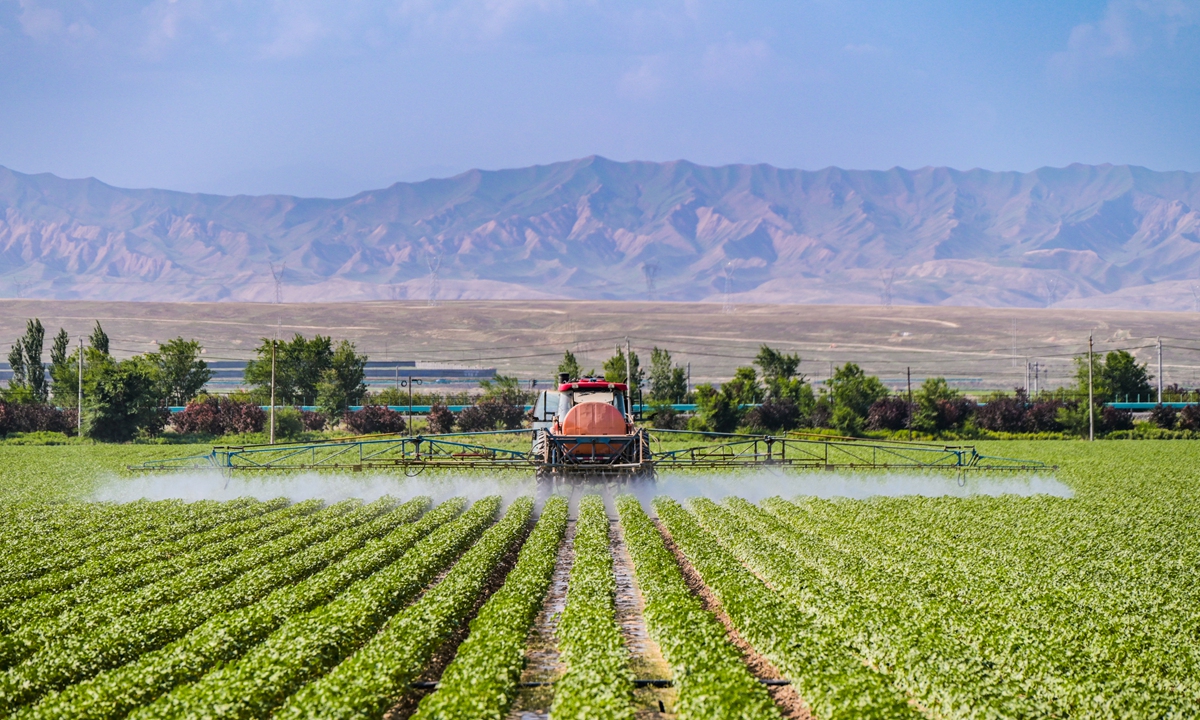
A farmer operates agricultural machinery to spray pesticides on cotton in Changji Hui Autonomous Prefecture in Northwest China's Xinjiang Uygur Autonomous Region on June 6, 2025. Photo: VCG
"Using the so-called allegations of 'forced labor' under the pretext of human rights, some disregarded facts, acted recklessly, and flagrantly trampled on international law and international trade rules. They engaged in political manipulation and economic bullying, attempting to use Xinjiang-related issues to contain China and hinder China's development. We firmly oppose this and will resolutely fight against it," Wang Kuiran, deputy to the 14th National People's Congress (NPC) and Secretary General of the people's government of Northwest China's Xinjiang Uygur Autonomous Region, said at the ongoing "two sessions."
The comments were made in response to a question about whether legislation introduced by certain countries to sanction certain Xinjiang-related enterprises and individuals would affect the region's development and how the local government plans to respond during a plenary meeting of the Xinjiang delegation to the fourth session of the 14th NPC at the Great Hall of the People in Beijing on Friday.
History has repeatedly shown that China has always moved forward by overcoming obstacles and has grown stronger through tackling difficult challenges.
At the early stage of being sanctioned, some export-oriented enterprises faced blocked exports, suffered profit losses, and saw reduced employment, leading to certain difficulties and problems, he said.
However, people know that our development has never depended on anyone's charity, nor do we fear any unreasonable suppression, Wang made the remarks during the meeting on Friday.
This reflects the resolve, integrity, and confidence that is deeply rooted in the history of the Chinese people - qualities that have forged our resilience to grow stronger under pressure, he said.
In recent years, a number of Western countries, led by the US, have imposed sanctions on businesses and individuals related to Xinjiang on the account of "genocide" and "forced labor" - lies and absurd fallacies they have concocted to interfere in China's internal affairs, according to a white paper titled "CPC Guidelines for Governing Xinjiang in the New Era: Practice and Achievements" released in September 2025.
China has promulgated relevant laws, regulations, and departmental rules, such as the Foreign Relations Law, the Anti-Foreign Sanctions Law, the Provisions on the Application of the Anti-Foreign Sanctions Law, and the Provisions on the Unreliable Entity List, taking countermeasures against the unjustified sanctions involving Xinjiang imposed by a mere handful of countries, the white paper said.
The Standing Committee of the People's Congress of the Xinjiang Uygur Autonomous Region has adopted a resolution opposing a series of US sanctions on Xinjiang and supporting the development of sanctioned enterprises and related industries, fighting back against unilateral sanctions by the US, the white paper noted.
In addition, the government has provided a range of services for sanctioned businesses, supported them in safeguarding their legitimate rights and interests in accordance with the law, given a boost to relevant industries, and created new employment opportunities for people affected by the sanctions.
Last year, Xinjiang's yarn output increased by more than 20 percent, fabric production rose by 36 percent, investment across the entire industry grew by 35 percent, and the value added of large-scale industrial enterprises increased by 23.6 percent, Wang said.
At the same time, 46,800 new jobs were created. Not long ago, we also studied and formulated a medium- and long-term development plan for Xinjiang's textile and garment industry, laying a solid foundation for our next steps and continued efforts, Wang added.
RELATED ARTICLES