ARTS / BOOKS
Humanity beyond AGI: Renowned author Mai Jia prescribes ‘screen-free deep reading’ as antidote to tech addiction
Humanity beyond AGI
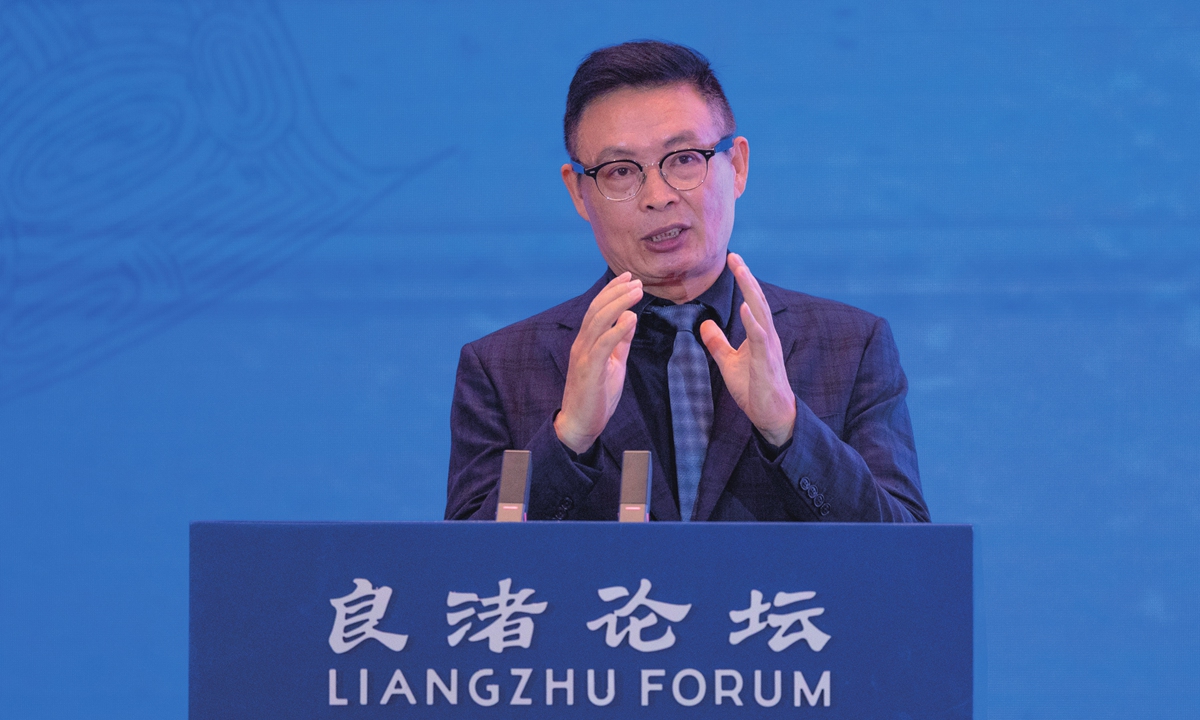
Mai Jia Photos: VCG
Editor's Note:Cultural thoughts and spiritual pursuits are vital for a society's progress. The Global Times has launched the "Voices from the Study" series dedicated to in-depth intellectual dialogues with distinguished scholars from the humanities and social sciences to explore cultural topics with fresh perspectives and contemporary relevance.
In this inaugural edition, Mai Jia, vice-chairman of the China Writers Association, shares his observations concerning the future relationship between AI and reading, the need for deep reading and why books remain irreplaceable.
Imagine being stranded on a desert island, no Wi-Fi, no gadgets, no one to talk to. What's one thing you would grab to keep your mind sharp, your spirit from fading? A toy to pass the time? Or… a book?
The answer, according to Chinese author Mai Jia, lies in one simple truth: A book is the most convenient tool to sustain your spiritual self and keep your brain active. You can read it over and over again, for a month or even months, and still uncover something new every time.
In 2026, a year widely hailed by tech icons like Elon Musk as a pivotal year for Artificial General Intelligence (AGI), that question feels more urgent than ever. If AI can write novels, dissect literary classics, and even mimic human emotion, do we still need to read deeply at all?
Mai's reply was clear: That is to embrace technological progress, but never surrender the unique human capacities that define the human spirit.
"Once originality and innovation are lost, one will eventually lose their own voice and become a puppet of technology," Mai told the Global Times.
The year 2026 also saw the implementation of the National Reading Promotion Regulation on February 1. It was against this backdrop that he, as a deputy to the National People's Congress, put forward a proposal during this year's "two sessions" to build "screen-free deep reading spaces" in schools and communities.

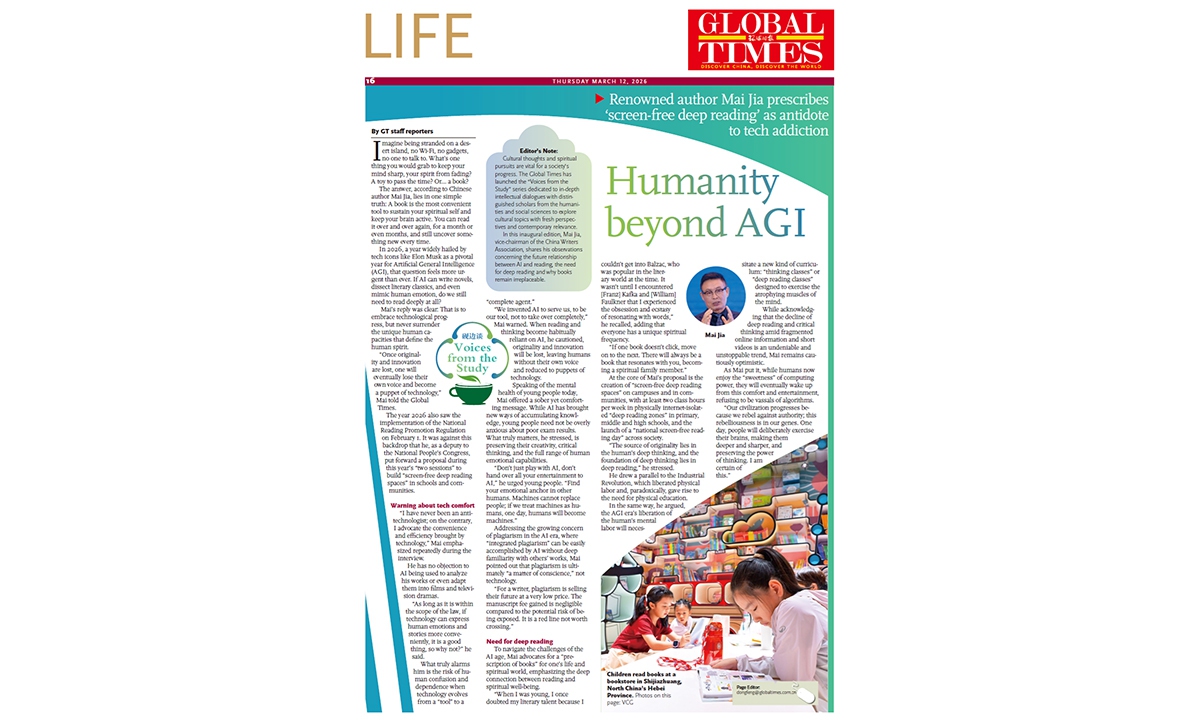
Children read books at a bookstore in Shijiazhuang, North China's Hebei Province.
Warning about tech comfort"I have never been an anti-technologist; on the contrary, I advocate the convenience and efficiency brought by technology," Mai emphasized repeatedly during the interview.
He has no objection to AI being used to analyze his works or even adapt them into films and television dramas.
"As long as it is within the scope of the law, if technology can express human emotions and stories more conveniently, it is a good thing, so why not?" he said.
What truly alarms him is the risk of human confusion and dependence when technology evolves from a "tool" to a "complete agent."
"We invented AI to serve us, to be our tool, not to take over completely," Mai warned. When reading and thinking become habitually reliant on AI, he cautioned, originality and innovation will be lost, leaving humans without their own voice and reduced to puppets of technology.
Speaking of the mental health of young people today, Mai offered a sober yet comforting message. While AI has brought new ways of accumulating knowledge, young people need not be overly anxious about poor exam results. What truly matters, he stressed, is preserving their creativity, critical thinking, and the full range of human emotional capabilities.
"Don't just play with AI, don't hand over all your entertainment to AI," he urged young people. "Find your emotional anchor in other humans. Machines cannot replace people; if we treat machines as humans, one day, humans will become machines."
Addressing the growing concern of plagiarism in the AI era, where "integrated plagiarism" can be easily accomplished by AI without deep familiarity with others' works, Mai pointed out that plagiarism is ultimately "a matter of conscience," not technology.
"For a writer, plagiarism is selling their future at a very low price. The manuscript fee gained is negligible compared to the potential risk of being exposed. It is a red line not worth crossing."
Need for deep reading
To navigate the challenges of the AI age, Mai advocates for a "prescription of books" for one's life and spiritual world, emphasizing the deep connection between reading and spiritual well-being.
"When I was young, I once doubted my literary talent because I couldn't get into Balzac, who was popular in the literary world at the time. It wasn't until I encountered [Franz] Kafka and [William] Faulkner that I experienced the obsession and ecstasy of resonating with words," he recalled, adding that everyone has a unique spiritual frequency.
"If one book doesn't click, move on to the next. There will always be a book that resonates with you, becoming a spiritual family member."
At the core of Mai's proposal is the creation of "screen-free deep reading spaces" on campuses and in communities, with at least two class hours per week in physically internet-isolated "deep reading zones" in primary, middle and high schools, and the launch of a "national screen-free reading day" across society.
"The source of originality lies in the human's deep thinking, and the foundation of deep thinking lies in deep reading," he stressed.
He drew a parallel to the Industrial Revolution, which liberated physical labor and, paradoxically, gave rise to the need for physical education.
In the same way, he argued, the AGI era's liberation of the human's mental labor will necessitate a new kind of curriculum: "thinking classes" or "deep reading classes" designed to exercise the atrophying muscles of the mind.
While acknowledging that the decline of deep reading and critical thinking amid fragmented online information and short videos is an undeniable and unstoppable trend, Mai remains cautiously optimistic.
As Mai put it, while humans now enjoy the "sweetness" of computing power, they will eventually wake up from this comfort and entertainment, refusing to be vassals of algorithms.
"Our civilization progresses because we rebel against authority; this rebelliousness is in our genes. One day, people will deliberately exercise their brains, making them deeper and sharper, and preserving the power of thinking. I am certain of this."
RELATED ARTICLES