US economic policies toward other countries prove costly

A view of the skyline in Manhattan, New York. Photo: VCG
The most consistently intractable problems facing the US today are economic. The current policy of global tariff imposition yields troubling results. It will not generate nearly enough revenue to reduce US budget deficits. Indeed, the budget for the US newly renamed Department of War contains a spending increase of $600 billion. That alone will worsen US deficits significantly - several times larger than estimates of what the new US tariff regime will yield annually. Similarly, projected savings from Elon Musk's Department of Government Efficiency (DOGE) fell far short of the department's own inflated estimates. In short, the recent years of record trillion-dollar budget deficits are not being corrected.Included among the many nations protesting and retaliating against US tariffs are also opponents of other key US foreign economic policies. Chief among them are the planned US takeover of Greenland, the reorganization of Venezuela's oil industry and oil trade, efforts to retake control of the Panama Canal and moves to force major changes in the Mexican and Canadian economies. The list also includes actions targeting Iran - not only over oil but also over broader ambitions in the Middle East.
Self-protection is the evident shared theme of those nations' responses. For example, the European Union signed a new trade agreement with Mercosur in Latin America, and China has reached new trade arrangements with Canada, Germany, France and the UK. Those deals will reshape the global economy.
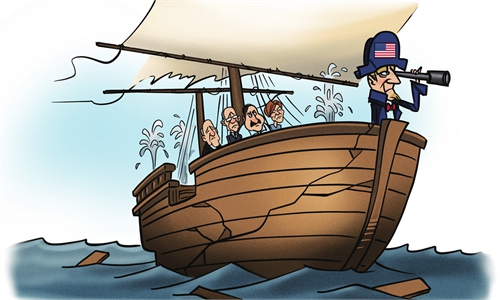
US policies suggest a certain desperation accompanying the decline of its global reach. In public, that decline is mostly ignored or denied by leading figures in politics, business, the mass media and academia. The few voices that acknowledge the decline are not well-known to the general public. What is allowed and even favored is a differently inflected discourse in which the US is portrayed as a nation victimized and cheated by other nations economically. Furthermore, any admitted US economic difficulties are then blamed on those other nations being "aggressive," with China singled out in particular.
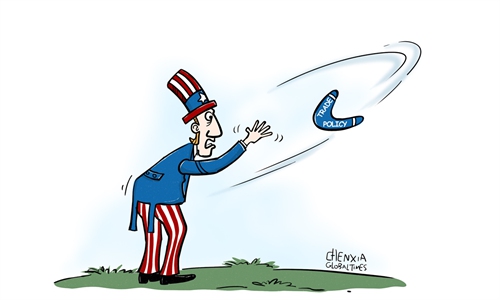
Regardless of how US economic policies toward other countries are depicted in US mainstream discourse, they have proved very costly to the US. Indeed, those costs threaten to exceed whatever gains US policies may achieve. The debate has begun about whether current policies worsen rather than solve its economic problems.
The rise of China and other BRICS countries both offsets and underscores the decline of the US and what remains of the G7 alliance. One statistic captures this momentous change: The combined GDP of the G7 is roughly 28 percent of world GDP, while BRICS accounts for about 35 percent. The GDP total for the G7 has been lagging that of the BRICS by increasing amounts for many years. The broad picture becomes clearer each day. One historical epoch is fading as another emerges.
We are at a social inflection point where change shifts from slow to fast, from quantitative to qualitative. Trying to hold all this back drives current moves toward political authoritarianism in many Western capitalist societies. But it may well be too late for such authoritarianism. These societies have inherited too many overlapping problems accumulated during the period of US hegemony after 1945, and now they have too little in the way of real options to solve them.
Various kinds of socialism, infused with different nations' histories and characteristics, are emerging and rebuilding around the world, including within the US itself. Many are preparing alternatives to today's authoritarian efforts to hold back historic change. These socialist self-developments often entail renewed commitments to democracy not only in politics but also in economics, including the democratization of the internal organization of enterprises (factories, offices and stores).
Socialists are becoming champions of democracy just as capitalism's self-preservation pushes it toward authoritarianism. Socialist movements respond to their own histories by moving more toward democracy, while capitalist systems respond to theirs by shifting toward more authoritarian social structures. These ironies of modern history not only reflect a profound period of change, full of abundant dangers, but also present historic opportunities for a new and better world.
The author is an American economist and professor emeritus of economics at the University of Massachusetts Amherst. opinion@globaltimes.com.cn
RELATED ARTICLES