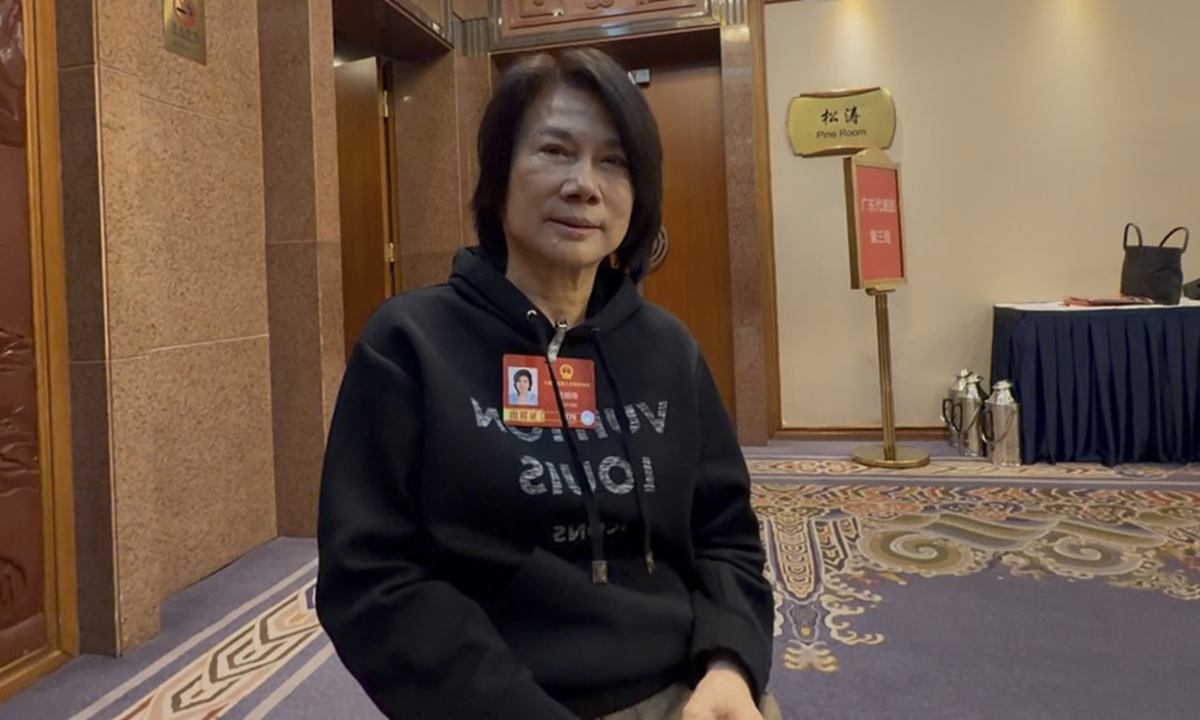
Dong Mingzhu, an NPC deputy and president of Gree Electric Appliances Photo: Chen Qingqing/GT
Multiple deputies to the 14th National People's Congress (NPC) and members of the 14th National Committee of the Chinese People's Political Consultative Conference (CPPCC) have made suggestions regarding how artificial intelligence could be developed, applied, and integrated to boost the country's development during this year's two sessions.At this year's two sessions of China's top legislature and top political advisory body, the government work report, submitted to the national legislature for deliberation, for the first time calls for creating new forms of "smart economy," Xinhua News Agency reported.
Zhou Li'an, a member of the 14th CPPCC National Committee and a professor at Peking University's Guanghua School of Management, told Xinhua that the phrase "smart economy" reflects a profound shift in how AI is positioned in policy thinking. "The idea of a smart economy suggests that AI itself is increasingly becoming a foundational element of the economic system, shaping how resources are allocated, industries organized, and services delivered," he noted.
On AI, the government work report said that China will advance and expand its "AI Plus" initiative, promote faster application of new-generation intelligent terminals and AI agents, and encourage large-scale commercial application of AI in key sectors and fields.
In an interview with the Global Times, Dong Mingzhu, an NPC deputy and president of Gree Electric Appliances, said that AI should only be regarded as a tool, and there is no need to exaggerate claims like "AI will replace humans" to create anxiety, and that any AI technology must ultimately be applied to the real economy.
"As technology upgrades in the future, there will be many uncertainties. But I believe that any AI technology or internet technology must ultimately be applied to the real economy. For example, without CNC machine tools or production lines, what use is AI? Therefore, we must focus on solidly applying technology to production and quality control," Dong explained. She noted that Gree Electric Appliances' factories have already achieved full automation, with production entirely handled by robots.
Dong told the Global Times that she views AI primarily as a tool. "If you say AI changes or replaces humans, that might only apply to certain moments or specific processes. Many things still need to be created by humans."
She gave an example: "I once asked a large AI model many questions. It answered quickly and quite accurately because it gathered information from the internet. But when we asked about things that haven't been made public yet, it knew nothing."
"Therefore, I believe AI enhances the convenience of our production and daily life—it is a relatively precise tool. But do we have to exaggerate to the point of saying 'AI will replace humans,' making young people feel anxious? I don't think so," Dong said.
Qiao Hong, a member of the 14th CPPCC National Committee and Director of the National Key Laboratory of Multimodal AI Systems, and Academician of the Chinese Academy of Sciences, told the Global Times that humanoid robots are also a key carrier of new quality productive forces.
Speaking about their transformative role across various fields, Qiao said that "robots can not only replace humans in doing dangerous and heavy work but also play significant roles in areas such as intelligent manufacturing, agricultural production, home services, and emergency rescue."
Taking emergency rescue as an example, she explained that future humanoid robots adapted to hazardous environments involving high temperatures, water immersion, or toxic conditions could be equipped with various detection devices to assist in searching for and rescuing trapped individuals and delivering emergency supplies.
In household settings, robots could undertake tasks such as cleaning, companionship, and elderly care assistance, alleviating the nursing pressure brought by an aging population. In the industrial sector, humanoid robots are expected to achieve versatile operations across multiple scenarios, driving the upgrading and transformation of manufacturing, according to Qiao.
Guo Yufeng, also a member of the 14th CPPCC National Committee and deputy general manager of Phytium Technology Co, said that AI should not be confined to customer service chatbots or simple image recognition. Instead, it must be deeply integrated into sectors such as the core processes of industrial manufacturing and core financial risk-control algorithms to truly reshape production methods.
The success of AI application should not be measured by the number of data centers built, but by whether it helps factories reduce costs and increase efficiency, and whether it makes people's lives more convenient. It must create measurable commercial value and social benefits, Guo told Economic Daily.
Essentially, Guo emphasized that whether it is deepening and expanding "AI+" to promote commercial, large-scale applications of AI in key industries, or improving AI governance, the ultimate goal is to seize the initiative in development and support Chinese modernization with high-level technological self-reliance and self-strengthening.
RELATED ARTICLES