Chinese scientists uncover first evidence of magma recharge on the moon 3 billion years ago
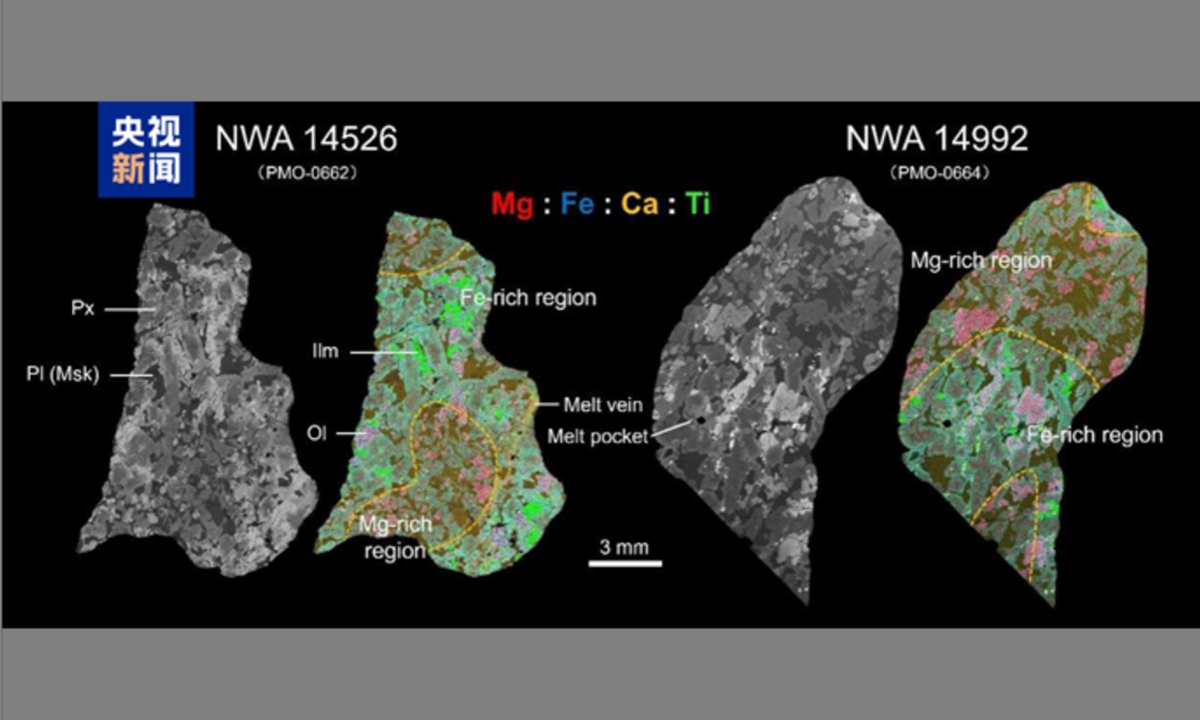
Backscattered electron images and X-ray elemental mapping images of lunar meteorites NWA 14526 and NWA 14992. Photo: Screenshot from CCTV News.
A research team of the Purple Mountain Observatory (PMO) of the Chinese Academy of Sciences recently studied two lunar meteorites, revealing for the first time a magma recharge event on the moon about 3 billion years ago. The finding provides evidence for the moon's late-stage thermal evolution, China Central Television (CCTV) reported on Thursday.
The research was recently published in the international academic journal Geochimica et Cosmochimica Acta.
Young mare basalts are key targets for studying volcanic activity during the moon's later history. Scientists have generally believed that since the moon formed, basaltic magma activity in its interior has mainly involved simple crystallization, lacking the dynamic processes commonly observed in magma chambers on Earth. Using analytical techniques such as scanning electron microscopy and electron probe microanalysis, the research team conducted a detailed investigation of two lunar meteorites - NWA 14526 and NWA 14992 - which were discovered in 2021.
The results show that the two meteorites are highly consistent in petrographic structure, mineral composition, geochemical characteristics and crystallization age, indicating that they form a paired set. Both samples also exhibit a unique lithological dichotomy, consisting of magnesium-rich and iron-rich lithologies. The research team believes this rare lithological dichotomy was driven by magma recharge.
Based on these findings, the researchers proposed a co-genetic magma recharge model. About 3 billion years ago, magnesium-rich magma that had intruded earlier from the moon's interior partially crystallized within a magma chamber. Later, a relatively iron-rich, more evolved magma was injected, mixing and reacting with the earlier magma and ultimately producing the coexistence of the two lithologies.
This marks the first time that a magma recharge process has been clearly identified in lunar samples worldwide.
The results suggest that although the moon experienced a long period of gradual cooling and progressively lost its geological "vitality," its interior may still have sustained a dynamic magmatic system during the late stage of its evolution around 3 billion years ago.
Complex processes such as magma recharge and mixing could still have occurred, indicating that the magmatic evolution of the moon in its "middle age" and even "old age" was far more complex and prolonged than previously thought.
Global Times
RELATED ARTICLES