Photo: VCG
Editor's Note:"China speed" means more than bullet trains racing across the landscape. It reflects a different way of working - more efficient, more daring and more focused. More than a measure of pace, it is proof of what a determined nation can achieve. The Global Times invites foreign observers from different countries and regions to share their personal experience of the "China speed."
Fernando Munoz Bernal, a reporter at Alianza Informática Latinoamericana (AIL) based in Dongguan
News stories often frame China's technological growth as a fierce global "competition." We hear about "China speed" - the drive for electric vehicles and solar power, and the race to lead in AI, robotics and chip manufacturing.
However, after 25 years of working and traveling in China, I've noticed that the real impact of modernization isn't just found in official reports. It's in the way many small hassles have quietly disappeared. It doesn't feel like a "competition"; it feels like modernization is making life easier.
China has built the world's largest and most advanced 5G network. By 2025, official data showed there were over 4.83 million 5G base stations, laying the groundwork for this connected way of life. This network isn't just fast; it's everywhere and built for a reason. 5G, fiber broadband, and mobile IoT are not just extras - they are the basic "information arteries" of the economy and society, as important as roads or electricity. That's why I can buy Hami melons from a farmer livestreaming in Northwest China's Xinjiang Uygur Autonomous Region, pay for parking with the same card I use on the highway, start the water heater and air conditioner at home before I open the door, and take a robotaxi that's often cheaper and safer than a regular cab.
One of the biggest changes is how people deal with the government. If you need to renew your driver's license, notarize a document or register property, you can go to a citizen service center where everything is handled in one place, often in just minutes. Most government services are also available through simple official apps. This shows how much digital technology has changed things.
China has set clear, ambitious goals to continue improving this transformation. These aren't just broad hopes; they are specific targets aimed at improving citizens' lives. Whether it's medical apps that help book your blood test and send results straight to your doctor or high-speed rail gates that scan your ID instead of a paper ticket, the pattern is clear: It's all about removing obstacles.
I often say that tools alone don't make art; it's the person using them. In China, I've seen a careful and thoughtful use of modern tools like AI, big data and constant connectivity to shape an environment that fits real life. These changes keep us safe and make daily life run more smoothly. This is truly "China speed" as a service, and for those living here, that's what really counts.
Pierre Picquart, an expert in geopolitics and human geography from the University of Paris-VIII
I first arrived in China in 2000. The country was already in motion. Skylines were rising, reforms were reshaping cities and a palpable energy suggested a society preparing for something larger. Yet what I observed then still felt like a gradual transformation.
The 2008 Olympic Games served as a catalyst. Not everything was complete in 2008, but enough had been achieved to demonstrate a remarkable capacity for coordination and execution. Beyond the stadiums, it was the infrastructure - transport networks, logistics, urban redesign - that revealed the depth of the transformation. The Olympic Games were not merely a global event; they were a national synchronization point.
What impressed me most was the collective dimension of this acceleration. Engineers, workers, planners and citizens alike seemed engaged in a shared momentum. Construction was perceived as participation in a broader national trajectory. One sensed a quiet but visible pride - a country conscious of its civilizational depth demonstrating its ability to translate heritage into modern capability.
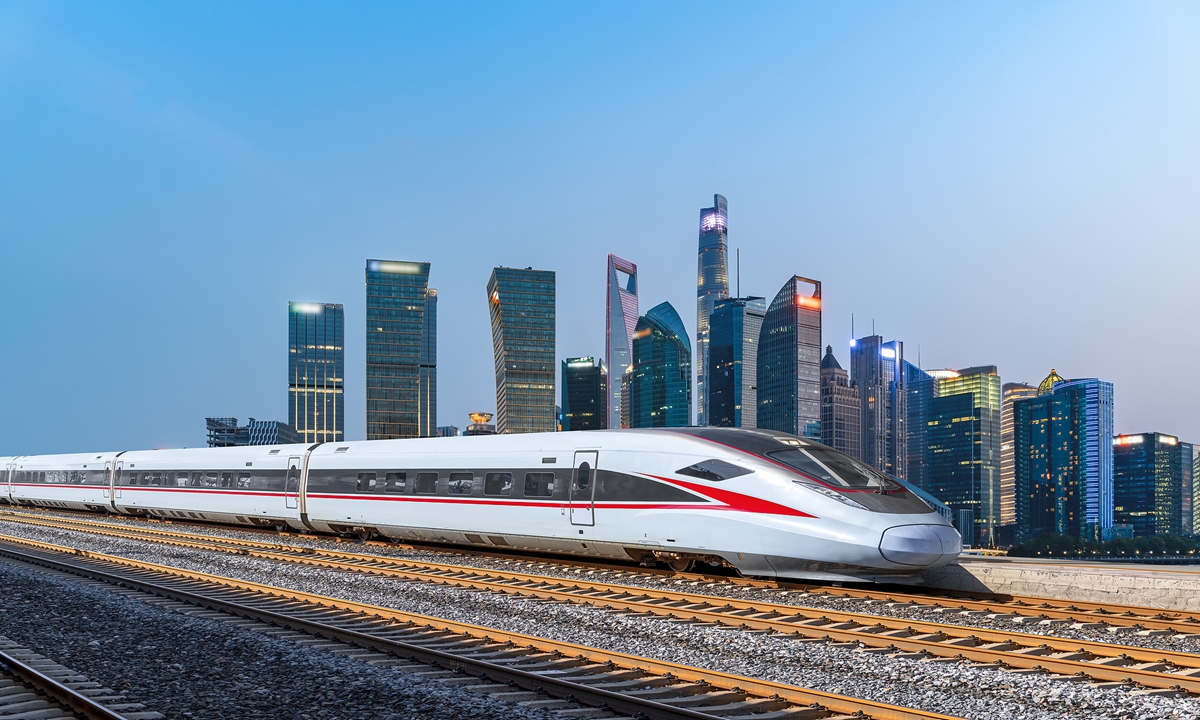
After 2008, the acceleration did not fade. The high-speed rail network expanded across provinces, regional airports multiplied and highways connected once-distant regions. In just over a decade, mobility across China had been fundamentally reshaped. Distances shrank not only physically but psychologically.
In the 2000s, China faced a historical moment. Rapid urbanization, industrial expansion and the urgency of modernization created conditions for concentrated acceleration. The Olympic milestone crystallized that momentum, but the deeper dynamic lay in a convergence of ambition, planning capacity and collective mobilization. "China speed" is not simply about building quickly. It reflects a particular alignment of historical timing and national determination.
To acknowledge this is neither to idealize nor to compare hierarchies of models. It is to recognize that, at certain moments, a nation may enter a phase of synchronized acceleration.
In the years leading to 2008, I had the impression that I was witnessing precisely such a moment - when infrastructure became both a tool of development and a symbol of confidence.
Speed, ultimately, is not only technical. It is historical.
Christine Susanna Tjhin, director of Strategic Communication and Research at the Gentala Institute, Indonesia
The excitement during my first ride on the Jakarta-Bandung High-Speed Railway in 2024, known as Whoosh, far surpassed the thrill of my first high-speed trip on the Beijing-Tianjin Railway in 2010. I used to wonder when Indonesia would have this system. The answer came in 2023, to the astonishment of many.
Glancing at the 350 km/h display above the automatic door, I reveled quietly that the comfortable 153 km journey would take a mere 40 minutes. Normally, it takes 2-4 hours by car or bus or 3 hours by the Parahyangan Train.
Scanning a QR code for coffee at Indomaret before boarding Whoosh, I reminisced about the surprising convenience of transitioning from debit cards and bank tokens to WeChat Pay for the first time over a decade ago. China's fintech industry soared by the mid-2010s: Alipay and WeChat handle trillions of transactions yearly, seamlessly integrating everything from banking, dining, shopping, utility payments to bike sharing. The shift to a cashless lifestyle was almost effortless and instant. My smartphone became my wallet. Moreover, facial recognition has further redefined convenience.
In Indonesia, there is sometimes a sense of delayed comfort and disconnection compared to my experiences in China. I often miss Taobao and Pinduoduo when using Tokopedia and Shopee. Though popular, they lack more advanced filters and search engines, superfast delivery with real-time courier tracking, Cainiao driverless delivery vehicles and drones, smart lockers for 24/7 simple and secure access, as well as consumer-friendly services, such as AI-driven dispute settlements, a seven-day unconditional return policy, instant refunds and cash returns for recycling packages.
"China speed" in itself is immensely impressive, but it would bring even greater meaning when it is also felt in China's engagement with the world. Of all the "China speed" stories, the fintech revolution is a strategic one that will reshape the region's digital and green tech landscape.
In 2025, a landmark MOU was signed between the central banks of Indonesia and China, aiming to integrate QRIS (Indonesia's national QR standard) with China's extensive network. QRIS, which has nearly 60 million users, over 40 million merchants and is accessible in major ASEAN cities, can soon join China's fintech linkages with six other ASEAN states - gradually creating an integrated digital payment ecosystem and empowering the 2-billion-strong China-ASEAN market.
RELATED ARTICLES