Iran, Ukraine involved in bitter dispute as Kiev reportedly offers anti-drone expertise to US, Gulf allies
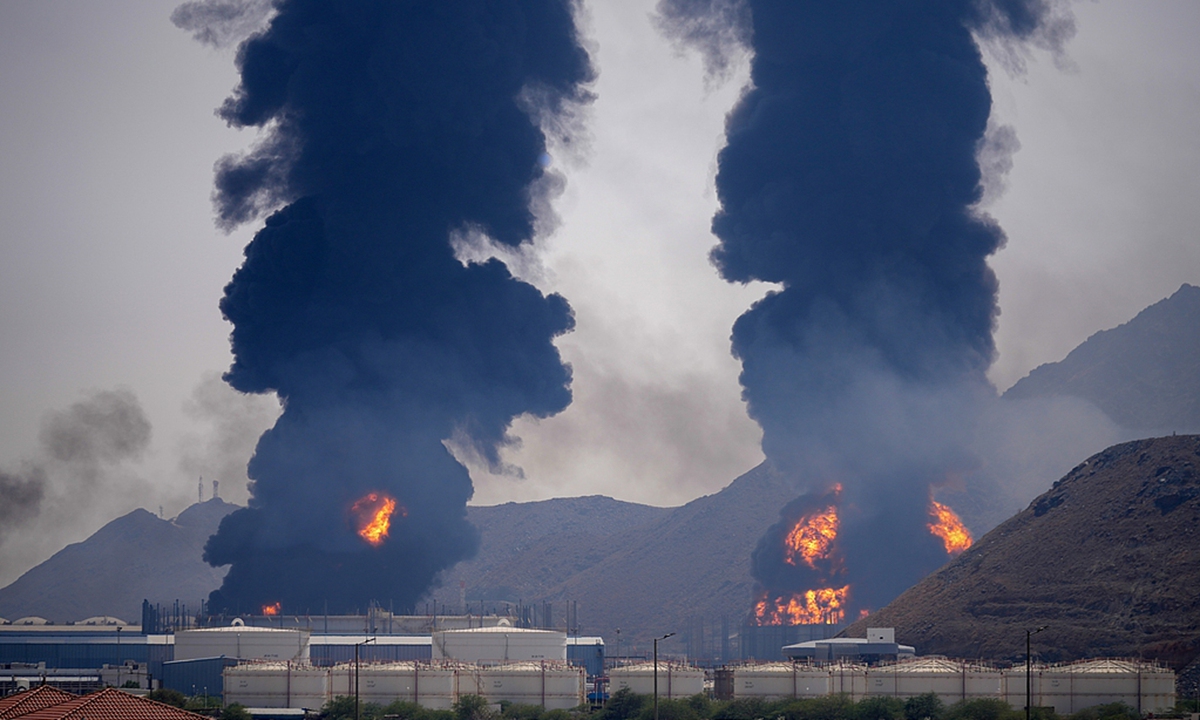
Plumes of smoke and fire rise after debris from an intercepted Iranian drone struck an oil facility, according to authorities, in Fujairah, United Arab Emirates on March 14, 2026. Photo: VCG
While the conflict between the US, Israel and Iran has continued to draw global attention, a bitter dispute has erupted between Iran and Ukraine over Kiev's offer to share anti-drone expertise in the Middle East.
Iranian officials on Saturday local time accused Ukraine of playing the "Iran card" to obtain more resources from the West, warning that Ukraine has now become a legitimate target for Iranian strikes, which followed reports that Ukraine had sought to help US forces and their allies in the Middle East with its anti-drone technology and expertise - an offer Washington reportedly dismissed as unnecessary.
"By providing drone support to the Israeli regime, failed Ukraine has effectively become involved in the War and, under Article 51 of the United Nations Charter, has turned its entire territory into a legitimate target for Iran," Ebrahim Azizi, head of Iran's parliamentary committee on national security and foreign policy, posted on social media platform X on Saturday local time.
His comments came after Ukrainian President Volodymyr Zelensky earlier this month offered to help US forces and their allies in the Middle East with intercepting Iranian drones, using the Ukrainian military's experience with shooting down Russian drones, NBC News reported.
In a post on X late Friday, Zelenskyy wrote: "Countries in the Middle East have reached out to us, asking to share our expertise in intercepting Iranian 'shahed' drones during massive strikes. That is why we have already sent expert teams to three countries."
Shahriar Amouzegar, Iran's envoy to Ukraine, condemned the move, which involved the claim that experts had already been sent to Gulf states, according to the AFP on Saturday.
Kiev had "played the 'Iran card' in order to obtain more resources from the West," Amouzegar was quoted by the AFP as saying.
According to the BBC News on March 6, Zelenskyy suggested, in particular, that Ukraine would be willing to swap its interceptor drones for more US Patriot air defenses to protect against Russian ballistic missiles.
Per BBC, Zelensky said the US has asked Ukraine for help defending Gulf allies against Iranian drones. Asked about the Ukrainian offer, Trump said: "I'll take any assistance from any country."
However, US President Donald Trump told Fox News radio on Friday that his country didn't need Ukraine's help in drone defense, contradicting statements from Zelensky that the US had asked for help, according to the AFP.
If Ukraine involved itself in the Middle East and Iran were to open a direct front against Ukraine, it could lead to convergence of the two theaters, potentially expanding the overall scale of the warfare, Song Zhongping, a Chinese military affairs expert, told the Global Times on Sunday.
The conflict in the Middle East has diverted Washington's attention from a peace deal, according to four EU diplomats involved in talks with Ukraine, reported the Financial Times on Sunday.
Song said that in the context of the current Russia-Ukraine talks, Zelensky's move is essentially an attempt to maintain US attention and garner more Western resources.
"However, by attempting to involve Ukraine in Middle East conflicts, he risks turning the country into an active participant in a wider conflict," said Song.
The expert said that if the conflict in Ukraine and the Middle East were to become intertwined, the likely outcome would be an expansion in both the scale of the conflict and the geographical scope of the battlefield, bringing greater tragedy. For this reason, such escalatory actions are seen as undesirable, as they risk further damaging regional and global peace.
RELATED ARTICLES