Multiple Chinese regions launch spring recruitment events; talent in cutting-edge technology fields in high demand
By Published: Mar 15, 2026 10:01 PM

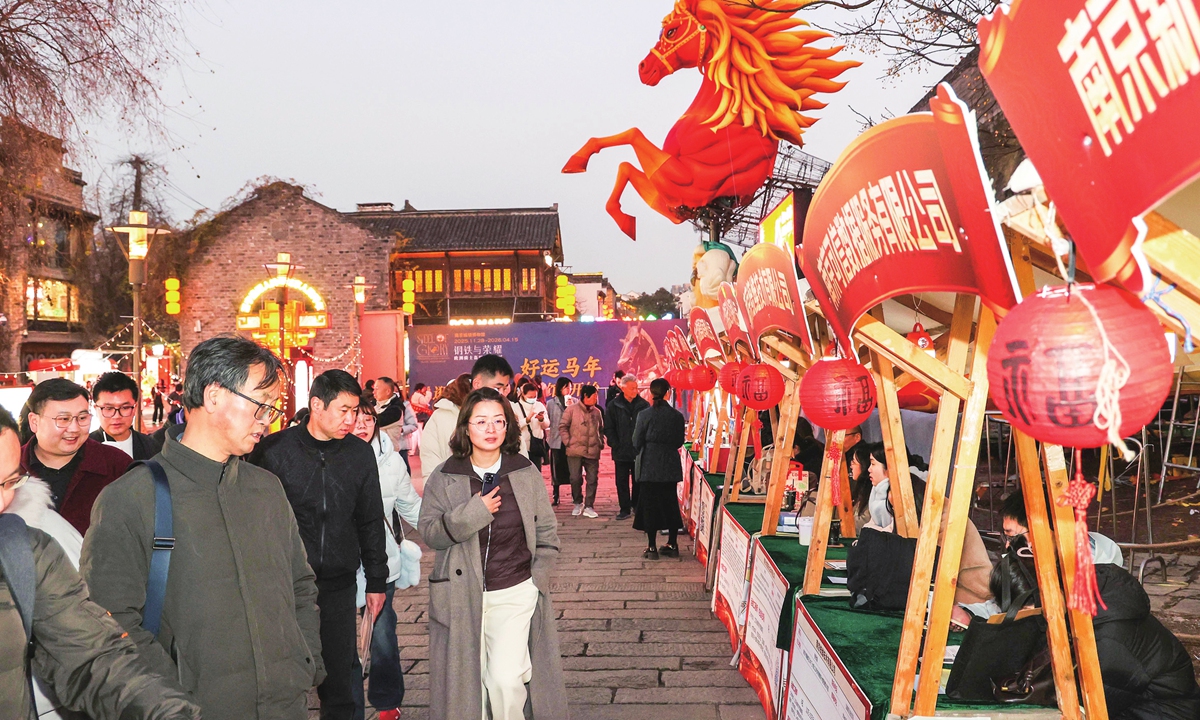
Job seekers browse stalls at the first talent night market of the new year in the Confucius Temple scenic zone in Nanjing, East China's Jiangsu Province on January 9, 2026. The event featured five sections, including technological innovation, manufacturing and public services, with more than 50 companies offering over 1,000 job openings. Photo: VCG
As the peak spring recruitment season gets underway, localities across China are ramping up efforts to connect workers with employers through a series of job fairs, with emerging roles in robotics, artificial intelligence (AI), and new energy commanding attention.
In a major push in Guangzhou, South China's Guangdong Province, a large job fair kicked off on Sunday. The two-day event boasts participation from more than 1,800 high-quality enterprises and institutions, offering more than 70,000 job vacancies, the Guangzhou Daily reported on Sunday.
A dedicated pavilion at the fair is targeting key new quality productive forces sectors, including prominent AI and robotics zones, as well as an intelligent home appliances and equipment manufacturing zone.
At a job fair held at Nanjing Tech University in East China's Jiangsu Province, 100 enterprises offered 1,393 job positions. The event attracted students, resulting in 740 preliminary employment intentions. The recruitment drive focused on fields aligned with the university's academic strengths, including integrated circuits, new materials, intelligent manufacturing, and biomedicine, CCTV News reported on Saturday.
On Friday, Zhengzhou, Central China's Henan Province held a "Spring Breeze Action" campaign, providing more than 4,500 positions from more than 100 companies. Targeting young graduates and skilled professionals, the fair featured enterprises in sectors such as medical equipment, cross-border e-commerce, telecommunications, and equipment manufacturing, according to CCTV News.
Notably, emerging professions such as AI animation storyboard artists, drone operations and maintenance specialists, and cross-border e-commerce operators were particularly popular among job seekers.
Data from Zhaopin, an online recruitment platform in China, highlighted significant talent shortages in cutting-edge technical fields.
Currently, the demand-to-supply ratio for robotics technology positions stands at 5.2:1. Demand remains high across the robotics sector, from body manufacturing and core component research and development to system integration and debugging maintenance. Furthermore, versatile talent proficient in multiple core skills remains scarce, the platform said.
Another position with insufficient talent supply is new-energy technology engineer, with a demand-to-supply ratio of 5.1:1, second only to robotics technology. The demand-to-supply ratio for AI technology positions is 3.5:1. The AI field has a long talent development cycle and rapid technological iteration, so the supply gap will continue in the short term.
This situation reflects economic development and technological progress, demonstrating that scientific and technological advancement is playing an increasingly significant role in the national economy, Li Chang'an, a professor at the Academy of China Open Economy Studies under the University of International Business and Economics, said on Sunday.
He added that this aligns with the national strategy, as strong demand for technical talent is driving the transformation and upgrading of employment.
The outline of the 15th Five-Year Plan (2026-30), adopted on Thursday, places the integration of technological and industrial innovation in a prominent position, aiming to move lab-born technologies onto factory floors to unlock trillion-yuan opportunities across sectors of the real economy, according to the Xinhua News Agency.
These high-value opportunities stem from the plan's designation of next-generation information technology, new energy, new materials, intelligent connected new-energy vehicles, robotics, biomedicine, high-end equipment and aerospace as strategic emerging industries for priority development.
China's emerging pillar industries are expected to break the benchmark of 10 trillion yuan ($1.45 trillion) by 2030, while frontier technologies are poised to mushroom into an entirely new high-tech sector over the next decade.
Specifically, many Chinese localities have been carrying out recruitment events under the nationwide "Spring Breeze Action" campaign to boost post-holiday employment.
A total of 22,000 job fairs have been organized across the country this year, CCTV News reported on March 2, citing data from the Ministry of Human Resources and Social Security.
These fairs have featured a total of 13 million job postings so far, with demand for labor being particularly strong in industries such as new energy, information technology, intelligent manufacturing and modern services, according to the report.
RELATED ARTICLES