Illustration: Chen Xia/GT
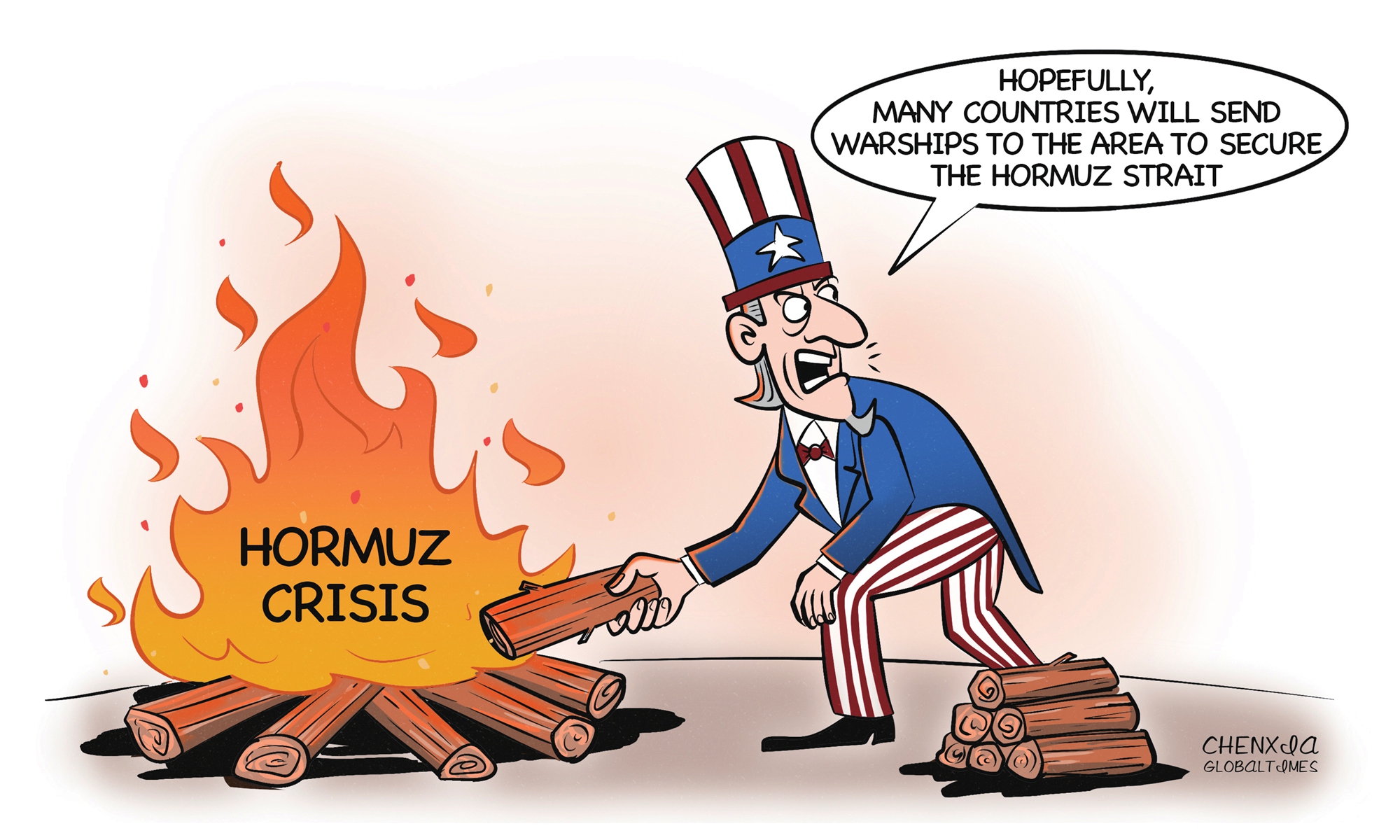
US President Donald Trump took to Truth Social to call on allies on Saturday - explicitly naming China, France, Japan, South Korea and the UK - to send warships to the Strait of Hormuz. His argument was straightforward: These countries depend on this waterway for their energy supplies, so they should share the responsibility for keeping it open.
The remarks made headlines. But they deserve a harder look. Is this really about "sharing responsibility" - or is it about sharing the risk of a war that Washington started and can't finish?
The Strait of Hormuz is barely 50 kilometers wide. But what it carries - energy, commerce and the fragile order of an entire region - is far heavier than any warship sailing through it. If Iran closes it, the damage won't be limited to the US. Every energy-importing nation would feel the pain. Shared stakes, shared burden - seems fair. But there is a fundamental problem with this framing: Who ignited the crisis in the Strait of Hormuz in the first place? Who is still bombing Iran?
The cause of the tension in the Strait of Hormuz is not a shortage of naval vessels, but rather an ongoing war.
Chinese Foreign Minister Wang Yi addressed this directly during phone calls with his counterparts from Kuwait, Bahrain, Pakistan and Qatar for exchanges of views on the situation in Iran. "This is a war that should not have happened - it is a war that does no one any good," he said, noting that "without the UN's authorization, the US and Israel attacked Iran in the process of the ongoing US-Iran negotiation, which clearly violates international law." In other words, someone set the fire. Now they're asking the world to help put it out - and split the bill.
Crowding a volatile waterway with warships from multiple nations doesn't create security. It creates flashpoints. If any single vessel were struck, the consequences could rapidly spiral beyond anyone's control. This is less international cooperation "to keep the Strait open and safe" and more a carefully structured transfer of risk.
The Middle East issues have taught this lesson more than once: Military force can win battles. However, it cannot secure stability or build trust. Relying solely on military power risks deeper disorder and long-term instability.
From Iraq to Libya, from Afghanistan to Syria, every US-led military intervention came with promises of order and security. Each one left behind a deeper disorder. The crisis in the Strait of Hormuz today is not an isolated incident - it is the accumulated consequence of decades of policy choices, now reaching a boiling point. Iran's threat to close the Strait is, at its core, a last-resort deterrent. It is not Iran's preferred outcome. Iran's own oil exports pass through the same waters. If the war stops, the threat disappears.
Washington is asking who will send warships. Beijing is asking how to stop the war. The contrast in approach is sharp. This isn't just diplomatic tone - it's a fundamental difference in how the problem is understood, urging a shift toward diplomatic solutions instead of military escalation.
Foreign Minister Wang has also laid out China's principles for addressing the Iran situation. All sides should return to the negotiating table as quickly as possible, resolve differences through equal dialogue, and make efforts to realize common security, he said, highlighting the principle of promoting political settlement of hotspot issues. Wang called on major countries to act in the spirit of justice and righteousness, and contribute more positive energy to peace and development of the Middle East. Each of these principles speaks directly to what has gone wrong in this conflict.
One thousand warships cannot achieve what one negotiating table can. The security of the Strait of Hormuz does not depend on how many navies patrol it. It depends on whether the guns fall silent.
RELATED ARTICLES