US wants other countries, including China, to help keep Hormuz open; experts warn root cause of blockade lies in US-Israeli military operation
By and Zhang Yuying Published: Mar 15, 2026 11:27 PM

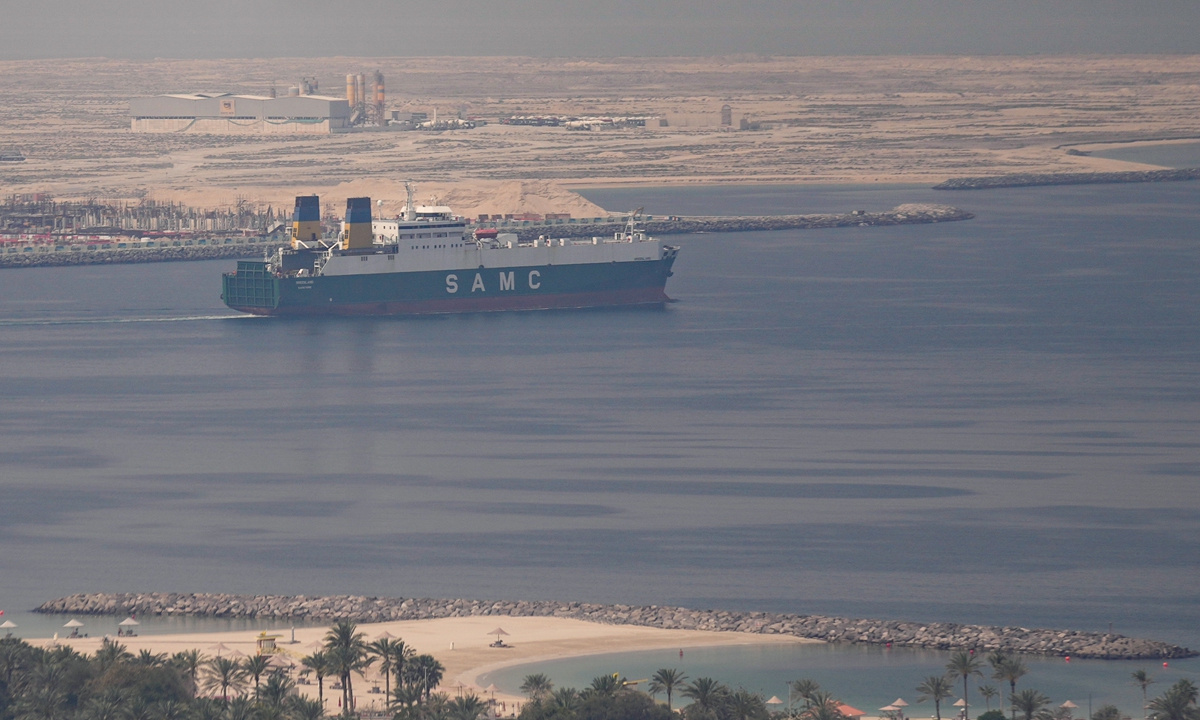
A cargo ship sails in the Arabian Gulf toward Strait of Hormuz, on March 15, 2026. Photo: VCG
The Strait of Hormuz, that slender 21-mile choke point where the Persian Gulf meets the open sea, has become the world's most expensive bottleneck as the war triggered by the US-Israeli attack against Iran progressed into the third week. Marking a new development to situation, US President Donald Trump in a social media post urged countries including China, the UK, France and Japan to deploy war ships to keep the strait "open and safe." This move drew sarcasm from Iran, with Iranian Foreign Minister commenting that "US is now begging others, even China, to help it make Hormuz safe."
Chinese observers noted that both the US and Iran have explicitly mentioned China. This may stem from each side's strategic considerations, they said. They also believed that Washington is distorting the logic of the issue by dragging more countries into the conflict as the root cause of the Hormuz blockade lies in the US-Israeli military operation against Iran.
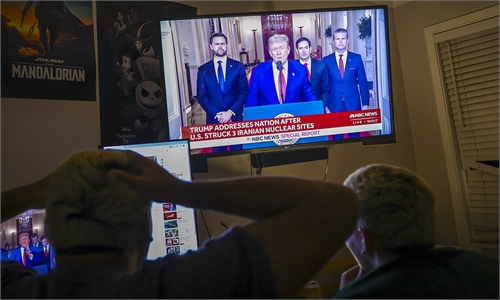
Trump wrote in a post on Truth Social on Saturday that "Many Countries, especially those who are affected by Iran's attempted closure of the Hormuz Strait, will be sending War Ships, in conjunction with the United States of America, to keep the Strait open and safe."
"Hopefully China, France, Japan, South Korea, the UK, and others" will send ships to the area, Trump claimed, adding that the US will be "bombing the hell out of the shoreline," and continually shooting Iranian boats and ships out of the water.
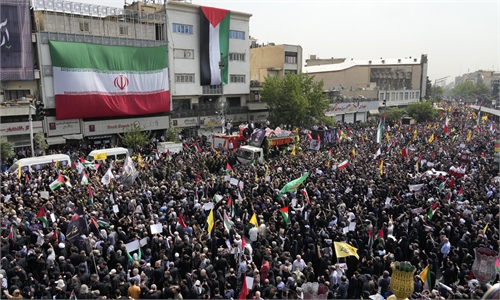
According to Al Jazeera, Iranian Foreign Minister Abbas Araghchi clarified that the strait was only closed to "tankers and ships of enemies and their allies," not all shipping, while Mohsen Rezaee, a member of Iran's Expediency Discernment Council, an influential body close to the supreme leader, said, "No American ship has the right to enter the Gulf."
And commenting on Trump's call, Araghchi, in a social media post, urged neighbors to "expel foreign aggressors" and described Trump's call as "begging," AP reported Sunday.
The Washington Post highlighted Trump's "frustration" evident in his post, as the US media said in an article on Sunday that "Iran's ability to threaten ships in the strait by use of low-cost drones and mines, regardless of how battered its defenses, has proved a frustration for Trump, who conceded in a post Saturday that Iran would retain such capabilities 'no matter how badly defeated they are.'"
Muddy the waters
When requested by the CNN to comment on the latest call from Trump, a spokesperson for the Chinese Embassy in Washington said in a statement that China calls for an immediate stop to hostilities, and that "all parties have the responsibility to ensure stable and unimpeded energy supply." The CNN claimed that the spokesperson did not confirm whether China is planning to deploy naval assets to the region.
"As a sincere friend and strategic partner of Middle Eastern countries," the statement concluded, "China will continue to strengthen communication with relevant parties, including parties to the conflict, and play a constructive role for de-escalation and restoration of peace."
Liu Zhongmin, a professor at the Middle East Studies Institute of Shanghai International Studies University, said that the US wants to muddy the waters and drag more countries into the issue.
"In reality, the US is distorting the underlying logic of the crisis," Liu told the Global Times on Sunday. "By its own argument, since the Strait of Hormuz serves the entire world for oil transit, the international community as a whole should bear corresponding responsibilities for its security. However, the fundamental cause of the current tensions lies in the military strikes launched by the US and Israel against Iran."
Few supportive response
Trump's call for "team effort" has met few instant supportive voices, even from traditional allies as of press time.
According to BBC, on Saturday, hours after Trump's post, French foreign ministry's official response account on X denied reports that the country was sending its warships to the Strait of Hormuz.
Japan, another close ally of the US, also reportedly claimed that the threshold is "extremely high" for Tokyo to send its warships to help protect the Strait of Hormuz, Al Jazeera reported, citing Takayuki Kobayashi, policy chief of Japan's ruling Liberal Democratic Party as saying.
"I regard the threshold as extremely high" for sending navy ships to the region under existing Japanese laws, Kobayashi said on the public broadcaster NHK. Legally speaking, we do not rule out the possibility, but given the current situation in which this conflict is ongoing, I believe this is something that must be considered with great caution," he added.
Without confirming whether they are sending warships to the strait, CNN reported that a spokesperson for the British Ministry of Defense said that the UK is "currently discussing with our allies and partners a range of options to ensure the security of shipping in the region."
Likewise, a Cheong Wa Dae official reportedly said regarding Trump's request that "we will maintain close communication with the US and prudently review the matter before making a decision," the Korea Times reported Sunday.
"The safety of international shipping lanes and the freedom of navigation serve the interests of all countries, and are protected under international law," said the presidential official, expressing hopes that the maritime logistics network will be normalized as soon as possible based on these principles.
The report also cited analysts by saying that such request "forces Seoul to weigh its alliance with Washington and its reliance on Middle Eastern energy supplies against the risks of being drawn into an escalating conflict involving Iran."
Day 16
As the conflict entered its 16th day on Sunday, the struggle between the two sides persists both on the front lines and in the information and narrative domains. The US and Israel carried out attacks on Iran's Isfahan city in the early hours of Sunday, killing at least 15 people, per Al Jazeera. Sirens blared in central Israel on Sunday as Iran launched multiple barrages of missiles in retaliatory attacks on the country, per the network's update.
Iran's Revolutionary Guards pledged to target Israeli prime minister Benjamin Netanyahu as Iran's war with the US and Israel continues, the Guardian reported Sunday.
"Iran wants to make a deal, and I don't want to make it because the terms aren't good enough yet," Trump said in a phone interview with NBC News. When asked what terms he sought, he said, "I don't want to say that to you," but agreed they would involve Iran committing to abandoning its nuclear ambitions, per the German DW News.
The president confirmed US forces carried out strikes on Kharg Island, home to an oil terminal that supplies the majority of Iran's oil exports. "We totally demolished Kharg Island, but we may hit it a few more times just for fun," Trump told the US broadcaster.
Iran's foreign minister Araqchi said on Sunday Tehran is open to dialogue with neighboring countries as part of efforts to bring an end to the conflict with the US and Israel. In posts on his Telegram channel, Araqchi said Iran is in contact with several Gulf capitals and would welcome any initiative to help secure a complete end to the war, Arabian Radio Network reported.
"The constant shifts of US and Iranian stances toward ending the war could indicate that they both are currently facing difficulties in the war situation," Ding Long, a professor at the Middle East Studies Institute of Shanghai International Studies University, told the Global Times on Sunday.
Should the conflict continue at its present intensity, neither side possesses the capacity to sustain a "forever war," Ding said, noting that they both now aim to gain the upper hand for better leverage in negotiations.
According to the CNN, on Friday, the average per-gallon price of gas in the US stood at $3.63, an increase of 65 cents since the war began and the highest level in nearly two years. Within the Republican Party, the surge has undercut a core element of its political pitch ahead of midterm elections focused chiefly on the cost of living, erasing all the progress made toward lower gas prices since Trump took office, the CNN noted.
In the run-up to the war, Trump officials weighed the possibility that Iran would effectively halt traffic through the waterway, people familiar with the internal deliberations said, but underestimated Tehran's willingness to do it. Some were comforted by Iran's decision not to disrupt oil shipments in the wake of last year's bombing of its nuclear sites, believing that closing the strait would be so painful to the regime that it wouldn't take such a destructive step, the CNN wrote on Saturday,
But they were wrong, the article criticized.
RELATED ARTICLES