Chinese economy 'gets off to a good start', as major indicators outpace market expectations in first 2 months of 2026: official data
Upbeat economic indicators lay solid foundation for achieving long-term vision of 15th Five-Year Plan
By Published: Mar 16, 2026 10:56 AM

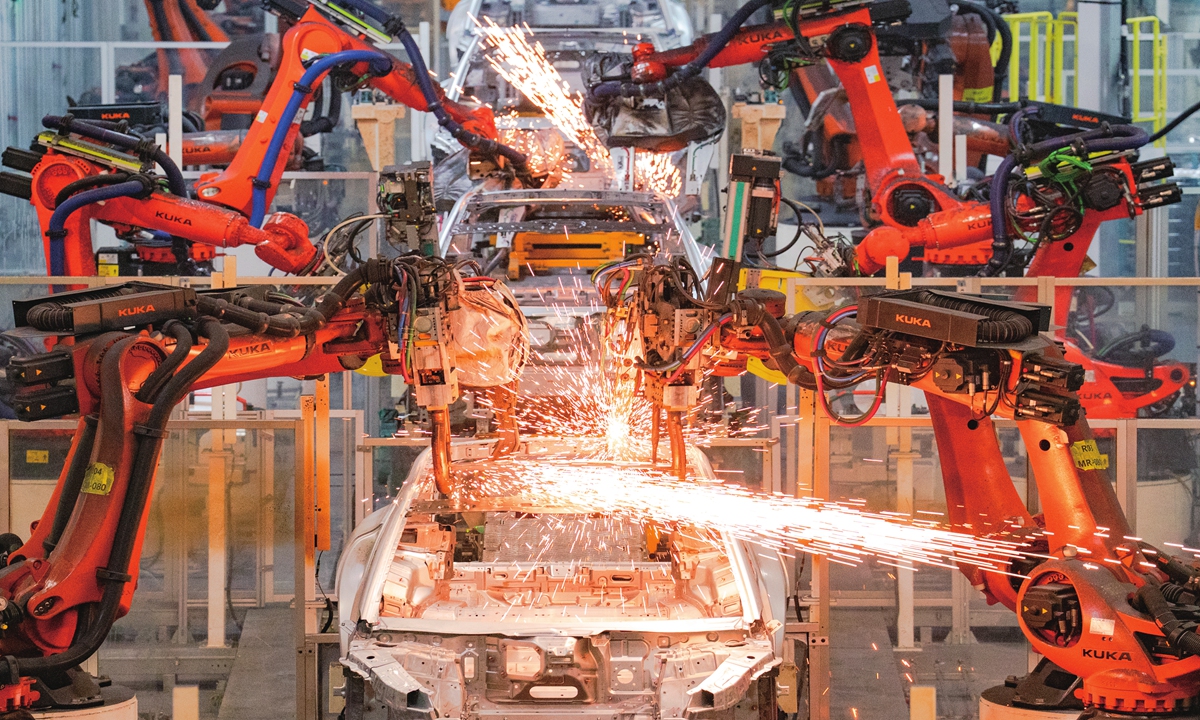
Robots perform welding operations at the BAIC New Energy Super Factory in Beijing on December 12, 2025. Photo: VCG
China's major economic indicators have outpaced broad market expectations and achieved strong growth momentum in the first two months of 2026, the latest data from the National Bureau of Statistic (NBS) showed on Monday.
To be specific, in the January-February period, the total value-added of industrial enterprises above designated size grew 6.3 percent year-on-year, 1.1 percentage points faster than December. Meanwhile, retail sales of consumer goods reached 8.6 trillion yuan in the first two months, up 2.8 percent year-on-year, 1.9 percentage points faster than December, NBS data showed.
Also, fixed-asset investment jumped by 1.8 percent year-on-year to reach 5.272 trillion yuan in the first two months, while that of the previous year was down by 3.8 percent, NBS data showed.
Monday's data also showed the surveyed urban unemployment rate averaged 5.3 percent in the first two months, unchanged from the same period last year, indicating that the country's employment situation has remained generally stable, according to the Xinhua News Agency.
Officials and analysts said the data indicates that the world's second largest economy has got off to a strong and promising start this year despite persistent domestic headwinds and escalating external pressures.
A good start
The data came after China's Government Work Report approved on March 12 set out major social-economic development goals this year, also the first year of the 15th Five-Year Plan period (2026-2030). Observers said the slew of upbeat data in the first two months, while displaying strong inner strengths in high-tech industry development and domestic consumption - key priority areas outlined in the Government Work Report - has laid a solid foundation for achieving this year's GDP target of 4.5 percent to 5 percent as well as long-term vision laid out by the 15th Five-Year Plan (2026-2030).
NBS spokesperson Fu Linghui said at the press briefing of the State Council Information Office on Monday on the release the data that the year 2026 marks the opening year of the 15th Five-Year Plan period. Thus, the performance of the economy in the early months holds significant indicator value for assessing the overall trajectory of economic operations throughout the year, he said.
"From the released data, the overall performance [of the Chinese economy in the first two months] has clearly exceeded market and institutional expectations. This fully demonstrates the strong vitality and resilience of the Chinese economy, and we have every reason to feel fully confident about China's economic development," Fu said. He noted that in the first two months, key economic indicators have shown a marked rebound, indicating a good start for the national economy.
The steady growth of the world's second-largest economy has received extensive media attention.
China's economy began the year on a firmer footing as factory output quickened while retail sales and investment rebounded in January-February, Reuters reported in an article, headlined "China's economy builds early momentum in 2026 as global risks mount."
A Wall Street Journal report said that the better-than-expected performance in the first two months of the year opens space for Chinese policymakers to "pursue the goal of shifting toward consumption-led growth."
Tian Yun, a Beijing-based veteran economist, told the Global Times on Monday that the robust economic readings in the first two months are highly "encouraging" and provide a vivid picture of how the economy, in line with major tasks outlined in the Government Work Report, will unfold throughout the year.
"We can expect the first quarter GDP growth to hover above 4.5 percent if such a growth momentum is sustained in March," Tian told the Global Times on Monday. He nevertheless took note of some external headwinds, including rising geopolitical tensions, ongoing conflicts in the Middle East, and potential tariffs escalations which could all disrupt global supply chains and drive up energy prices.
Wan Zhe, an economist and professor at Beijing Normal University's Belt and Road School, told the Global Times that as a series of positive economic factors are palpably "converging and gaining strength", China's first-quarter GDP growth is likely to reach around 5 percent.
The Chinese government has set a target of achieving an annual GDP growth of 4.5 to 5 percent in 2026 and vowed to strive for better results in practice, according to the Government Work Report.
Strong endogenous momentum
The higher-than-expected growth is a result of multiple factors, including strong endogenous momentum, the visible effects of policy measures, and a consumption boom brought by extended Spring Festival holidays, according to a research note sent by the Minsheng Bank to the Global Times.
The fact that growth in fixed-asset investment has turned to positive territory after months of negativity is particularly noteworthy, according to analysts.
"Front-loaded issuance of special-purpose bonds has boosted infrastructure investment, while the real estate market has begun to show initial signs of a mild recovery," the research note said. Analysts also noted that a number of major infrastructure projects have commenced construction in the opening year of the 15th Five-Year Plan period (2026-30), therefore offering a further boost in related investment.
In outlining the major tasks for 2026, the Government Work Report called for the country to foster new growth drivers at a faster pace. In line with the trend, the development of new growth drivers has accelerated in the first two months, solidifying China's high-quality economic development track.
For example, the output of 3D printing equipment, lithium-ion batteries, and industrial robots increased by 54.1 percent, 42.6 percent, and 31.1 percent year-on-year in January-February, respectively, NBS data showed.
The Government Work Report prioritized building a robust domestic market. "In 2026, the external environment for China's economic development will remain complex and grim. To achieve the annual economic growth target and make a good start to the 15th Five-Year Plan period, more emphasis should be placed on domestic demand-led growth and the development of the domestic market," Wan said.
According to Tian, the rebound in social retail sales in the first two months mirrors the great potential in consumption to be released this year. "As more policies continue to bear fruits, the momentum for consumption growth is expected to gradually improve throughout the year," Tian said.
Chinese economists said that the steady growth prospects of the Chinese economy will continue to make the country the most stable driving force when the world economy is mired in long-term stagnation.
"China's contribution to world economic growth, I believe, will be greater than in the past," Justin Lin Yifu, a member of the 14th National Committee of the Chinese People's Political Consultative Conference (CPPCC) and dean of the Institute of New Structural Economics at Peking University, told the Global Times in a recent interview.
He stated that amid rising geopolitical conflicts and technological revolutions, the current global governance system is under strain and external demand is slowing down, which are headwinds faced by all countries. "However, while a small boat will rock violently in stormy waves, a large ship like the Chinese economy can ride the wind and break the waves by managing its own affairs well," Lin said.
RELATED ARTICLES