Beijing's 'non-consensus' funding model fuels bold ideas to drive original innovation
By Published: Mar 16, 2026 10:54 PM

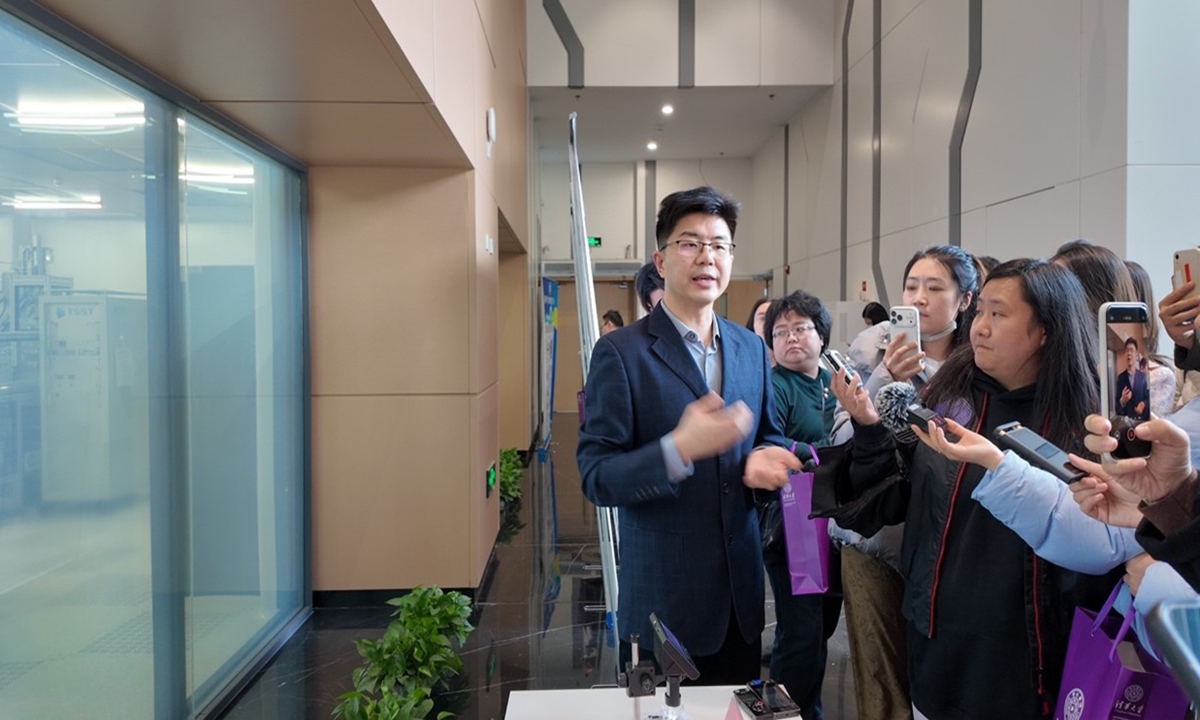
Song Cheng, a professor from the School of Materials Science and Engineering at Tsinghua University, speaks with journalists on March 16, 2026 at a sideline event of the ZGC Forum, which is scheduled to be held from March 25 to 29 in Beijing. Photo: Liu Caiyu/GT
"Without an inclusive environment and a scientific review mechanism, these world-changing achievements might never have seen the light of the day," Du Yanan, a professor at Tsinghua University, told the Global Times on Monday at a sideline event of the ZGC Forum, which is scheduled to be held from March 25 to 29 in Beijing. He highlighted these key factors behind Beijing's rise as a major hub for original innovation in China.
Du is one of the many experts involved in recommending projects for Beijing's "non-consensus innovation project."
Launched in 2025, Beijing took the national lead in exploring and establishing a real‑name expert‑recommended review mechanism for non‑consensus projects with the aim to support projects centered on major original and disruptive innovations.
Basic research used to be constrained by an excessive focus on papers, professional titles, academic degrees and past performance. "The concept of 'tolerating failure and selecting the best for rolling' contained in this mechanism is precisely the soil that non-consensus innovation most needs so that every valuable 'wild idea' has the opportunity to be seen and supported," Du said.
Beijing has always been at the forefront in terms of serving national strategic demands and undertaking major national basic research tasks. The Global Times learned that during the 14th Five-Year Plan period (2021-25), the proportion of funding from projects supported by the National Natural Science Foundation of China will stand at around 20 percent.
There are two other striking figures underscoring Beijing's innovative edge: The number of Beijing's research institutions among the world's top 200 first-class scientific research bodies has risen to 13, ranking first globally for three consecutive years. In 2023, the number of active researchers per million people reached 52,000, surpassing Boston (51,000) in the US for the first time and claiming the top position worldwide.
This makes the "non-consensus innovation project" a vital force driving scientific and technological progress, and a scientifically sound screening mechanism is the fertile ground for nurturing such innovation, according to Du.
The first batch will support 72 projects, of which 78 percent feature clear disruptive potential, while 22 percent target international research gaps. This initiative has provided a steady stream of innovation for seizing academic heights and nurturing cutting-edge technologies, the Global Times learned from the Beijing Municipal Science and Technology Commission.
Exploring non-consensus projects is inherently risky, as there is always a chance the research path does not work out or the expected outcomes are not achieved. "This mechanism does not simply judge success or failure as the sole criterion. Instead, it grants researchers a flexible timeline of one to three years."
Monday brought a moment of pride for Song Cheng, a professor from the School of Materials Science and Engineering at Tsinghua University. Speaking with the Global Times, he was still glowing from the breakthrough his team had achieved as one of the direct beneficiaries of this project.
With support from the National Natural Science Foundation and Beijing's Non-Consensus Project, his team made a world-first discovery with altermagnets, a special type of magnetic material. Fully immersed in sharing the story of how they uncovered this material, Song explained that once these basic research achievements are turned into practical applications, they will strongly support China in achieving high-quality development in advanced storage, terahertz technology, the artificial intelligence industry, and other fields.
When asked about the project's fairness guarantee mechanism, Du added, "To ensure impartiality, we adopt double-blind reviews — we hide the information of both reviewers and applicants to eliminate interference from nepotism. We also implement a real-name recommendation system, where review experts lend their personal credibility to endorsements to strengthen responsibility constraints.
"Each project is evaluated by five to 10 experts, who make decisions on the same day in a unified space free from communication interference, ensuring efficient, independent, and objective reviews," Du said.
Beijing's "non-consensus innovation project" is one of many mechanisms that the capital city is leading to diversify investment and support its basic innovation.
According to the Beijing Municipal Science and Technology Commission, Beijing will continue to target foundational fields like mathematics, physics, chemistry, and biology, pursuing high-risk, high-reward original research.
Aligning with national strategy and regional needs, we will prioritize applied basic research in next-generation IT, medicine, and integrated circuits, an official from the commission said.
RELATED ARTICLES