‘Sports event economy’ fuels China’s consumption
Integrated development of business forms offers great potential: expert
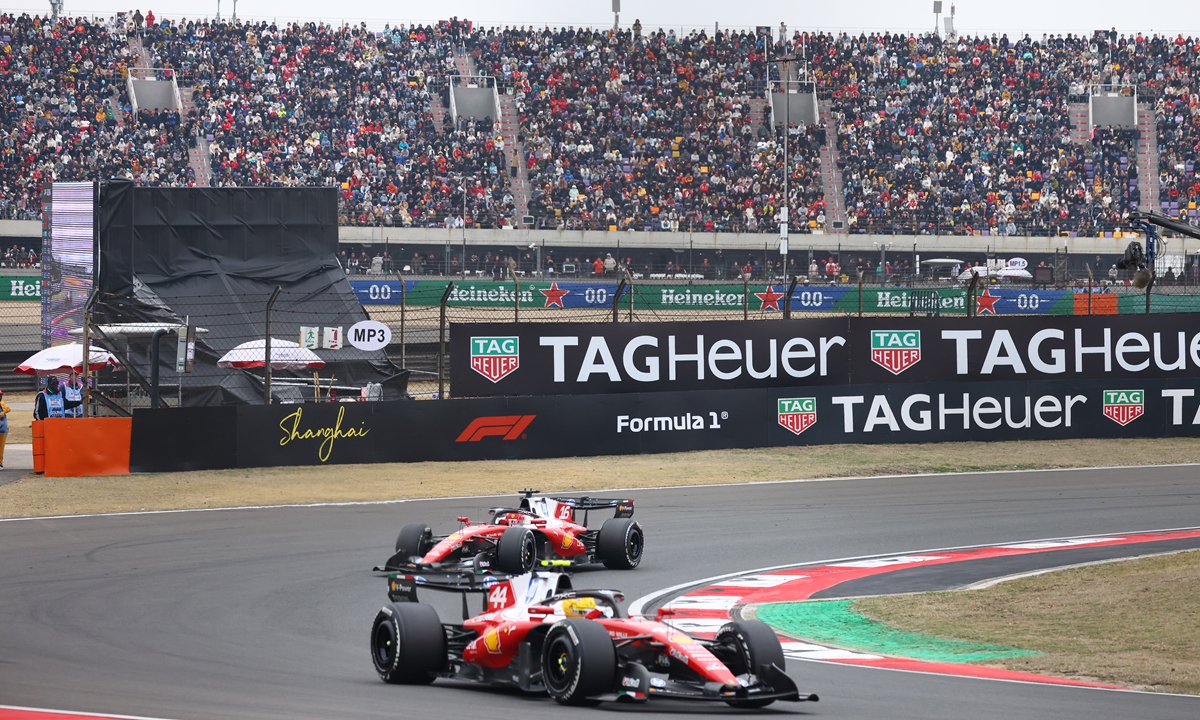
Spectators watch the 2026 Formula 1 Chinese Grand Prix race from the grandstands in Shanghai, March 15, 2026. Photo: VCG
Multiple Chinese cities including Wuhan, capital of Central China's Hubei Province, Shanghai, and Shenzhen in South China's Guangdong Province have recently intensively held sports events including marathons, Formula 1 and football matches, with analysts saying the surge in event traffic is expected to translate into consumption growth.
These sports events are becoming a new engine for stimulating domestic demand and driving economic growth at the start of 2026.
On March 22, the 2026 Wuhan Marathon will start at 7:30 am, attracting 30,000 runners this year, according to the local government website. Ahead of the event, the city on Monday launched Wuhan Sports Consumption Week, when 10 million yuan ($1.44 million) worth of sports consumption vouchers will be issued to stimulate spending, read a separate notice.
While runners are expected to gather soon in Wuhan for the marathon, the 2026 Formula 1 Chinese Grand Prix, which concluded in Shanghai on Sunday, has emerged as a major catalyst for the megacity's tourism and commerce.
Official estimates said that 230,000 spectators attended the three-day event, generating revenue of 190 million yuan, up 35 percent year-on-year. Meanwhile, the popularity of F1 races continuously radiates outward, deeply integrating with cultural and tourism consumption, the Xinhua News Agency reported.
According to data from Trip.com, hotel bookings within 3 kilometers of the venue in Jiading District, Shanghai averaged a surge of 125 percent during the event, with some hotels even fully booked, according to the report.
In addition, the Chinese Super League and China League One kicked off simultaneously in Shenzhen on March 14 and 15, which not only ignited fans' enthusiasm but also boosted the match-day economy,
Song Ding, a research fellow at the China Development Institute, attributed the booming of sports event consumption to the effect of joint factors including policy support, the steady growth of China's per capita GDP, and new trends in household consumption related to demand for strong experiential value and high added value.
Sports events can directly drive consumption in ticket sales, merchandise, and on-site services. In addition, they extend to sectors such as tourism, transportation, accommodation, and catering, significantly amplifying the scale of consumption. In the long term, sports events can also ignite public participation enthusiasm and promote relevant consumption in areas such as sports equipment and training, Song said.
The boom of the sports event economy also relies on forward-looking strategies and policies at the national level. For instance, in September 2025 the General Office of the State Council issued a new guideline aimed at stimulating sports consumption and driving the high-quality development of the sports industry. According to the guideline published on the State Council's official website, China aims to cultivate sports enterprises and events with global influence, and the country's sports industry is projected to exceed 7 trillion yuan by 2030.
Ai Yu, an official of the General Administration of Sport of China, said at a press conference in February that the administration launched pilot programs last year in seven provincial-level regions to monitor consumption driven by key sporting events. In 2025, 1,947 events were tracked, generating 43.128 billion yuan in related consumption, or an average of 22.151 million yuan per event.
The popularity of sports events will further stimulate the potential for the integrated development of diverse business forms such as commerce, tourism, culture, sports, and health during the 15th Five-Year Plan (2026-30) period, Li Changan, a professor at the Academy of China Open Economy Studies at the University of International Business and Economics, told the Global Times on Tuesday.
China's Government Work Report released during the just-concluded two sessions stated that "we will boost high-quality development of cultural tourism and cultivate diversified forms of business featuring the integration of culture, tourism, sports, and commerce."
"Expanding domestic demand can focus efforts on aspects such as industrial demand and people's livelihood needs. In particular, in terms of people's livelihood needs - including the emergence of new demands such as the event economy - the potential of these demands is immense," Li said.
As localities continue to explore consumption scenarios in line with local conditions, this will further expand domestic demand and boost consumption, continuously injecting new vitality and momentum into China's economy, the expert said.
RELATED ARTICLES