Visa-free policy boosts inbound Russian tourists via NE China’s Heilongjiang by over 60% in six months
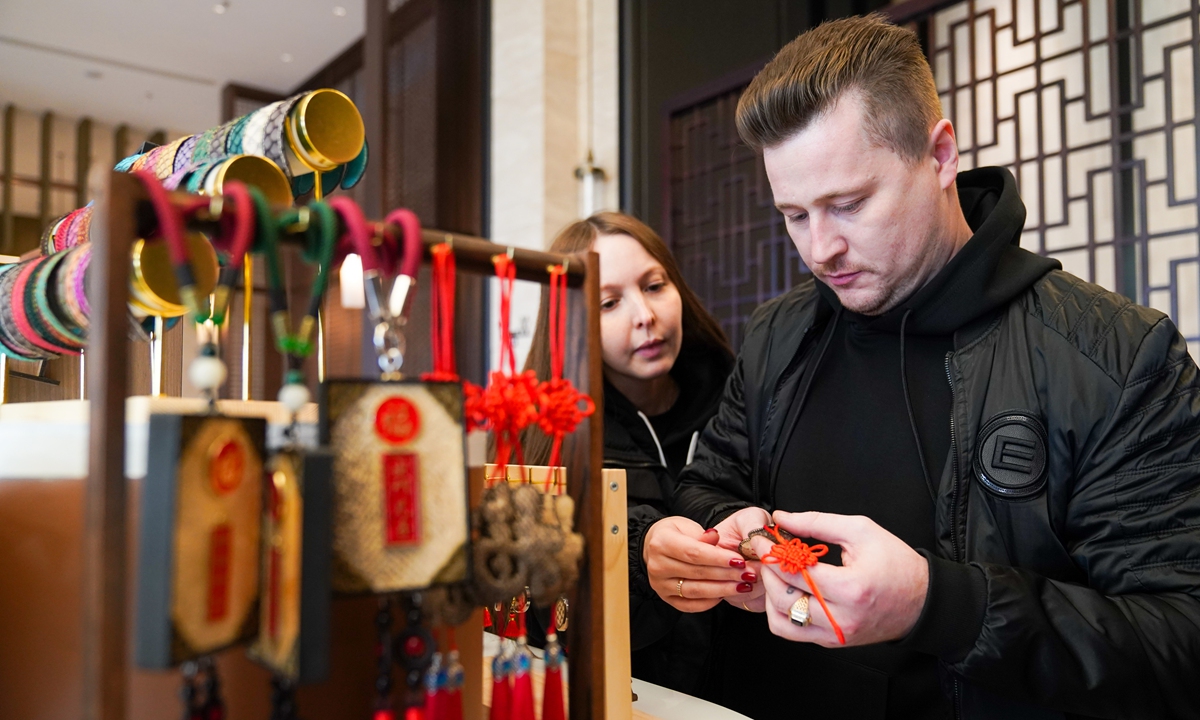
Russian tourists are drawn to ethnic handicrafts on display in Raohe county, Northeast China's Heilongjiang Province, October 11, 2025. Photo: VCG
Six months after China introduced a 30-day stay visa-free policy for Russian citizens, the policy's benefits have driven rapid growth in cross-border travel. Russian tourists entering China through ports in Heilongjiang Province increased by more than 60 percent in the past half-year, new data showed.
A total of 232,000 Russian nationals entered Heilongjiang via various ports from September 15, 2025 to Monday, a striking 61.2 percent year-on-year increase, CCTV News reported on Tuesday, citing statistics from the Heilongjiang Border Inspection Station.
On September 15, 2025, China implemented a 30-day visa-free policy for ordinary passport holders from Russia until September 14, 2026. This was followed by Russia's reciprocal measure for Chinese citizens that took effect on December 1.
Weekend getaways have become routine: many families now travel from Russia to China through Heilongjiang's Heihe or Suifenhe - both are China-Russia border cities - on Friday and return home by Sunday, enjoying Northeast China's folk customs, Liu Bin, a manager at the Xinxin Travel Agency, told the Global Times on Tuesday.
The agency, which specializes in inbound tours via Heihe and Suifenhe ports, has witnessed a surge in orders of roughly 50 percent in the past six months, said Liu.
Apart from Heihe, Heilongjiang's various ports have effectively become part of a "cross-border living circle" for Russian residents. The province has upgraded Russian-language signage, improved cross-border payment options, and enhanced overall reception capacity to better accommodate the diversified visitor flow, according to CCTV News.
Liu also said that thanks to the 30-day visa-free stay, many visitors use Heihe or Suifenhe as entry points before continuing to Harbin (Heilongjiang) or even coastal destinations, such as Dalian and Qingdao.
Border ports such as Heihe benefit from their one-river-away location, short distance, and streamlined customs clearance, resulting in exceptionally dense people-to-people exchanges. Many Russian tourists enter via land ports in Heilongjiang and then transfer to other parts of the country, Xu Xiaolei, marketing manager at CYTS Tours Holding Co, told the Global Times on Tuesday.
"However, land routes are not the only channels. Aviation gateways remain a major channel for Russian tourists travelling to China. Traditional destinations such as Beijing, Shanghai and Sanya in South China's island province of Hainan continue to see substantial inbound Russian tourists, with stable growth of about 30 percent since the visa exemption," said Xu.
According to Sanya's culture and tourism department, the city welcomed more than 5,000 Russian visitors per week in January. At Sanya Phoenix International Airport alone, Russian passenger arrivals in the fourth quarter of 2025 - the first quarter after the visa-free policy took effect - surged 400 percent year-on-year.
Xu has also observed a shift in travel patterns. "In the past, Russian visitors mainly came in tour groups for sightseeing or beach vacations. Today we see a strong trend toward independent travel, and more personalized itineraries. The visa exemption has dramatically lowered the barrier to entry, so tourists are no longer content with superficial tours. Instead, they want to explore smaller cities, and experience authentic Chinese life."
Beyond classic attractions, Russian travelers are increasingly drawn to traditional local cuisine, folk customs - especially Chinese-style body scrubbing - and martial arts, said Xu.
"Previously our business focused mainly on shopping and business trips. Now traditional Chinese medicine treatments, and cultural experiences are equally popular," said Liu.
Meanwhile, localities have announced new measures to better boost cross-border travel under the mutual visa-free arrangement.
For example, Heilongjiang Province in January rolled out two sets of 10 facilitating measures - one to attract more Russian visitors, and another to encourage Chinese outbound travel to Russia, according to a statement released by the Heilongjiang Department of Culture and Tourism.
To meet Russian tourists' needs, key measures included increasing flight routes and frequencies, developing diverse specialty cultural and tourism products, and improving payment and tax refund systems, read the statement.
RELATED ARTICLES