Illustration: Liu Xiangya/GT
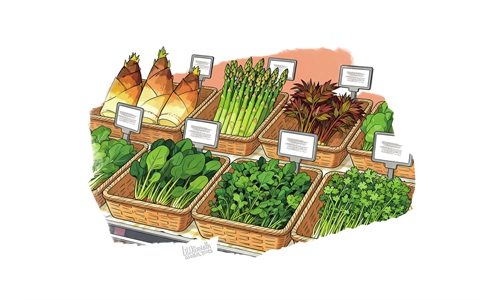
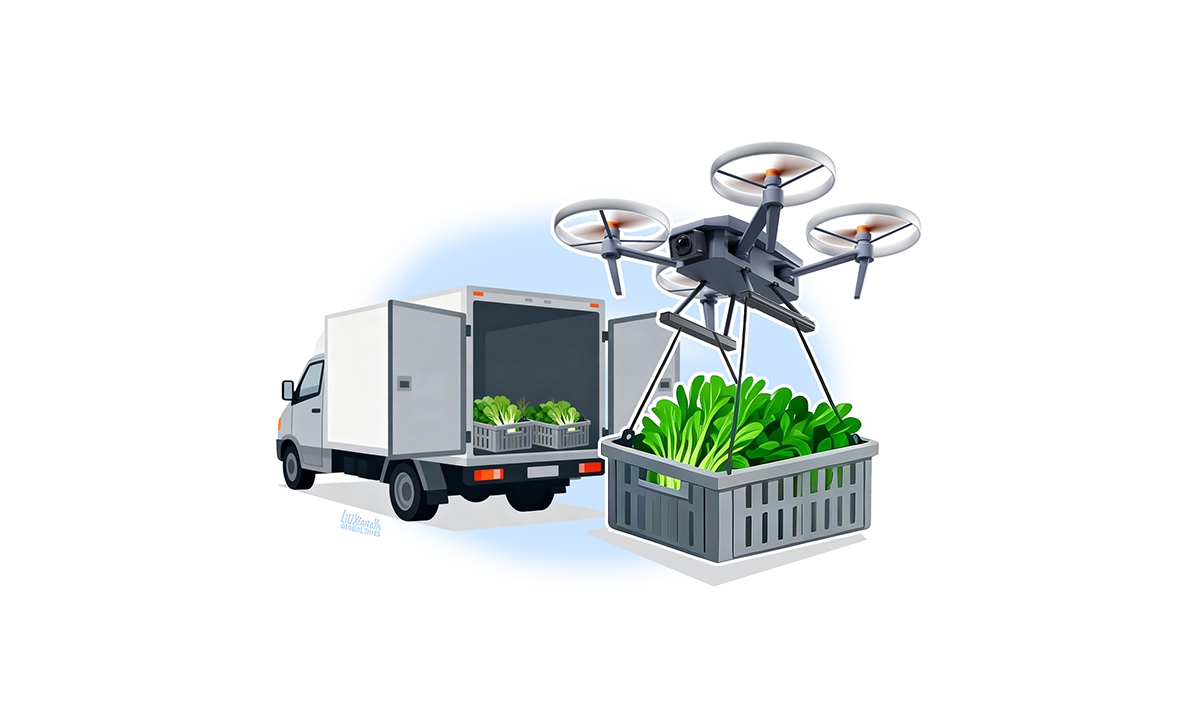
In the remote mountains of Pingwu County, Southwest China's Sichuan Province, at an elevation of 1,500 meters, freshly harvested wild vegetables no longer need to be carried down on foot by villagers. According to CCTV.com, drones now transport the produce from the mountain to the roadside in mere two minutes. The sight of unpretentious wild greens being delivered alongside cutting-edge drone technology - or, more broadly, the juxtaposition of traditional agriculture and modern logistics - offers an insightful snapshot of China's rapidly evolving supply chain and consumer market.As reported by CCTV.com, these wild vegetables, harvested deep in the mountains, now reach consumers within hours, thanks to a seamless logistics network. Upon landing, the drones transfer the produce to cold-chain vehicles, which quickly take over, maintaining the freshness of the goods throughout the journey. This efficient integration of advanced technology and logistics is emblematic of broader trends in China's supply chains, where innovation is reshaping how goods move from rural producers to urban markets.
At the core of this transformation is the growing influence of consumer demand. More and more, consumers are placing increasing importance on the freshness, health, and safety of their food. For instance, during spring, many seek out seasonal vegetables, such as freshly grown wild greens from the mountains. As reported by CCTV.com, the general manager of a company in Sichuan noted that the firm's business faces no challenges selling the wild vegetables it sources, with demand so strong that it can obtain as much as possible. This shift in consumer preferences is not only driving the use of drones to transport wild vegetables but also spurring broader innovation throughout the production and logistics processes.
This shift in consumer demand is also steadily translating into tangible sales growth, supported by several factors. First, a range of advanced technologies, such as drones and precision navigation systems, are being integrated across production and supply chains. These innovations enhance efficiency and speed, enabling faster, more reliable deliveries and ensuring that goods reach consumers in better condition and more quickly.
Second, the advancement of technology has helped drive a steady reduction in costs. As a result, vegetable prices in China have remained relatively stable. This stability has prompted some analysts to introduce the term "vegetable freedom" to describe the availability and affordability of a wide range of fresh produce in the country.
Third, China's advancements in production and logistics are not isolated developments but part of a broader, interconnected transformation unfolding across the country. This widespread modernization is reshaping infrastructure in ways that enhance the entire supply chain.
For instance, China's cold-chain logistics sector continues to expand. According to data released in January by the China Federation of Logistics and Purchasing, total cold-chain logistics demand reached 381.4 million tons in 2025, up 4.5 percent year-on-year, with the growth rate accelerating by 0.2 percentage points compared with 2024. This extensive infrastructure development lays a strong foundation for the integration of new technologies, improving overall supply chain efficiency and supporting the evolving needs of China's consumer market.
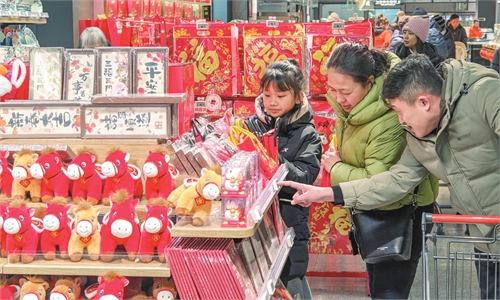
During the 2026 Spring Festival, the cold-chain market further expanded alongside rising demand for fresh products. For example, data cited by the Xinhua News Agency from freight platform Huolala showed that from January 1 to 25, orders for food and fresh goods doubled compared with the same pre-holiday period in 2025.
These changes collectively point to growing demand in China's consumer market, one that is increasingly being converted into real purchasing power. A combination of new technologies, advanced logistics, and other factors has enabled China's vast consumption potential to materialize into tangible economic activity. This shift is not merely theoretical; it is being realized through actual sales that are transforming the dynamics of the domestic market and beyond.
This purchasing power extends well beyond China's borders. Agricultural imports have also steadily expanded. Total imports of agricultural products approached 1.5 trillion yuan ($217.8 billion) in 2025, while the number of overseas agri-food enterprises registered with Chinese customs increased by 83,000, bringing the cumulative total to more than 500,000.
The example of drones transporting wild vegetables is just one of many micro-level trends that illustrate the broader shifts unfolding in China's production and logistics systems. These stories, though small in isolation, converge into a larger narrative of comprehensive change, one that extends from production to distribution and signals new opportunities in the evolving consumer market.
The author is a reporter with the Global Times. bizopinion@globaltimes.com.cn
RELATED ARTICLES