Shenzhou-21 taikonauts carry out second extravehicular mission to install space debris shielding
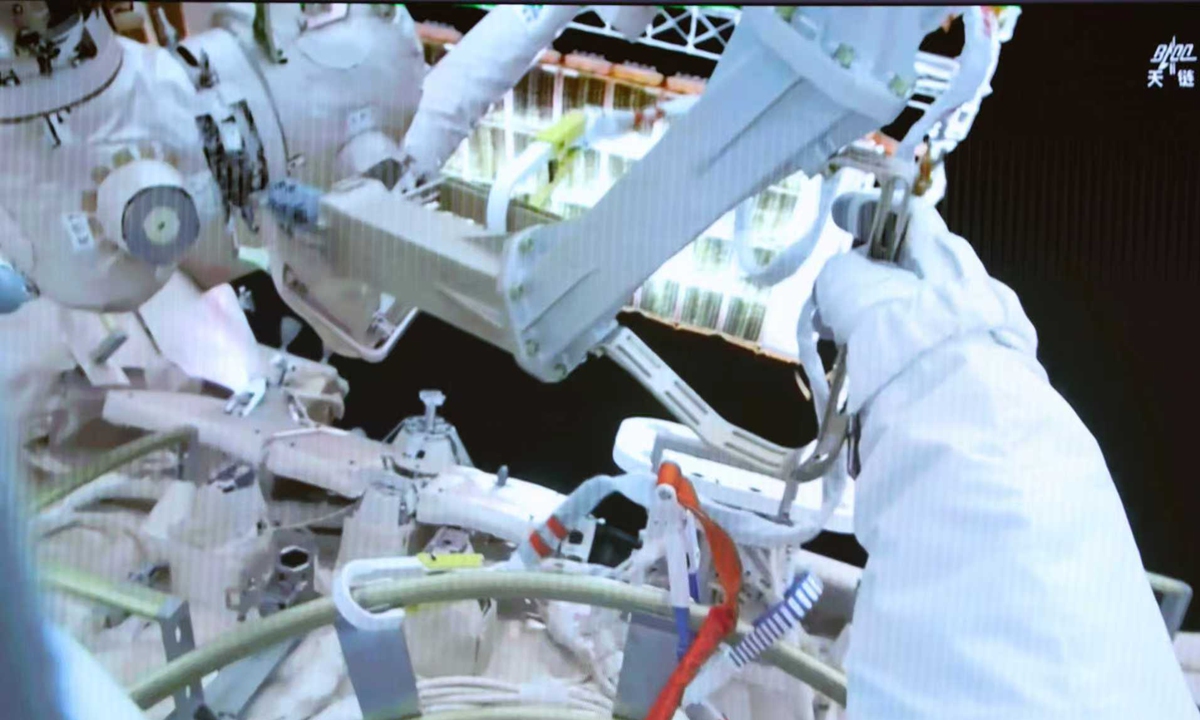
A Chinese taikonaut performs extravehicular activities. Photo: Courtesy of China Manned Space Agency
The Shenzhou-21 crew aboard China's orbiting space station on Monday completed their mission's second series of extravehicular activities (EVAs), including installing a space debris protection device for the space station, which a space expert said is a precaution to protect critical systems from debris that cannot be addressed by robotic arms.
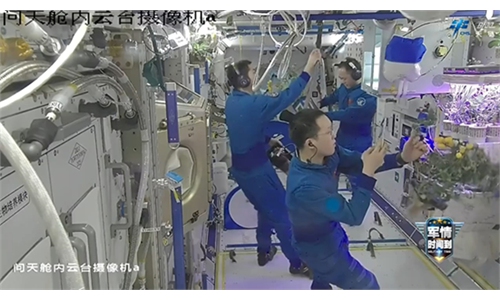
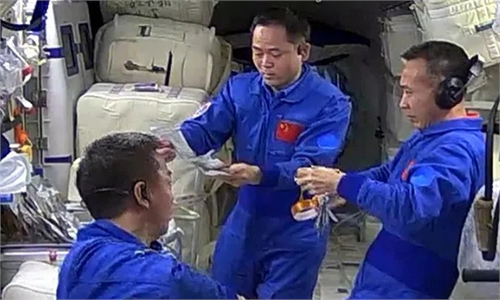
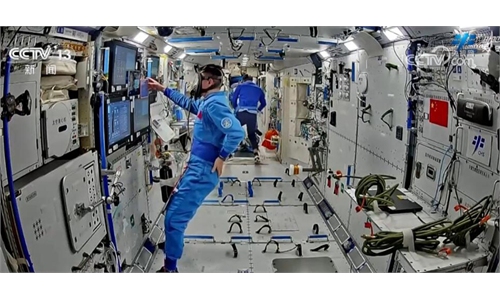
The taikonaut trio - Zhang Lu, Wu Fei and Zhang Hongzhang - worked for roughly seven hours and completed their tasks at 7:35 pm, assisted by the space station's robotic arm and ground supporting team. The trio installed a space debris protection device for the space station and completed other tasks, according to a statement the Global Times obtained from the China Manned Space Agency (CMSA).
As human space activities rapidly expand, the threat of space debris grows more prominent, making space debris protection devices the "armor" of space stations, the People's Daily reported.
Space debris refers to all non-functional, uncontrolled man-made objects and their fragments in orbit, originating largely from defunct satellites, spent rocket stages, collision debris, as well as fragments from human testing activities.
Space debris has surged since 1957 when the first artificial Earth satellite was launched, with over 44,000 trackable objects in orbit by 2024 and more than 1 million fragments larger than one centimeter posing risks to spacecraft. Traveling at speeds close to the first cosmic velocity, around 7.9 kilometers per second, these objects carry enormous kinetic energy and pose significant destructive potential, according to the People's Daily.
According to a senior space expert who requested to be identified by his surname Pang, space debris larger than 10 centimeters can typically be avoided, while fragments between one and 10 centimeters are harder to detect and pose the greatest threat to spacecraft. Meanwhile, debris smaller than one centimeter can generally be withstood by existing shielding.
While core shielding is pre-installed on Chinese space station modules, taikonauts have to conduct spacewalks to install additional protective devices designed for external pipelines, facilities, equipment and experimental apparatus, the People's Daily reported.
Due to launch weight constraints, not all shielding can be pre-installed on space station modules, leaving critical systems like fuel tanks and attitude-control components requiring added protection. Additionally, stronger, upgraded shielding has to be installed post-assembly, with taikonauts performing complex spacewalks to equip key areas beyond the capability of robotic arms, Pang told the Global Times on Tuesday.
Chinese taikonauts began installing debris shielding during the Shenzhou-18 mission on May 28, 2024, according to the People's Daily.
At present, technologies for protecting against space debris are evolving toward an integrated approach that combines avoidance, shielding and repair. Meanwhile, with the advancement of space technology, emerging technologies are paving the way for active debris removal - shifting the approach from passive defense to proactive management, according to CNR.
According to the CMSA, Zhang Lu and Wu, who have conducted spacewalk operations, returned safely to the Wentian lab module. Zhang has so far carried out six EVAs, making him one of the Chinese taikonauts with the highest number of spacewalks to date.
Since completing the first series of EVAs on December 9, 2025, the Shenzhou-21 crew has carried out equipment inspection and maintenance, environmental monitoring, and health management aboard the space station. The crew members have also conducted in-orbit training exercises, including rendezvous and docking, medical rescue, and emergency lifesaving, according to the report.
The scientific experiment and test projects they undertook, covering space life science and human research, microgravity physics, and new space technologies, have been progressing steadily. They also celebrated the Spring Festival in Year of the Horse while in orbit.
RELATED ARTICLES