Ministerial meeting of China-Vietnam ‘3+3’ strategic dialogue held, lifting strategic communication, coordination
By Li Yu and Published: Mar 17, 2026 11:58 PM

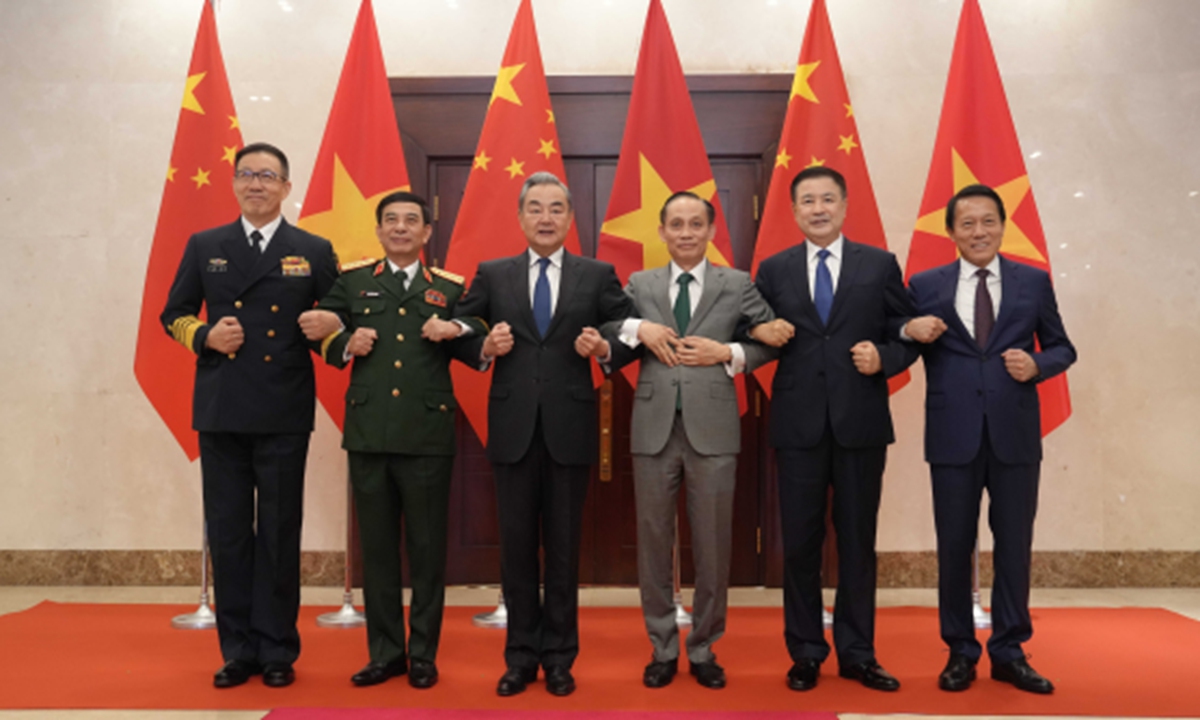
The first ministerial meeting of the China-Vietnam "3+3" strategic dialogue on diplomacy, defense and public security is held in Hanoi, Vietnam, on March 16, 2026. Photo: Xinhua
As an important force for peace, stability and justice in the world, China is willing to work with Vietnam and other countries to strengthen coordination within multilateral mechanisms such as APEC, ASEAN and the Lancang Mekong Cooperation, to spare no effort in safeguarding Asia's common home, to jointly advance the construction of an Asia Pacific community, and to set an example in promoting a community with a shared future for mankind, Chinese Foreign Minister Wang Yi told media on Tuesday, after attending the first ministerial meeting of the China-Vietnam "3+3" strategic dialogue on diplomacy, defense and public security in Hanoi, according to a readout released by Chinese Foreign Ministry on Tuesday.
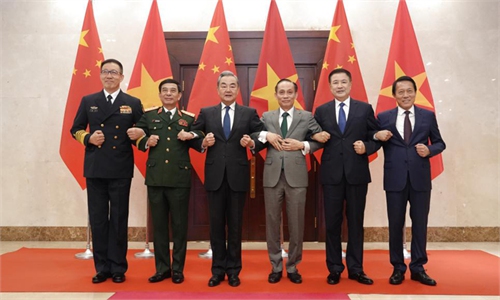
The first ministerial meeting of the China-Vietnam "3+3" strategic dialogue on diplomacy, defense and public security was held in the Vietnamese capital of Hanoi on Monday, Xinhua News Agency reported on Tuesday. Chinese Foreign Minister Wang Yi, Minister of Public Security Wang Xiaohong and Minister of National Defense Dong Jun chaired the meeting, together with Vietnamese Foreign Minister Le Hoai Trung, Defense Minister Phan Van Giang and Minister of Public Security Luong Tam Quang.
The two sides held in-depth exchanges on developments and changes in the international landscape, safeguarding political security, and advancing defense and law enforcement cooperation, reaching broad consensus, Xinhua reported.
Both sides agreed the successful conclusion of the event signifies that China-Vietnam strategic communication and coordination have established a new platform, advanced to a new stage, and been elevated to a new level, according to a release from Chinese Foreign Ministry on Tuesday.
During the dialogue, Wang Yi said the "3+3" strategic dialogue on diplomacy, defense and public security between the two countries at the ministerial level represents the first strategic communication platform of its kind globally, established by both sides as a vital initiative to safeguard political system security and deepen strategic coordination.
The mechanism is both an inherent requirement for advancing the building of the China-Vietnam community with a shared future and a necessary step for revitalizing the world socialist cause, fully demonstrating the high level and strategic nature of the relations between the two parties and countries, Wang Yi noted.
According to the Chinese Foreign Ministry, the Vietnamese side said the country is willing to work hand in hand with China to prepare for high-level exchanges, promote cooperation in various fields, and strengthen multilateral coordination to jointly elevate the Vietnam-China comprehensive strategic cooperative partnership to a higher level.
According to a report by Vietnamese news portal VnEconomy, discussions took place in a "friendly and open atmosphere."
Both sides agreed to hold the second ministerial meeting of the "3+3" strategic dialogue in China, and to deepen counterpart exchanges in diplomacy, defense and public security by fully leveraging the role of routine liaison between senior officials under the mechanism, the Chinese Foreign Ministry said.
The "3+3" strategic dialogue mechanism is a natural outcome of the two socialist neighbors strengthening strategic consensus in response to an increasingly uncertain and unstable regional and global landscape, Ge Hongliang, vice dean of the ASEAN College at Guangxi Minzu University, told the Global Times on Tuesday.
Ge said that guiding bilateral relations of two countries through ties of two parties, while advancing the building of a China-Vietnam community with a shared future of strategic significance through strengthened strategic dialogue, has become a core diplomatic and strategic orientation for both countries.
China's Minister of Public Security Wang Xiaohong noted that the public security ministries of the two countries should prioritize political security and enhance efforts to prevent and resist "color revolutions," per Xinhua.
He added that the two sides should also focus on improving law enforcement and security cooperation mechanisms in areas such as cybersecurity, combating online gambling and telecom fraud, drug control, and fugitive repatriation and asset recovery.
China's Defense Minister Dong Jun stated that China is willing to work with Vietnam to continuously enhance mutual trust in military security, further expand cooperation areas, jointly safeguard maritime security and stability through positive interaction, and push bilateral defense exchanges and cooperation to a new level, setting an example of unity and self-reliance for the armed forces of socialist countries, Xinhua reported.
According to the Chinese Foreign Ministry, the 9th ministerial conference on collaborative crime combat between the public security ministries of the two countries, along with the 10th border defense friendship exchange, were also scheduled during the meeting.
The establishment of the China-Vietnam "3+3" dialogue is not only a joint response by the two countries to a more challenging international and regional landscape, but also helps to jointly address challenges including external interference, separatism and "color revolutions," Ge said.
According to the expert, as neighbors, China and Vietnam are reaching increasing consensus on maintaining security, peace and stability in the South China Sea region. Properly managing and handling maritime issues is also a key component in building the community with a shared future between the two countries.
The "3+3" dialogue mechanism helps both sides, in ways that serve their mutual interests, manage differences while advancing bilateral relations, and jointly safeguard regional peace and stability, he added.
RELATED ARTICLES