Western claims that US-Israel attacks on Iran prove China 'unreliable' are nothing but jarring noises

Illustration: Chen Xia/GT
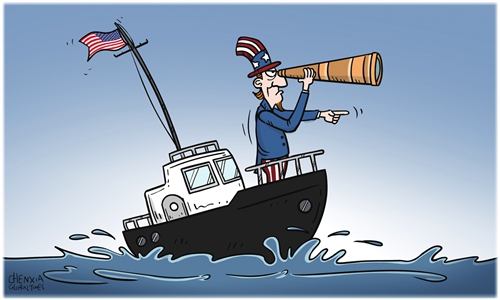
The US-Israel military operation against Iran has entered its third week, with a swirl of information — true and false — flying around. Amid the reports, a particular narrative hyped up by Western media stands out. They claim that China, despite its strong opposition to the war, has neither provided substantial support to Iran, nor demonstrated the military capability necessary to back it. The ongoing strikes, they argue, have exposed the limits of China's influence in the Middle East.Following this logic, they conclude that by standing idly by watching as its partners get targeted by the US one by one, China has proved itself an "unreliable" partner, and its influence is waning.
This narrative is rather strange. Would they be satisfied if China did provide military support to Iran? Would providing military support validate China's rising influence? Ironically, the West has watched China closely during the Russia-Ukraine conflict for fear that it might provide military aid to Russia.
A closer analysis reveals the West's calculations in promoting such rhetoric.
Firstly, it is an "anti-China reflex." It fits well into Western media's long-standing practice of spinning any story, regardless of where it occurs, to cast China in a negative light. In their narratives, China is always the biggest loser, whether in the Russia-Ukraine conflict, the EU-India free trade agreement or the US kidnapping of Venezuela's Maduro. They have used this anti-China playbook so frequently that Chinese netizens mock it as the "biggest loser style." Clearly, Western media does this not only to peddle the narrative that aligning with China leads nowhere, but also to serve the hidden agenda of suppressing China's growth momentum or even derailing its growth trajectory. Simply put, it is the same old "China threat theory" and "China collapse theory" under a new name.
On a deeper level, these arguments are rooted in Western centrism — the assumption that its worldview and ideology are superior and universally applicable. The West sees the world in binary terms: "our camp" vs the "enemy's camp," and believes this divide is the defining — and eternal — feature of international relations.
They stubbornly believe that the traditional alliance system is the most effective framework for international relations and fail to appreciate the progressiveness of the partnership networks China has built, under which all countries, big or small, rich or poor, strong or weak, are all equal. Stuck in a zero-sum game mentality, they often talk about the "Thucydides Trap," unwilling to believe in win-win cooperation. They seem to have forgotten how World War I started. Wasn't it the rigid alliance systems that forced countries to pick sides and open fire?
In response to the rising tensions in the Middle East, in order to prevent further escalation and spillover of the conflict and spare the people in the region the scourge of war, China calls for an immediate cessation of the hostilities and an early return to the path of dialogue and negotiation. As the Chinese side has repeatedly stressed, peaceful dialogue remains the only viable option to solve the Iranian nuclear issue and to start to bring an end to regional instability. To this end, China urges all nations to jointly reject the notion that "might makes right," and oppose hegemonism and unilateral actions.
China's approach to the current situation is prudent and responsible. Its handling of global hotspot issues has been consistent and will not be swayed by some jarring noises from Western media. Instead of exhausting their energy trying to prove that China has lost ground, Western media would do better to focus on their own countries' affairs and reflect on the responsibility they should bear for the current crisis in the Middle East.
The author is a commentator on international affairs, writing regularly for Xinhua News, Global Times, China Daily, CGTN. He can be reached at xinping604@gmail.com.
RELATED ARTICLES