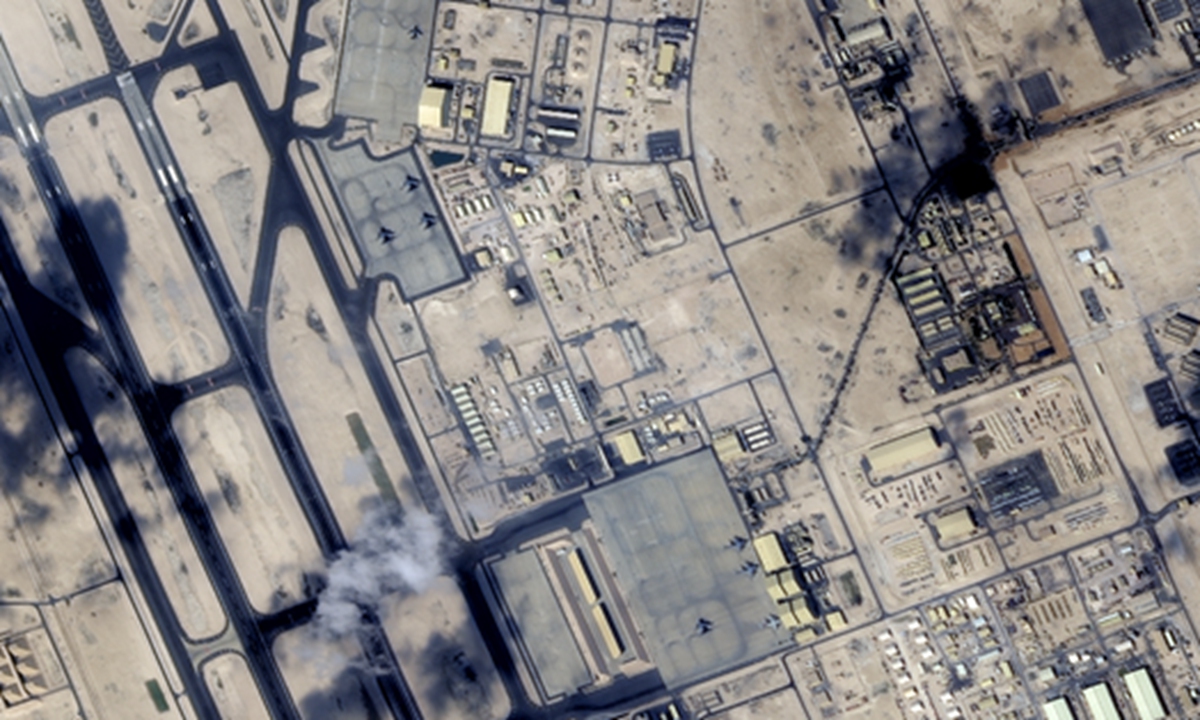
Satellite images taken on January 16 showed five KC-135 aerial refueling aircrafts At Al Udeid Air Base in Qatar
The US-Israel military operation against Iran has entered its third week. On March 15, Iran confirmed that the 53rd wave of Operation True Promise 4 had attacked the US Al Dhafra Air Base in the United Arab Emirates. Using ballistic missiles, cruise missiles, drones and other types of equipment, Iran has also launched saturation attacks on multiple US bases and facilities in Qatar, Kuwait, the UAE, Bahrain, Saudi Arabia, Iraq and Jordan.These facilities, which host countries viewed as vital for security, have now become "security burdens" amid ongoing conflicts. The presence of US overseas bases, as core strategic pillars of US global hegemony, not only triggers geopolitical conflicts but also generates controversies under international law, forcing relevant countries to confront a harsh reality: Should they rely on US hegemony for illusory guarantees, or uphold their sovereignty and achieve independence?
In the current international legal context, overseas military bases are important and legitimate platforms for international military cooperation. However, the approximately 800 military bases deployed by the US in about 80 countries and regions around the world constitute a "global network" for its hegemonic ambitions. By signing agreements with host countries, the US uses "security guarantees" as bait to secure a military presence in key regions, thereby achieving intervention and dominance in regional affairs. The "base-for-security" model, while seemingly providing security protection for the host country, actually binds it to the hegemonic chariot of the US, making it a potential victim.
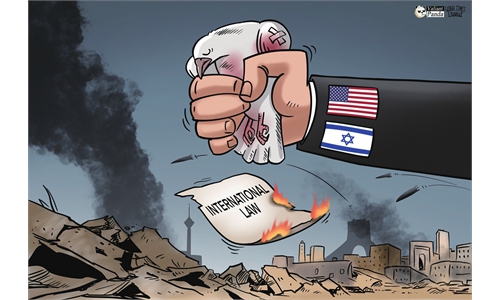
Countries hosting US military bases also face legal difficulties. The US and Israel bypassed the UN and launched military strikes against Iran while US-Iran negotiations were ongoing, violating international law and the basic norms of international relations. The definition of aggression adopted by UN General Assembly Resolution 3314 includes "the action of a State in allowing its territory, which it has placed at the disposal of another State, to be used by that other State for perpetrating an act of aggression against a third State."
Iran considers the US-Israel attacks to be "acts of aggression" and, based on Article 51 of the UN Charter regarding the right of self-defense, has targeted US military bases in Middle Eastern countries. Iran has said that Tehran is not attacking its neighbors, but rather "US military bases, facilities and installations in the region."
This conflict once again proves that the "security model" of relying on US hegemony is unsustainable. True security for sovereign states can only stem from upholding their sovereignty and pursuing an independent path of development. Historically, many countries have rejected the hegemonic coercion of US military bases. In 1966, France announced its withdrawal from NATO's integrated military command and demanded the complete withdrawal of US troops; in 1970, Libya reclaimed the Wheelus Air Base, where US troops had long been stationed; in 2005, Uzbekistan closed the US Khanabad Air Base; in 2024, Niger terminated its military agreement with the US, demanding the complete withdrawal of US troops.
In the current conflict, Spain has refused to authorize US troops to use its Moron and Rota bases to participate in the strikes against Iran, forcing 15 US military aircraft to leave the country. Behind these different choices lies the balancing of sovereign states between "relying on US hegemony" and "upholding autonomy."
In today's era of widespread long-range precision strike technology, US overseas bases have become easily targeted objectives. They not only fail to provide genuine security for host countries but also push them to the forefront of geopolitical conflicts. For all countries with US military bases within their borders, the US-Israel-Iran conflict serves as a profound warning: A security model reliant on powerful nations will ultimately come at the heavy price of compromised sovereignty and increased risks. Only by upholding sovereignty and territorial integrity, maintaining independence and autonomy, respecting the sovereignty, territorial integrity and national dignity of other countries, handling foreign relations in accordance with international law, resolving differences through equal dialogue, and opposing the abuse of force and unilateral actions can countries truly escape the predicament of a "security burden" and achieve genuine peace and development.
The authors are research fellows at the Military Law Research Institute of the Academy of Military Sciences. opinion@globaltimes.com.cn
RELATED ARTICLES