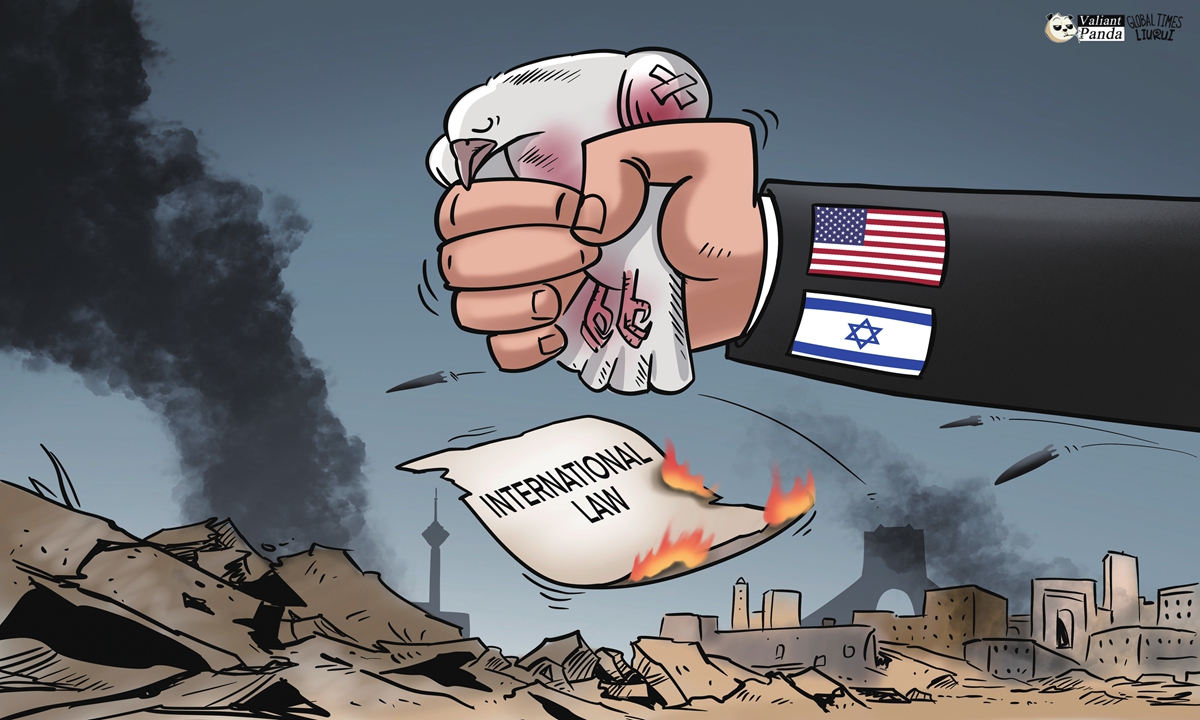
Destroyers of peace. Illustration: Liu Rui/GT
The US-Israel-Iran conflict has lasted more than two weeks, and tensions continue to escalate. It is evident that when the US launched its surprise strike against Iran on February 28, it expected a swift and decisive victory. However, Iran's firm domestic resolve to resist the US, combined with its flexible, powerful and effective military counterattacks, has already dealt Washington serious setbacks both at home and abroad. These signs suggest that Iran could very likely become another "Vietnam" for the US. The US overwhelming military advantage is proving difficult to translate into political victory; instead, it is dragging the country into a costly and protracted war of attrition.Iran's strategic response to the US bears similarities to the "horizontal escalation" strategy of Vietnam during the Vietnam War. Faced with Washington's attempt to use its air superiority and firepower to achieve a quick military victory, Iran has adopted a cost-effective asymmetric strategy. More countries in the Middle East are being drawn into the turmoil, and global energy markets have become highly volatile. Although the US may appear to have achieved numerous tactical "victories," it is becoming increasingly passive at the strategic and political levels. Ultimately, it may find it difficult to escape the tragic fate of strategic failure.
At present, the US is becoming increasingly passive in the conflict. US military expenditures have skyrocketed, with costs exceeding $11.3 billion in the first week of military operations alone. The rapid depletion of US stockpiles of precision-guided missiles and interceptors has forced it to urgently redeploy weapons from other parts of the world, fully exposing the fatal flaw of the US as a "military giant with a limp."
Meanwhile, rising energy prices during the conflict have driven up domestic gasoline prices in the US, significantly increasing the cost of living and production for ordinary Americans. The US repeated guarantee of low fuel prices for voters has been debunked by reality, and this issue may become a major factor contributing to potential setbacks for Republicans in the upcoming midterm elections.
The enormous financial and human costs imposed on the US during the Vietnam War triggered severe social and political divisions at home in the 1960s, giving rise to large-scale anti-war, civil-rights and counterculture movements. That conflict eventually pushed the US to the brink of a "civil war," ultimately forcing the US Congress to terminate war funding. Burdened by internal strife and external pressure, the US government had to admit it had failed to achieve its objectives defined at the onset of the conflict.
The fallout from the US-led attack against Iran will likely mirror the Vietnam quagmire. Prior to this conflict, American society was already mired in multiple crises: worsening political polarization, widening economic inequality, confusion over national identity, and intensifying ethnic tensions. Although the current administration secured its mandate by pledging a pivot toward addressing domestic problems, a protracted conflict with Iran threatens to derail these promises and trigger chain reactions that weaken the country's overall national strength. Instead of providing a resolution, this conflict is likely to act as a catalyst for aggravating internal fissures and exposing the US as a "colossus with feet of clay."
The Vietnam War significantly weakened US national power and global influence. At the time, trust among US allies declined sharply, divisions within alliances deepened and many allied countries began seeking strategic autonomy.
The Vietnam War exposed the fragility of American hegemony. Now, even within the first two weeks into the conflict with Iran, some European allies have already criticized the US military action for lacking authorization from the UN and for openly violating international law. The illegality and arbitrariness of the conflict have generated widespread unease and opposition in the international community. Moreover, the hurried redeployment of weapons from other regions to the Middle East not only reveals the limits of America's supposed military superiority, but also leads its allies to question the credibility of US security commitments.
The Vietnam War remains a stark reminder for the US that the forces and variables involved into a conflict are highly complex, and the costs it brings usually far outweigh any gains. Those who initiate wars often find themselves unable to determine how or when they will end, and may ultimately be consumed by the very conflict they started. In this light, the US must urgently regain its strategic sobriety, prevent further escalation of the Iran situation and bring its military operations to an immediate end.
The author is a professor at the China Foreign Affairs University. opinion@globaltimes.com.cn
RELATED ARTICLES