US tech firms, including Boston Dynamics, push for curbs on Chinese robot makers over alleged 'security risks'; Chinese experts say claims reflect anxiety, envy
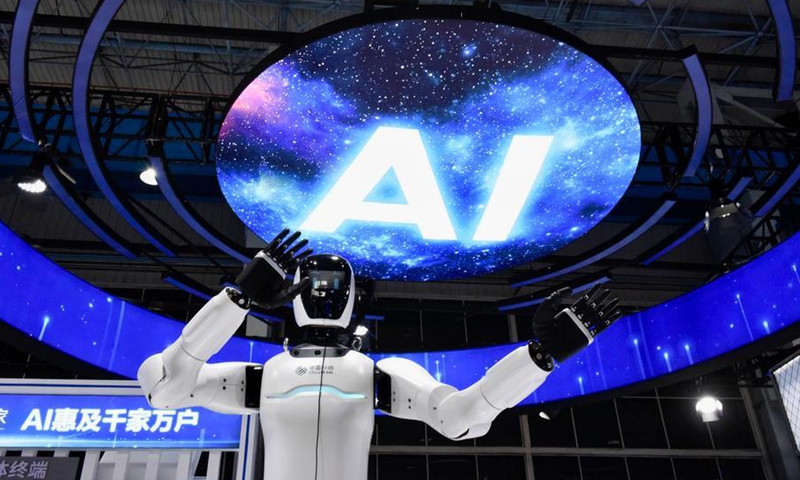
A humanoid robot of China Mobile is pictured at the exhibition area of the 2025 Global Industrial Internet Conference in Shenyang, northeast China's Liaoning Province, Sept. 7, 2025. (Photo: Xinhua)
Confronted with China's remarkable advances in humanoid robot technology, American tech executives are seemingly on edge. Instead of engaging in fair competition, they resort to their old trick of smearing Chinese products.
US artificial intelligence (AI) and robotics firms have pushed lawmakers to take action against Chinese robot manufacturers — singling out Unitree Robotics — using excuse of rising competition and so-called national security concerns, according to media reports and a congressional hearing record released Tuesday local time. Chinese experts said such rhetoric reflects mounting anxiety and envy in the US' tech sector as China's manufacturing scale and improving R&D capabilities continue to gain ground in the robotics sector. They added that this move also reflects the US side's abuse of "national security" as a pretext to target Chinese enterprises, which is essentially a defensive reaction triggered by its inability to cope with the intensifying market competition from China.
China's pace of progress in humanoid robotics is raising concerns, prompting calls for the US government to develop coordinated policies and strategies to respond to the growing presence of Chinese firms in the sector, some tech insiders claimed at a Tuesday hearing held by the Cybersecurity and Infrastructure Protection Subcommittee of the House Committee on Homeland Security, according to the congressional hearing record.
The participants, including executives from Scale AI and Boston Dynamics, called on the government to take steps such as examining alleged "national security risks" linked to Chinese robot manufacturers, extending export controls to AI inference chips, and potentially restricting federal agencies from procuring certain Chinese AI and robotics technologies, per the record.
Ma Jihua, a veteran industrial analyst, told the Global Times that remarks from the US industry players reflect anxiety, envy and a defensive mindset, as well as abuse of national security claims to target Chinese firms. While acknowledging its own robots can be autonomously and remotely controlled — and may carry similar risks — Washington has, in the absence of evidence, projected such concerns onto Chinese companies and sought restrictions on "security" grounds, in what he described as "a thief crying stop thief."
He added that so-called "security risks" have long been used by the US government and industries as a pretext to suppress foreign competitors, and the robotics sector is no exception. "Some industry players are invoking so-called security concerns as a means to attack competitors amid declining competitiveness, rather than enhancing their own capabilities to compete in the market," he said.
Witness Max Fenkell, global head of policy and government relations at San Francisco-based Scale AI, singled out Unitree Robotics' performance last month at China's annual New Year gala, where its humanoid robots performed martial arts including backflips and leaps from trampolines. "The video went viral, not because it was impressive, but because of what happened when people compared it to last year, 12 months ago, [when] the same robots could barely shuffle through a dance routine," Fenkell said, South China Morning Post reported.
Witness Matthew Malchano, vice-president of software at American robot maker Boston Dynamics, also noted that at this year's Consumer Electronics Show in Las Vegas, Chinese companies displaying humanoid robots appeared to have outnumbered US firms by a factor of five to one, per the hearing record.
Zhou Mi, a senior researcher at the Chinese Academy of International Trade and Economic Cooperation, told the Global Times that US concerns stem from both a lack of confidence in its domestic robotics industry and the perception of China's rapid advances in robotics — particularly embodied AI — as a threat to their own competitiveness, as well as efforts to safeguard its profits and technological leadership.
Ma said past experience shows the US has moved from underestimating China to being overtaken in several emerging technologies. He noted that China's rapid progress in robotics is driven by the accelerated development of a self-reliant industrial system, with a complete ecosystem spanning intellectual property, R&D, design, manufacturing and sales.
Zhou further said that if such concerns translate into administrative restrictions and government intervention, it would be detrimental to industry development, especially as the sector remains at an early stage. He noted that there is still broad room for cooperation, as US firms maintain strengths in areas such as large models and chip manufacturing. Reducing restrictions and limiting market intervention would help improve efficiency, support industrial upgrading and promote economic growth, while relying solely on confrontation is unlikely to yield effective results.
Ma said China's technological development has consistently followed a path of global cooperation and mutual benefit, noting that the US holds strengths in advanced large models and chip manufacturing, while China has a well-developed industrial chain, making the two highly complementary. He added that in the long run, market forces will outweigh administrative barriers, and China-US cooperation in the robotics industry will take diverse forms, with ample room for collaboration from company-level partnerships to broader market expansion.
RELATED ARTICLES