86% of Canadian firms rank China as top or No.1 priority as stabilizing ties boost business confidence
Stabilizing ties open broader room for co-op despite global woes: expert

A vessel carrying 60,000 tons of imported Canadian barley docked at the grain and oil terminal in Nantong, East China's Jiangsu Province, on March 15, 2026. Photo: VCG
Canadian companies are increasingly elevating China as a priority market and expressing stronger confidence in their business prospects, even as geopolitical tensions and external uncertainties persist, according to a latest business survey pointing to a pragmatic recalibration and improvement in bilateral economic engagement.
The vast majority of firms surveyed (86 percent) view China as a top or number one priority in their global strategies, while over two-thirds (68 percent) are preparing to expand their operations in China, according to the Canada-China Business Survey 2025/2026 released by the Canada China Business Council (CCBC), a Canadian business association.
The findings reflect warming and stabilizing bilateral relations that have enhanced mutual trust and created broader space for business cooperation, while underscoring that the Chinese market continues to provide certainty for global corporate planning despite external uncertainties, Chinese analysts said.
In addition, 72 percent of Canadian firms said branding as a Canadian company in China is a business asset, while more than half expressed optimism about their future operations in the country, read a report summary released on CCBC's WeChat account.
The survey, conducted from late 2025 to early 2026 as a follow-up to its 2023 edition, comes amid ongoing supply chain shifts and elevated geopolitical frictions, examining how Canadian and Chinese companies adapt to evolving policy and market conditions.
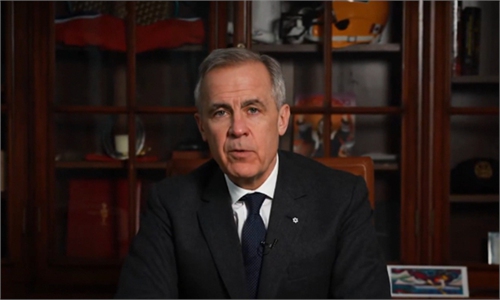
It also comes amid a turnaround in China-Canada relations, following Canadian Prime Minister Mark Carney's visit to China in January, during which the two sides committed to strengthening cooperation in various areas and promoting stable growth in bilateral trade.
According to the survey, more than eight in ten surveyed firms (82 percent) said the Carney government's new approach to China would have a positive business impact, suggesting what analysts said that policy adjustments are translating into improved corporate confidence.
The report further describes the current phase as one of "pragmatic re-engagement," noting that as Ottawa has "taken steps to recalibrate and improve economic relations with China… Canadian companies have likewise elevated China as a priority market and adopted a more positive outlook on their business prospects there."
The warming and stabilization of bilateral ties, along with a clearer economic and trade direction, have significantly strengthened mutual trust, reduced uncertainties, and boosted business confidence, Liu Dan, a research fellow at the Center for Regional and Country Studies at Guangdong University of Foreign Studies, told the Global Times on Thursday.
Liu emphasized that amid global geo-economic uncertainty, stronger China-Canada cooperation can act as a stabilizing anchor for bilateral ties, delivering tangible benefits to businesses and the public while helping both sides better manage external risks and build more resilient supply chains.
This resilience is also reflected in financial performance. Nearly two-thirds (61 percent) of Canadian firms reported being profitable or breaking even in China, while over three-quarters (77 percent) of Chinese firms reported profitable or break-even business in Canada, per the CCBC report.
Beyond the near term, the survey points to a structural shift, with China carrying growing weight in global corporate strategies. The country "remains an overwhelming priority for Canadian businesses surveyed," as over one-third of firms identify it as a top priority and more than half place it among their top five globally.
As companies advance supply chain diversification, China remains central as both a key market and production base, Liu said, adding that strong economic complementarity between China and Canada, along with cooperation potential in both traditional and emerging areas, provides a solid foundation for deeper practical collaboration.
During Carney's visit to China in January, the two sides signed multiple cooperation documents covering trade, customs, energy, construction, culture and public security, and pledged to expand cooperation in areas such as clean energy, digital technology, modern agriculture, aerospace, advanced manufacturing and finance.
The positive momentum is also translating into more active exchanges. Canada will serve as the guest of honor at the Sixth China International Consumer Products Expo (CICPE) in South China's Hainan Province from April 13 to 18, and will send its largest-ever delegation, Behzad Babakhani, Consul General of Canada in Guangzhou, said in a video address at a press conference held by the Hainan provincial government on Wednesday.
Maninder Sidhu, Canada's Minister of International Trade, who will lead the delegation, said in a recent government news release that "through a pragmatic approach in our engagement with China, we are delivering tangible trade results for Canadians. "This arrangement opens new opportunities for Canadian businesses and reflects a practical, forward-looking approach that supports jobs at home and keeps Canada competitive globally," he noted.
China and Canada have also shown signs of adjustment in handling trade frictions, with China announcing an adjustment to its anti-discrimination measures on some Canadian imports in late February after Canada partially revised its additional tariffs on certain Chinese steel and aluminum products.
China is Canada's second-largest single-country merchandise trading partner, with bilateral trade reaching $124.8 billion in 2025, data from the Canadian government showed.
Responding to a question on China-Canada trade cooperation, Chinese Foreign Ministry spokesperson Lin Jian said in February that China and Canada have established a new strategic partnership. This reflects the spirit of equality, openness and inclusiveness, peaceful cooperation, and shared benefit. It serves the common interests of the people of both countries, and is conducive to world peace, stability, development and prosperity, Lin said.
RELATED ARTICLES