Hong Kong IPOs rise 537% year-to-date, with tech, medical firms leading rush
By Published: Mar 19, 2026 11:05 PM

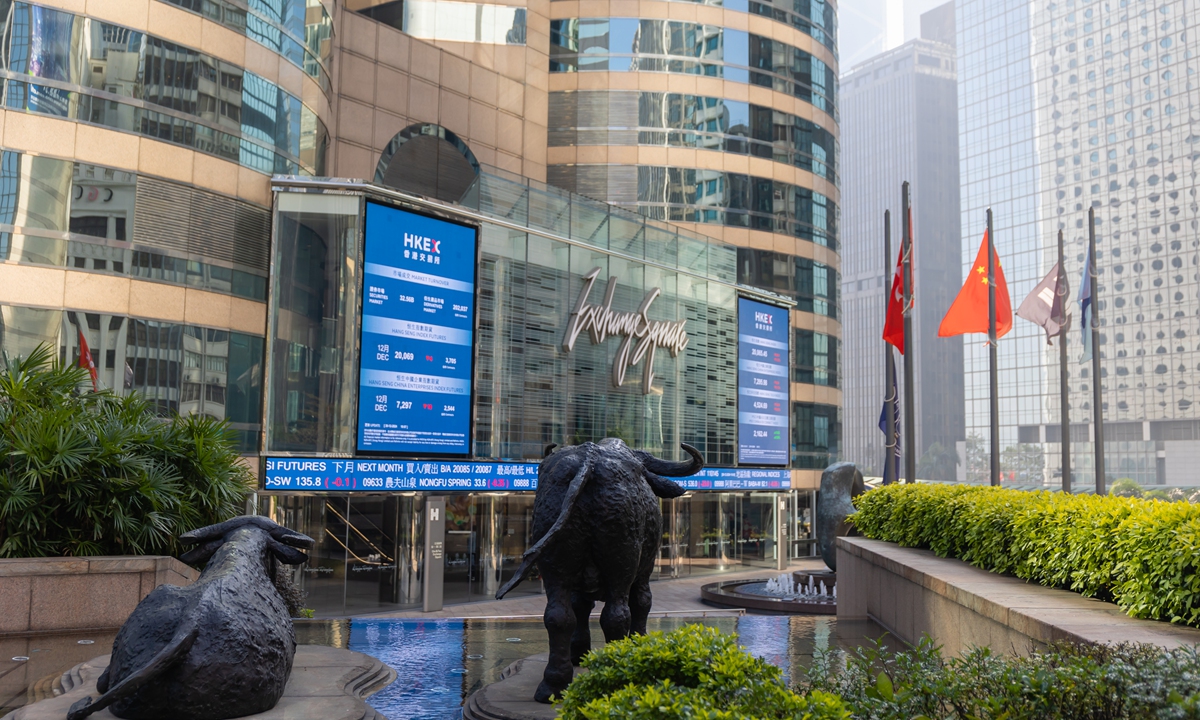
View of Hong Kong Exchanges and Clearing Ltd Photo: VCG
The IPO market in Hong Kong has remained on a fast track since the beginning of 2026, with total funds raised so far exceeding HK$97.16 billion ($12.4 billion), a year-on-year gain of 537.34 percent, the Securities Daily reported on Thursday.
As of Wednesday, 28 companies had completed their IPOs, a 133.33 percent year-on-year increase, according to the report. Also, 12 companies have had listing hearings, with another 377 companies in the pipeline, demonstrating the expanding scale of the IPO craze.
Ning Bo, a chief analyst at CMS (HK) Research, told the Global Times on Thursday said that the Hong Kong stock market is undergoing structural reshaping. Information technology and healthcare companies are becoming the main drivers of IPOs, while industries such as artificial intelligence, semiconductors, and innovative drugs are gradually forming a new source of assets.
Regulatory authorities are strengthening their oversight of listing quality and sponsorship responsibilities, which will help the Hong Kong IPO market shift from "quantity expansion" to "quality priority," Ning said.
Dual listings are a major feature of the ongoing IPO craze. According to the Securities Daily, a total of 13 A-share companies have been listed in Hong Kong so far this year, accounting for 64.4 percent of the total funds raised by all IPOs during the period.
By sector, these IPOs are from companies in the industrial, information technology and daily consumer goods sectors. Many have sizable operating revenue from overseas markets.
As of Wednesday, there were 183 dual-listed companies, the report said, citing data from industry portal Wind. Just three of those A-share companies were listed in Hong Kong in 2024, while 19 were listed in 2025. This compares with 13 A-share companies that had listed on the Hong Kong Stock Exchange as of Wednesday.
Tian Lihui, a professor of finance at Nankai University, told the Global Times on Thursday that the accelerated pace of A-share companies listing in Hong Kong is driven by policy dividends, market appeal, and corporate strategic needs.
"On the policy front, the connectivity mechanisms between the two markets continue to deepen, further lowering the threshold for listings. In terms of the market, current valuations in Hong Kong appear attractive, as relatively low valuations provide a wider margin of safety, positioning these companies to potentially benefit from a valuation rebound in the future," Tian said.
"Lastly, from a corporate strategy perspective, international financing and brand enhancement from a Hong Kong listing have become strategic imperatives for business development," said Tian.
The brisk pace of Chinese mainland companies seeking Hong Kong listings came as the city saw a bumper IPO year in 2025. The Hong Kong Special Administrative Region government is expediting the compilation of Hong Kong's first five-year plan for completion this year.
Paul Chan, financial secretary of the HKSAR government, wrote in his blog on March 15 that the outline of the 15th Five-Year Plan (2026-30) provides clear guidelines for supporting Hong Kong to consolidate and enhance its competitive advantages and better integrate into and serve the nation's overall development.
With its world-class financial market and professional services, Hong Kong can provide strong support for accelerating the development of a modern industrial system, as well as the deep integration of innovative technology and industries, he noted.
In a February 8 blog post, Chan revealed that Hong Kong's IPO market led globally last year, with 119 companies raising more than HK$280 billion.
Enterprises in information technology, biotechnology, new energy, and advanced industries accounted for about 70 percent of the funds raised, according to the official.
In January, Chan predicted that Hong Kong's IPO market will continue to progress steadily in 2026, with cautious optimism, and the fundraising amount is likely to surpass 2025.
RELATED ARTICLES