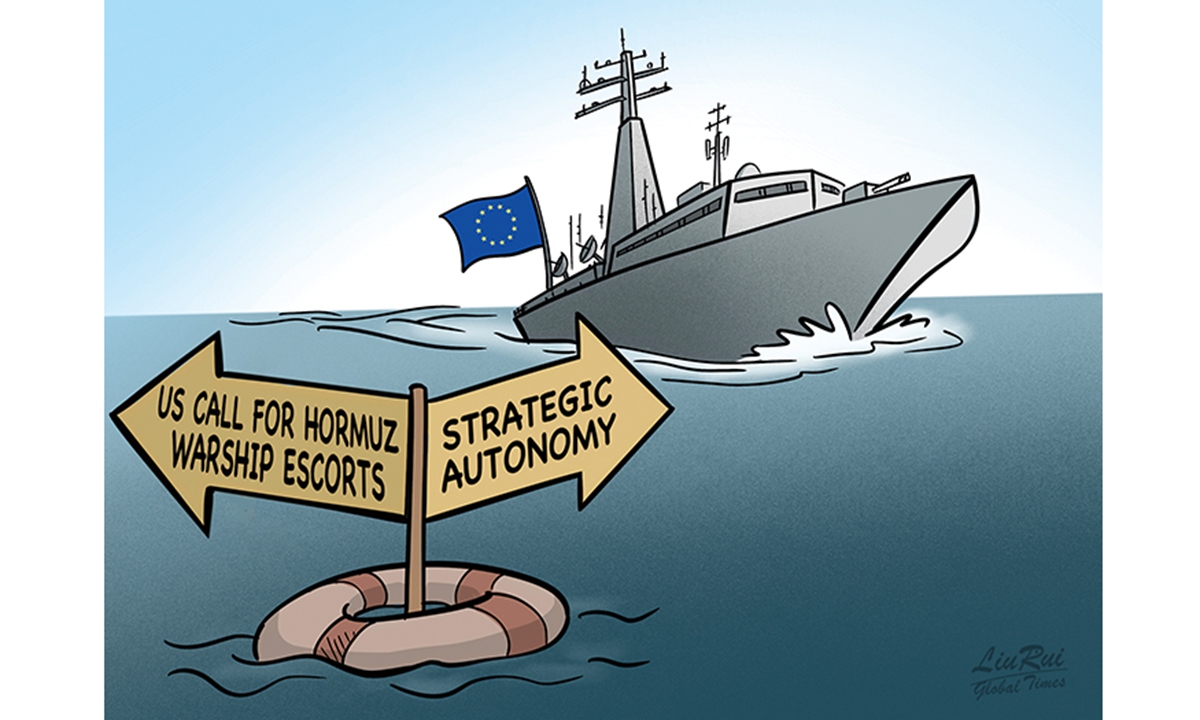
Illustration: Liu Rui/GT
When the US called its European allies to deploy warships to the Strait of Hormuz, several allies rejected the direct involvement in military operations against Iran, asserting that the conflict was "not our war."
Beyond the leadership of Spain and Italy, even a self-described Transatlanticist like German Chancellor Friedrich Merz stated bluntly that Germany would not participate in ensuring freedom of navigation in the Strait of Hormuz, for example, by military means as long as the war continues. Even as some European countries were discussing ways to help reopen the Strait of Hormuz, which is vital to their energy supply, they explicitly ruled out the US-led approach of deploying warships.
This reflects Europe's pragmatic interests. Zhao Junjie, a senior research fellow at the Institute of European Studies at the Chinese Academy of Social Sciences, told the Global Times on Wednesday that participating in warship escorts would bring significant risks and costs. Amid high fiscal pressure and continuous drain of resources by the Ukraine conflict, using taxpayer funds for such missions risks triggering a backlash from domestic opposition. Moreover, any direct or indirect clash with Iran could draw Europe into a quagmire of conflict.
The deeper reason lies in Europe's reassessment of its alliance with the US. Reflecting on past experiences of blindly following the US into the Iraq and Afghanistan wars, Europe has gradually realized that bloc-based confrontation in the name of "collective defense" and "burden-sharing" often amounts to unlimited "sharing of risks and costs." Following the Iraq War, what the US delivered to Europe was not security promised by neutralizing the so-called "weapons of mass destruction," but rather the multifaceted fallout of wars, including heightened terrorist violence, energy crises, inflation and migration pressure. Footing the bill for an ally's "military adventurism" has become a heavy political lesson for Europe.
This perception has been further reinforced during the current US-Israel-Iran conflict. The US launched military strikes without any prior consultation with its transatlantic allies. These traditional allies found themselves with no voice in the decision-making process, yet were forced to bear the fallout of surging global oil and gas prices.
Acting as a "cheerleader" or even a "vanguard" for wars has not brought Europe the respect or recognition it might have expected. Instead, what it has received from the US are critiques of "civilizational erasure," continued pressure over defense spending and burden-sharing, and even the "purchase order" for Greenland.
The "adversaries" Washington urges Europe to confront do not pose any direct threat. Rather, it is the US' unilateral and hegemonic approach that is damaging the interests of its allies. As Washington doubles down on unilateral action and logic of "might makes right," the rules-based international order on which Europe depends is being eroded, and its normative influence in global governance risks being marginalized. Europe is thus beginning to reassess a fundamental question: who is truly undermining the rules it has long sought to uphold, and who is eroding its security and development environment.
Against this backdrop, Europe's "no" marks not only a widening rift in the transatlantic alliance, but also a substantive step toward European strategic autonomy. "Europe's response to the US-Israel-Iran conflict serves as a key test of its strategic autonomy, with the concept increasingly transitioning from rhetoric to practical policy," Zhao added.
An awakening Europe appears to be moving from contemplation to action, with the rejection serving as a pivotal milestone. Spanish Foreign Minister José Manuel Albares said the EU has finally stood up to defend the rules-based order against "a unilateral war that is not our own." During a government statement in the lower house of German parliament, or Bundestag, Merz also emphasized that the EU "should no longer sell itself short." He noted that Europe needs to act united and take charge of its own security and the defense of its freedom in order to be able to prevail in a new world order dominated by superpowers including the US.
Europe's value should not lie in serving as a vassal or instrument of another country's interests, but in its constructive role in promoting international stability and global governance. Within Europe, discussions about building its own security capabilities and enhancing strategic autonomy are gaining momentum. However, whether this path toward strategic autonomy can be sustained in the long run will ultimately depend on a series of critical choices Europe makes in the future.
RELATED ARTICLES