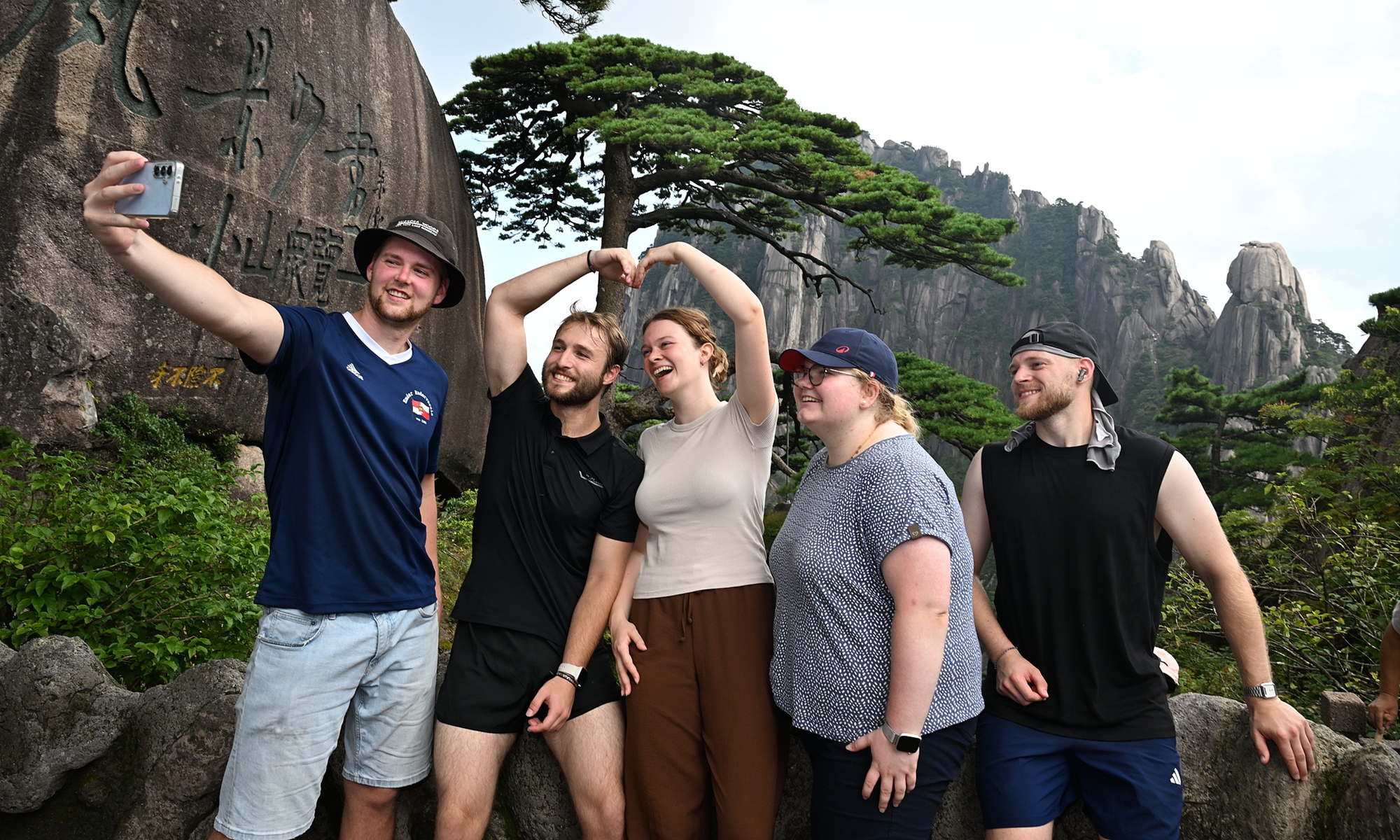
German students pose for a group photo by the Guest- Greeting Pine on Huangshan Mountain, East China's Anhui Province, on September 3, 2025. Photo: VCG
Editor's Note:It appears that younger generations in Europe are taking a more objective and positive view of China. A recent poll, "China in the Eyes of European Youth: Perspectives of Young Europeans on China-Europe Relations," shows that 82 percent of young Europeans hold a positive view of China, and 72 percent of respondents characterize China-Europe relations as friendly or primarily cooperative. Young people represent the future and hope of China-Europe relations. In the sixth article of the "China-Europe Resonance" column, we invite scholars from both China and Europe to further explore how this positive perception of China among European youth can serve as a bond for strengthening people-to-people exchanges between China and Europe, and to solidify the foundation for China and Europe to advance hand in hand in the future.
European youth are keenly aware of changes in the international situation
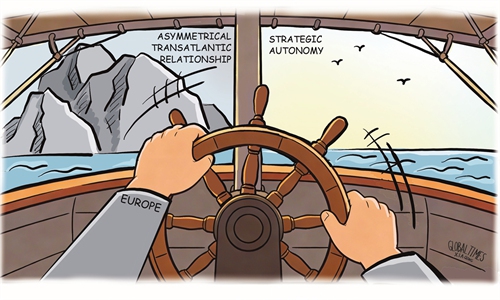
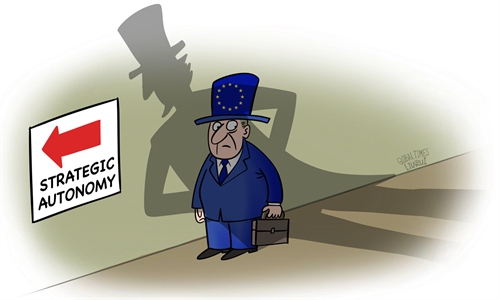
Xin Hua (director of the Center for European Union Studies, Shanghai International Studies University and deputy secretary-general of the Shanghai Academic Society of European Studies): European youth's perception of China is gradually becoming more positive, primarily due to their keen awareness of global issues and changes in the international landscape. Currently, the transatlantic relationship between the US and Europe is increasingly turbulent. The US extremely arrogant and domineering attitude toward Europe is prompting Europe to reflect on the drawbacks of its long-term unilateral reliance on the US.
China and Europe share similar positions and common ideals on global issues such as climate change. Europe hopes to maintain the existing framework of global governance and multilateralism, uphold the set of international rules represented by the WTO that sustain the operation of the world economy, and oppose the wanton undermining of international law.
Zhang Chao (an associate research fellow at the Institute of European Studies, Chinese Academy of Social Sciences): The widespread use of the internet and social media has enabled European youth to learn about China through more diverse channels. The deepening of China-Europe economic and trade cooperation has significantly impacted European youth's perceptions of China. And the expanding cultural exchanges have provided European youth with opportunities to experience China directly. Thus, their perceptions of China exhibit four distinct characteristics: pragmatism, openness, diversity and rationality.
Bennet (master's student at Sciences Po in Paris): One factor shaping how young Europeans perceive China is growing curiosity about China's role in the global economy and technological development. In many European universities, China frequently appears in discussions about international trade, global supply chains and emerging technologies. Students often encounter China when studying topics such as renewable energy or digital platforms. This exposure makes many young Europeans interested in understanding how China has developed so rapidly and what role it will play in the international system.
Another important factor is direct interaction with Chinese students. European universities host large numbers of Chinese students. Through everyday interactions, China becomes less of an abstract political topic and more connected to personal experiences and friendships.
Enhancing European youth's perception of a vibrant and dynamic China
Zhang Chao: In terms of cultural exchange, China's rich cultural heritage and thriving creative industries hold strong appeal for European youth. More young Europeans can engage with and understand Chinese culture in their daily lives. Efforts should also be made to encourage offline exchanges through travel and exhibitions, enabling cultural understanding to move from mere "observation" to genuine "experience."
In terms of education, expanding joint training programs, student exchanges and research collaboration among universities will help build long-term networks for youth interaction. The cross-cultural partnerships formed through study and research often endure for many years and have a profound impact on fostering mutual understanding.
In terms of career development, bilateral economic cooperation can provide more opportunities for European youth. Through corporate partnerships, internship programs and entrepreneurship platforms, young people can experience the tangible benefits of China-Europe cooperation.
Bennet: To strengthen China-Europe people-to-people connectivity, the most important dimension is long-term educational cooperation. Universities are one of the few spaces where young people from different countries can regularly exchange ideas and collaborate on shared challenges. Exchange semesters, joint research programs and dual degrees allow European and Chinese students to study together. This helps create a deeper understanding of how people in other countries approach global problems.
International research projects, youth conferences and policy programs that bring together participants from both regions can create opportunities for collaboration. Over time, these educational and professional exchanges help build long-lasting personal networks, which can contribute to mutual understanding and provide a stable social foundation for cooperation.
Xin Hua: When young Europeans come to China, they are often drawn to the country's vibrant and dynamic economic and social life. They can also clearly perceive the strong capabilities of Chinese enterprises and the rapid pace of technological advancement in the current round of global technological and industrial competition. We can introduce more China-Europe youth cooperation programs to attract a greater number of young Europeans to join the momentum of developing China's new quality productive forces.
Targeted and sustained institutionalized engagement
Bennet: One important insight from the perceptions of China among many young Europeans is that exposure often leads to more nuanced views. Direct interaction, whether through study, travel or professional collaboration, often creates a more complex and balanced perspective.
It is important to recognize that perceptions of China in Europe remain diverse and are shaped by broader discussions. For this reason, the most effective way to reduce misunderstandings is to encourage continued dialogue and engagement rather than avoiding differences.
Zhang Chao: In the context of economic globalization, cross-cultural understanding often stems from real exchanges and firsthand experiences. This phenomenon offers important insights for deepening mutual trust at the societal level.
First, real exchanges are more influential than one-way communication. European youth tend to develop relatively positive and rational views of China largely through contact with Chinese friends. People-to-people exchanges play an irreplaceable role in shaping national images.
Second, a diverse information environment helps reduce bias. In the digital age, European youth can learn about China through multiple channels. Therefore, more open and pluralistic platforms for exchange should be encouraged.
Third, more constructive approaches are needed to address negative perceptions of China within certain segments of European society. Objective and transparent communication should be strengthened, and differences in values shaped by distinct cultural backgrounds should be respected.
Xin Hua: To address negative perceptions and misconceptions about China among some Europeans, it is necessary to engage different segments of European society, including grassroots communities, intellectual circles and political elites. Only through persistent, long-term, nuanced and diversified cooperation and exchange can these stereotypes be effectively mitigated.
RELATED ARTICLES