Trump’s Pearl Harbor remarks put Takaichi in an ‘uneasy’ spot; Japanese PM under criticism over flattering attitude
By Published: Mar 20, 2026 11:22 PM
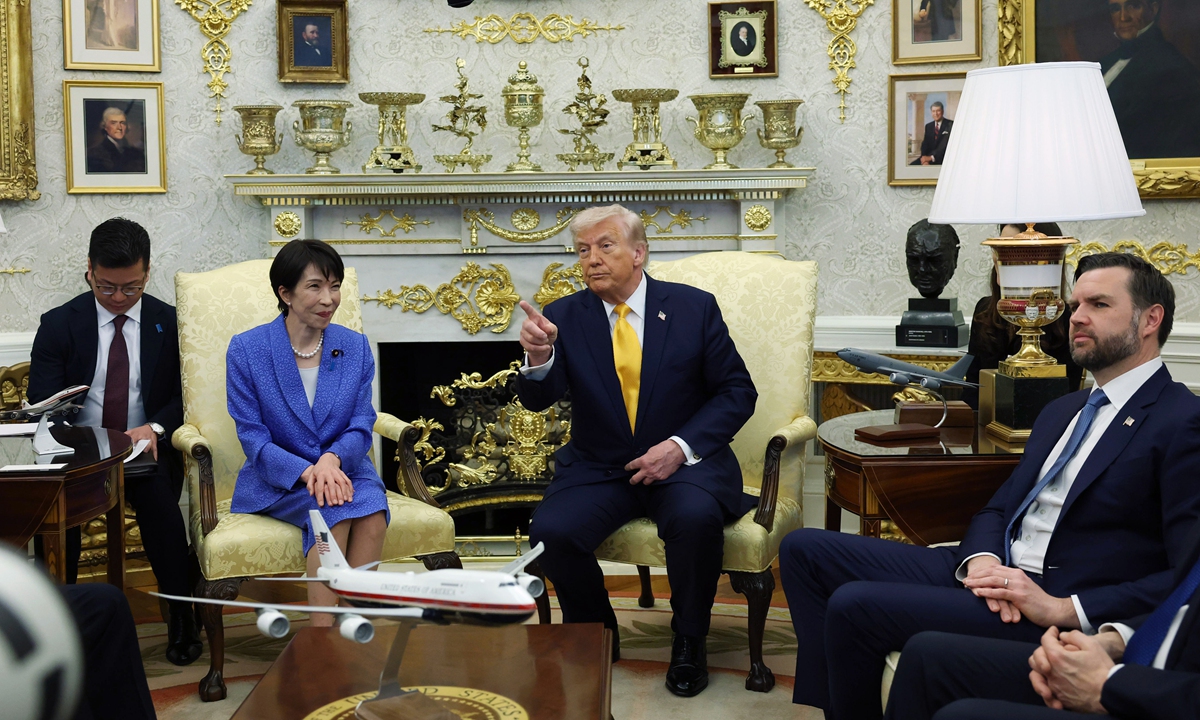
US President Donald Trump and Japanese Prime Minister Sanae Takaichi hold a meeting at the White House in Washington, DC, on March 19, 2026. Photo: VCG
As US President Donald Trump invoked Japan's 1941 attack on Pearl Harbor, which propelled the US into World War II and ushered in ferocious sea battles in the Pacific that would finally force Japan to surrender in 1945, to defend the war Washington launched against Iran without informing allies such as Japan, an awkward moment unfolded in the Oval Office beside Japanese Prime Minister Sanae Takaichi — a scene widely captured and reported in Japan and beyond, with some media describing Takaichi's reaction as uneasy and embarrassed.While Japan's Ministry of Foreign Affairs said in a release that Takaichi and Trump had built strong mutual trust and would elevate the Japan-US alliance to new heights, some in Japan saw her performance differently, criticizing her conduct — including her rushed embrace of Trump — as pandering and as a reflection of Japan's subordinate position.
Awkward moment
At the Oval Office on Thursday when Trump and Takaichi met with the press, a Japanese reporter asked Trump why the US didn't alert allies like Japan ahead of the Iran strikes, a decision that the reporter said "confused" the Japanese. Trump, in his response, said his administration "didn't tell anyone" about the February 28 military action in advance, according to a CBS News report.
"When we go in, we went in very hard. And we didn't tell anyone about it because we wanted surprise. Who knows better about surprise than Japan? OK? Why didn't you tell me about Pearl Harbor? OK? Right?" "We had to surprise them, and we did," the president said of Iran. "... If I go and tell everybody about it, there's no longer a surprise," Trump said, according to the report.
Trump's Pearl Harbor reference, made while seated next to Takaichi, drew wider attention from multiple media outlets. The New York Times said Trump "joked about" Pearl Harbor, while The Guardian said Trump had "mocked Japan." The Guardian also noted that the Japanese attack on the US naval base in Pearl Harbor took place on 7 December 1941. Then president Franklin Delano Roosevelt called it "a date which will live in infamy." The US defeated Japan in August 1945, days after atomic bomb attacks on Hiroshima and Nagasaki killed hundreds of thousands of civilians.
A report from India Today noted that "from English praise to Pearl Harbor jab, Trump leaves Japan PM visibly uneasy." It said that Trump's meeting with Takaichi "began on a lighter note, with Trump praising Takaichi's English fluency and joking about skipping translation." "Do you understand this? Very good, I'll tell you! So nice we don't have to sit through translation," Trump said, drawing smiles, per India Today.
Japanese media also gave prominent coverage to the exchange. Many outlets, including Mainichi, Asahi, Yomiuri, and Kyodo, highlighted in their headlines Trump's reference to the Pearl Harbor attack. Yomiuri reported that a former senior Japanese government official, commenting on the exchange during the Japan-US summit, claimed, "The public portion of the meeting went very well, but the comment about the Pearl Harbor attack was regrettable."
Trump's reference to Pearl Harbor may have seemed like a typical off-the-cuff joke, but it revealed a deeper view of US allies and a selective use of historical memory to exert pressure. By invoking Pearl Harbor in this context, he appeared to remind Japan of its subordinate position in the alliance and of Washington's dominant role in the current security cooperation, Xiang Haoyu, a research fellow at the China Institute of International Studies, told the Global Times.
Aside from the moment in the Oval Office, Takaichi also drew criticism for praising Trump during Thursday's meeting as the only person "who can achieve peace across the world," as well as for her remarks at the White House dinner, where she said, "Donald, tomorrow is the birthday of your son, Mr. Barron Trump, and I know he has grown so much into a very tall, good-looking gentleman," and "As I see you Donald, it is very clear where he got it, of course, from his parents, there is no doubt about it," according to the Daily Beast.
Her conduct when greeting Trump outside the White House also came under criticism. According to a Kyodo News report, when Takaichi arrived at the White House for the summit, she smiled and quickly moved in for a hug as Trump came out to greet her and extended his hand for a handshake.
In another video, Takaichi was seen opening her mouth wide and stretching out her arms when she saw a photo of Trump while walking through the "Presidential Walk of Fame" corridor. She then covered her mouth and laughed at the next image — a picture of an "autopen" representing former US president Joe Biden. The footage also went viral on X, with some criticizing her behavior as improper.
Hitoshi Tanaka, former Deputy Minister for Foreign Affairs of Japan, wrote on X on Friday that Takaichi's way of dealing with President Trump is "bizarre and embarrassing."
"It's a relationship between heads of state, and while some flattery is fine, if it's overdone, it ends up repulsing the onlookers. Clinging to him in public isn't a Western-style greeting, nor is it a symbol of closeness. Hugging is fine, but as a greeting, it requires moderation," said Tanaka.
Japanese Communist Party lawmaker Taku Yamazoe called it "the worst summit meeting" and wrote on X that Japan had gone out of its way to visit the US and displayed what he described as an attitude of "abject, servile praise."
The US-Japan summit is better described as awkward than successful, as Tokyo's primary goal was to shore up and strengthen the alliance, while Trump seemed far more interested in pressing Japan to do more for Washington, particularly by taking on a greater role in matters such as escort operations in the Strait of Hormuz. The two sides were plainly not working toward the same priorities, Li Haidong, a professor at China Foreign Affairs University, told the Global Times.
Strange bedfellows
During the meeting in the Oval Office on Thursday, a Japanese reporter claimed Japan's biggest concern was China and asked whether Trump would discuss Japan-China relations during his China trip. Trump said he would go to China "very quickly… I think we're going to have a great trip." He also said he would be "speaking Japan's praises" when he is in China, according to a transcript released by Roll Call's Factba.se, a political reference and tracking platform that aggregates and organizes White House materials.
Takaichi claimed that Japan has consistently remained open to dialogue with China, and that Japan has been handling its relations with China in a calm manner.
In response to Takaichi's remarks on dialogue, Chinese Foreign Ministry spokesperson Lin Jian said on Friday that true dialogue is built on the basis of respecting each other and honoring the agreements made. If anyone just talks about the need for dialogue on the one hand, while on the other, keeps stoking confrontation, then this so-called "dialogue" is apparently unacceptable.
Beneath the display of alliance unity, the two sides were clearly pursuing different agendas, making them, in Li's words, strange bedfellows. He noted that Japan sought to use the meeting to press for firmer and more explicit US support for a harder line on the Taiwan question and toward China and Russia. In Trump's foreign policy, however, an emphasis on coordination among major powers far outweighs the interest in satisfying the demands of allies.
This is why the Japanese media tried, through their questioning, to push the US side into making tougher remarks on China. But Trump neither accepts nor shares that logic. His response was, in effect, a reminder and a clear message to Tokyo that as a US ally, Japan is expected to align its China policy with Washington's broader approach. For Japan, that is a blow to both its pride and its interests, said Li.
RELATED ARTICLES