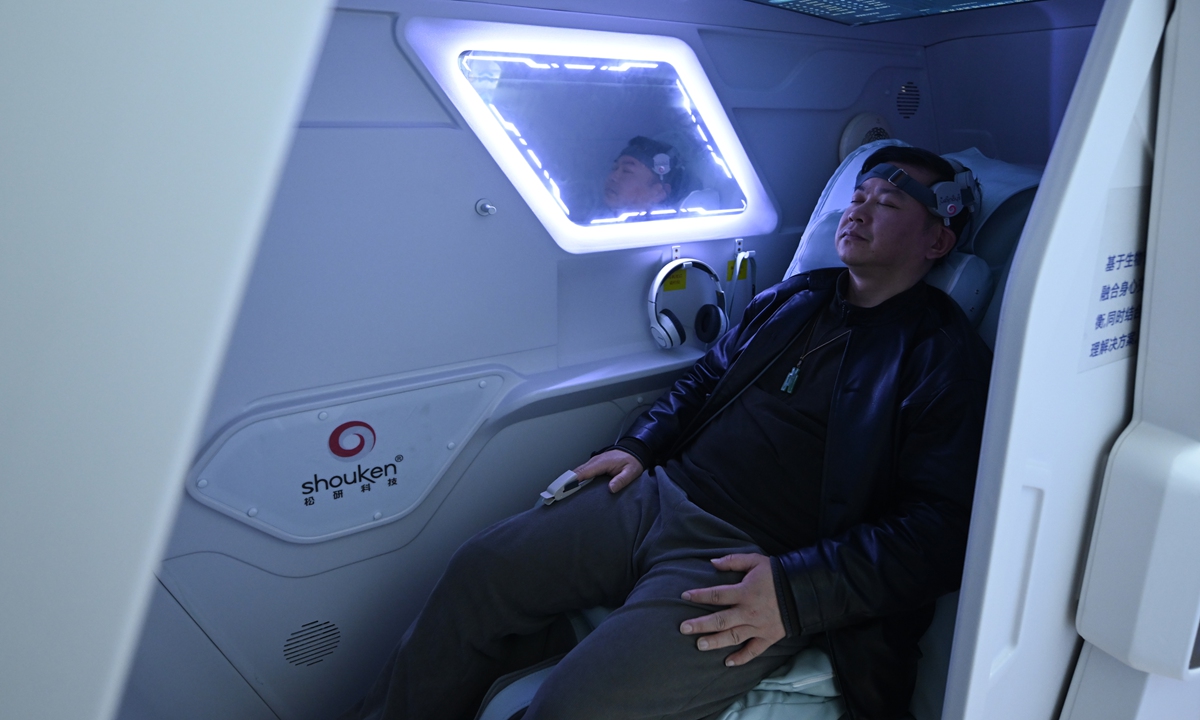
A citizen from Hangzhou, East China's Zhejiang Province, experiences the brain-computer interface slow-wave deep sleep conditioning technology on March 19, 2026. Photo: VCG
A park in Chongming district, Shanghai, will host a "sleep challenge," where participants' only goal is to wake up naturally, with the highest sleep score receiving a 3,000-yuan ($436.5) prize, local media outlet Jimu News reported.
The challenge will take place each Saturday from March 21 to April 26, as well as on May 2 and May 3, according to Jimu News citing a notice released via the official WeChat account of Shanghai Chongming district's converged media center.
Each session will accommodate 50 participants, with a registration fee of 299 yuan. Applicants must be healthy individuals aged 18 to 50, Jimu News reported.
Professional sleep monitoring devices will be provided by the organizer, and participants are required to wear them as instructed, the notice said. Awards will be determined based on the objective data recorded by these devices, according to the notice.
During the challenge, participants are prohibited from using electronic devices such as mobile phones for entertainment, engaging in conversation, or consuming food. Any medication intended to aid sleep is also forbidden.
The contestant with the highest overall sleep score will be awarded the title of "supreme sleep God" together with a 3,000-yuan cash prize, while participants who achieve instant sleep will receive 2,000 yuan, according to the notice.
Additionally, there is a total prize pool of 10,000 yuan, which will be shared among all participants who adhere to the rules and remain in the competition until the end, the notice said.
A staff member from the park said separate tents and beds will be provided at the venue, with each contestant competing inside their own tent, Jimu News reported. Citizens may observe the event but are not allowed to enter the competition area, the report added.
A staff member from the event's customer service said that the first session on March 21 has already reached full capacity, according to the report.
Global Times
RELATED ARTICLES