Gold suffers worst weekly rout in 43 years
Price may stay under pressure in the near term, but some analysts still bullish on its long-term prospects
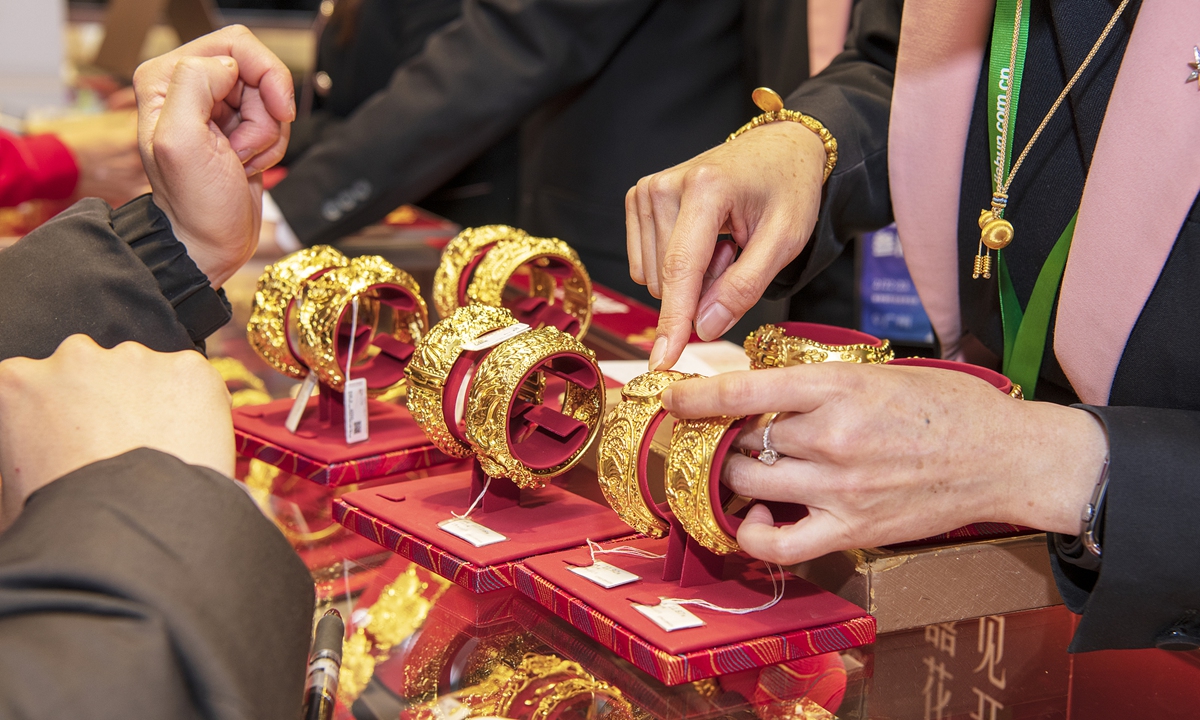
A sales representative shows a piece of gold jewelry at an expo in Guangzhou, South China's Guangdong Province. File photo: VCG
On Friday, gold dipped below $4,500 a troy ounce, erasing its gains across the past two months. Gold, usually considered a safe haven during periods of economic uncertainty, has slumped. According to a CNN report on Saturday local time, gold dropped 11 percent this week, posting its biggest weekly loss since 1983.
As of Friday's close in New York trading, spot gold fell 3.42 percent to $4,491.67 per ounce, a cumulative drop of more than 10 percent this week. COMEX gold futures fell 2.47 percent to $4,492 per ounce, a cumulative drop of more than 11 percent this week.
Chinese analysts said the market is currently experiencing a double whammy of liquidity shocks and expectations of tighter policy. Faced with such sharp fluctuations, investors should remain calm and cautious.
The gold price slump in 1983 stemmed from oil-producing countries selling gold to obtain foreign exchange amid falling oil prices-a supply-side shock. The current plunge, however, is driven by the US Federal Reserve's management of expectations, which has sharply increased the cost of holding gold and, essentially, collapsed demand.
Analysts emphasized that the commonality between the two crashes is that the short-term pricing anchor for gold has never been safe-haven sentiment, but rather real interest rates and the dollar's performance. This crash is both a correction of the overcrowded "interest-rate-cut trade" and a rational market adjustment to the real interest rate environment.
Figures from financial data provider Wind showed spot gold prices climbed to a high of $5,598.75 per ounce on January 29, 2026, representing a cumulative increase of 72.45 percent in just over six months compared to the closing price on June 30, 2025.
However, since the beginning of March this year, spot gold prices have shown an overall downward trend, coinciding with changes in the geopolitical situation, according to Shanghai-based news portal The Paper.
Short-term pressure
The plunge in gold prices followed central bank decisions that reinforced expectations for steady rates.
In times of turmoil, investors often buy gold, betting it will retain its value if inflation spikes, currencies drop or crisis hits. Yet surging energy prices because of the Middle East conflict are prompting central banks across the globe to rethink the outlook for interest rates. That matters a lot for gold, Chinese analysts said.
Market analysts expected the US Federal Reserve to hold interest rates steady this year, boosting the appeal of yield-bearing investments like bonds and dampening the appeal of gold, according to a CNN report.
Gold soared last fall when the Federal Reserve cut rates three times in a row, said the CNN report. Now rates are expected to hold steady for several more months, pushing bond yields up. That raises the opportunity cost of holding gold, it added.
The US Federal Reserve kept interest rates unchanged at 3.5-3.75 percentage points. In a statement released on Wednesday, the Federal Open Market Committee reiterated its strong commitment to supporting maximum employment and returning inflation to its 2 percent objective.
Federal Reserve Chair Jerome Powell said that surging oil prices due to the conflict in the Middle East are expected to increase inflation in the near term. "In the near term, higher energy prices will push up overall inflation," he said. Following the Federal Reserve's decision to further keep rates unchanged, US stock prices slid to session lows, US dollar index rose, and gold kept slipping below 4,900 dollars per ounce, the Xinhua News Agency reported at that time.
It's not just the US Federal Reserve. Central banks across the globe are adjusting policy rates in response to the US-Israeli war with Iran and the disruption to energy prices.
Concerns about inflation are prompting central banks to hold rates steady.
The Xinhua reported on Friday that, amid recent military tensions in the Middle East-which have pushed up international energy prices, intensified turmoil in global financial markets, and increased uncertainty about the global economic outlook-central banks around the world have taken a generally cautious approach to monetary policy and have kept interest rates steady.
The European Central Bank on Thursday held key interest rates unchanged amid heightened geopolitical tensions in the Middle East. Meanwhile, countries including the UK, Japan, the US and Canada have also announced decisions to leave rates unchanged, per Xinhua.
Overvalued amid geopolitical risks
According to CNN, the trajectory of the US dollar is another key factor for gold. The dollar index is up nearly 2 percent since the war began, halting a months-long slide. The rebound in the dollar could be dampening the appeal of gold.
Zhao Qingming, a Beijing-based veteran financial expert, said that the primary cause of the slump in gold prices is severe overvaluation. "After a prolonged surge, a pullback has become inevitable," he told the Global Times on Sunday.
Against the backdrop of already overvalued gold, the dollar's rally added further downward pressure on gold, Zhao noted.
"Starting from early March, the US dollar index has risen noticeably. Gold and the US dollar typically maintain a see-saw relationship: A stronger dollar usually weighs on gold prices," Zhao said.
Zhao said that in recent years, geopolitical risks have already pushed gold prices to an excessively high level. Markets have become desensitized to such risks.
Gold's safe-haven function only works when its valuation is reasonable or undervalued. When prices are severely overvalued, high geopolitical risks will no longer support gold; instead, they become a catalyst for long positions to turn short, he told the Global Times.
Based on weekly and monthly technical trends, as well as fundamental factors and the still-high overvaluation of gold, gold still has considerable room to fall, and a continued downward trend is more likely, Zhao predicted.
However, some experts are still optimistic about the outlook for gold. The US dollar rebound could fade, and geopolitical uncertainty abounds, they said.
Wall Street veteran investor Ed Yardeni told CNN he still expects gold to hit $6,000 before the year ends.
This is echoed by chief economist of Shenzhen-based First Seafront Fund Yang Delong, who told the Global Times on Sunday that the current Middle East situation has driven a sharp rise in oil prices, which in turn has pushed up global inflation expectations. Against this backdrop, the US Federal Reserve may delay interest rate cuts, fueling expectations that it might not cut rates at all this year. Since gold yields no interest income, its appeal has declined, Yang said.
Against the backdrop of a global push for de-dollarization, high US government debt, and persistent loose dollar liquidity, the long-term upward trend in international gold prices will remain unchanged, Yang said.
Data from the World Gold Council showed that central banks bought 230 tons in the fourth quarter of 2025, up 6 percent from 218 tons in the previous quarter, continuing the trend of de-dollarization and reserve diversification.
RELATED ARTICLES