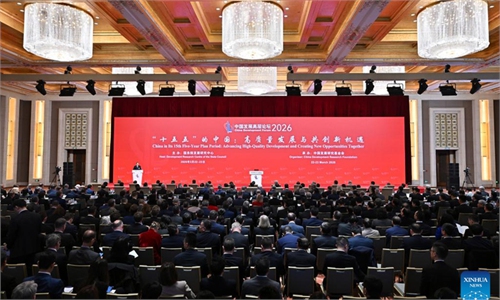
Participants attend the China Development Forum 2026 in Beijing, capital of China, March 22, 2026. The China Development Forum 2026 kicked off in Beijing on Sunday. The theme of this year's forum is "China in Its 15th Five-Year Plan Period: Advancing High-Quality Development and Creating New Opportunities Together." (Xinhua/Li Xin)
The China Development Forum (CDF) 2026 is held in Beijing from Sunday to Monday. Premier Li Qiang attended the opening ceremony and delivered a keynote speech. As the first large-scale national-level international forum after the two sessions, the theme of this year's forum is "China in Its 15th Five-Year Plan Period: Advancing High-Quality Development and Creating New Opportunities Together." It sent a clear signal to the world that China is willing to inject new momentum into global economic growth and share a prosperous future with all countries through its new achievements in high-quality development.
Against the backdrop of escalating geopolitical conflicts and international trade frictions, and the obstruction of the global economic recovery, the convening of the CDF demonstrates the determination to counter external pressures through openness and cooperation and to build global consensus through pragmatic actions, injecting much-needed confidence into the world economy. Premier Li's remarks, including "jointly expand the global economic pie" and "China is committed to being a 'cornerstone of certainty' and 'harbor of stability' for the world economy," have been cited by foreign media such as AFP. Reuters also said "China vows more open economy, national treatment for foreign firms." This forum allows the world to see China's confidence and openness in the first year of its 15th Five-Year Plan.
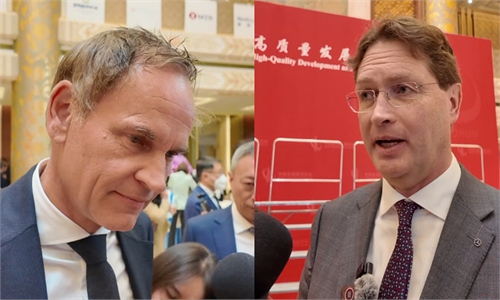
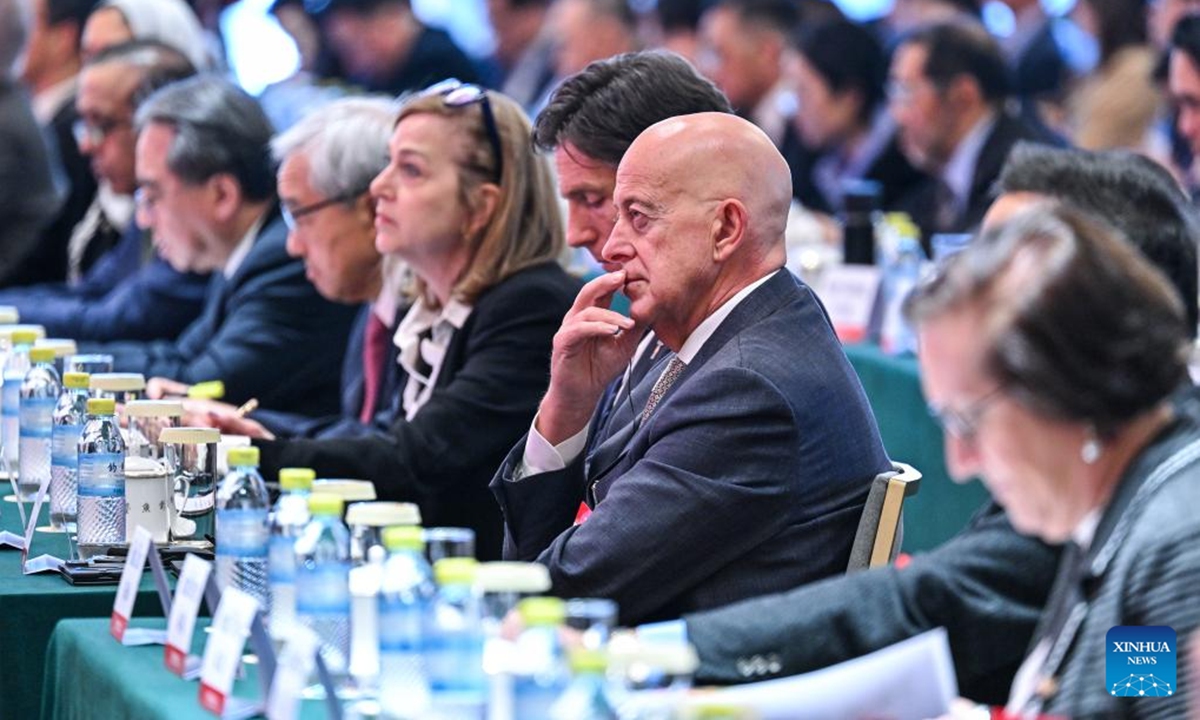
"Global CEOs gather in Beijing" - a post on the social media platform X vividly depicts the immense popularity of this year's meeting. The gathering of executives from over 90 renowned multinational corporations, including Apple, Volkswagen, Samsung, TotalEnergies, Mercedes-Benz, HSBC, and Shell, in Beijing is itself a powerful testament to their confidence. Their trip to China is far from a simple "check-in" event; it is a strategic choice to seize the development opportunities presented by China's 15th Five-Year Plan and to refine their global diversification strategy. The Financial Times cited a partner at the Asia Group consultancy as saying, "China is now safer, more reliable and stable, and more focused on economic development rather than conflicts." In the current turbulent global political and economic climate, as global CEOs look eastward to "seek certainty and stability amid uncertainty," the commitment of the world's second-largest economy to high-level opening-up is becoming increasingly attractive in the context of global economic fragmentation.
This "Summit of Global CEOs in Beijing" also reflects the vitality and resilience of the Chinese economy. Since its inception in 2000, the CDF has become the most authoritative dialogue platform between the Chinese government and the global business community. Unlike previous years, this year's meeting focuses on the blueprint of the 15th Five-Year Plan. It is believed that CEOs are attracted not only by China's market of over 1.4 billion people, its complete production and supply chain system, and long-term policy continuity, but also by the new blue ocean brought about by "high-quality development" and China's ability to continuously create incremental markets through openness and technological progress. This year's forum hosted 13 thematic seminars and multiple closed-door seminars, focusing on "new track topics" such as new trends in consumption growth, green and low-carbon transformation, future industrial development, and the industrial application of artificial intelligence, demonstrating China's open-mindedness in sharing development achievements and jointly promoting industrial upgrading with the world.
Some foreign media noted that the largest number of executives participating in this year's meeting comes from the US. This sends a clear signal: Despite frequent complaints from certain US media about China and accompanying rhetoric of "decoupling," the world's top business leaders are still embracing the Chinese market with concrete actions. China's interests are deeply intertwined with those of the international community, including the US, having long since transcended the zero-sum trap of "you lose, I win," and forming a community of shared future where "we rise and fall together." This two-way exchange is the most vivid illustration of mutual benefit and win-win cooperation.
Statistics show that 8,631 new foreign-invested firms were established nationwide in January and February this year, a year-on-year increase of 14 percent. Despite the complex geopolitical environment, firms continue to choose to register new companies in China, further dispelling rumors about "foreign capital withdrawing from China." In particular, the actual use of foreign capital in high-tech industries increased by 20.4 percent year-on-year, indicating that China is now attracting foreign investment more through "innovation dividends" rather than cheap labor. When the most astute capital begins to heavily invest in China's high-tech industries, it means that China's invitation to the world is no longer simply about "making money in China," but about "creating the future together with China."
In his letter, Apple CEO Tim Cook, who served as the foreign co-chair of the forum, quoted an ancient Chinese proverb: "A single tree does not make a forest; a single string cannot make music." This is the genuine feeling of a participant and beneficiary of China's development.
The world will eventually see that the fundamental reason why China is so attractive lies not only in its existing market but also in its future direction; not only in the possibility of cooperation but also in the fertile ground for win-win outcomes; and not only in its ability to achieve its own development but also in its willingness to help the world succeed. In Beijing, where CEOs are gathering, a brainstorming and in-depth exchange of ideas is taking place, involving policy interpretation, opportunity matching, and risk discussion, adding imagination to the expansion of global cooperation and win-win outcomes.
RELATED ARTICLES