Belgian PM’s ‘China devastating our economy’ remarks seen as bid to find scapegoat for EU's economic distress, outdated rhetoric: Chinese expert
By and Qi Xijia Published: Mar 23, 2026 02:01 PM

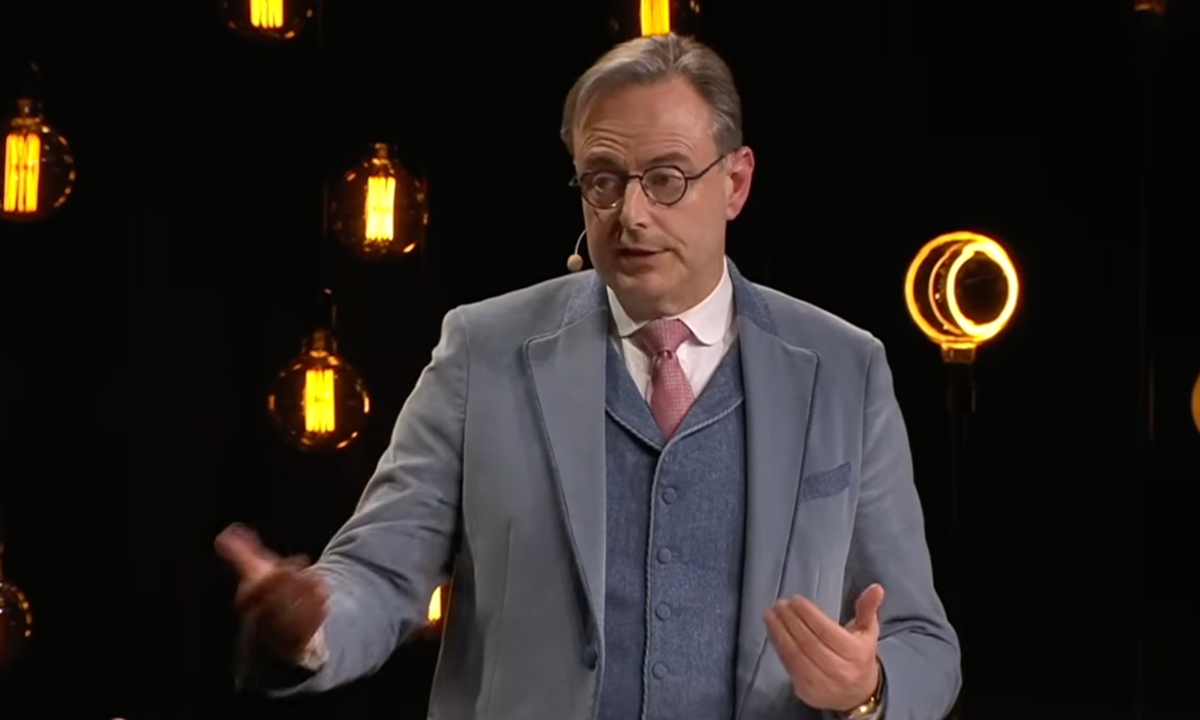
Belgian Prime Minister Bart De Wever speaks at the annual New Year forum "The Future of Europe," co-hosted by leading Belgian financial newspapers De Tijd and L'Echo. Photo: Screenshot from website.
Remarks made by Belgian Prime Minister Bart De Wever, who said that the EU should take a tougher stance on China in response to rising Chinese competition, represent a resurgence of protectionist rhetoric within the bloc, which is an outdated idea of ideological division and bloc confrontation that goes against the rising trend of cooperation, Chinese analysts said on Monday. This comes amid a growing atmosphere of cooperation between China and the EU, following visits by a number of European leaders since last year.
De Wever called on the EU to adopt a firmer approach toward what he described as unfair Chinese competition. In a letter to European Commission (EC) President Ursula von der Leyen, he warned that Beijing's economic policies are eroding Europe's industrial base, according to a March 21 report by belganewsagency.eu, citing Het Nieuwsblad and De Morgen.
De Wever's letter touched on a wide range of topics favored by the EU's China hawks. The points raised include warnings that China's export-led growth strategy — particularly in strategic sectors tied to the green transition, as well as chemicals and pharmaceuticals — is threatening European industry. He also claimed that China places European companies at a disadvantage in its domestic market through forced technology transfers and alleged breaches of intellectual property rights.
According to French news outlet Le Monde, De Wever wrote in the letter that China "is devastating our economy."
De Wever argued that the EU should reassess its current approach, which still defines China simultaneously as a partner, an economic competitor, and a systemic rival. He contended that this framework is outdated and called for a more coherent and assertive policy.
De Wever called for strengthening the EC's capacity to investigate unfair trade practices and called for closer coordination among member states to avoid fragmented bilateral agreements with third countries.
Zhang Jian, a vice president of the China Institutes of Contemporary International Relations, told the Global Times on Monday that the Belgian prime minister's statements reflect efforts by some EU politicians to make China a scapegoat for their inability to address competitiveness issues, as Europe grapples with multiple crises and the Russia-Ukraine conflict delivers a severe blow to its economy.
"Amid a sustained decline in competitiveness and deep divisions among EU member states and within them over how to navigate these challenges, there is always a faction looking to invoke protectionist measures, putting China in its crosshairs because of its economic capabilities," Zhang said.
"In essence, it is an attempt to divert public attention," Zhang said. "However, it must be pointed out that protectionism is nothing but a poison that worsens the very economic woes it purports to cure."
Since the second half of last year, China-EU relations have become more stable, with increased interactions, thanks to visits by many European leaders. However, this trend has made some hard-line and conservative forces within Europe uneasy, Cui Hongjian, a professor at the Academy of Regional and Global Governance at Beijing Foreign Studies University, told the Global Times on Monday.
"It could that in the view of EU conservative factions, failing to speak out now would allow the positive momentum of China-EU relations to grow further, which might affect their desired balance in China policy," Cui said.
Although some European countries and the EU have long claimed to uphold free trade and market openness, they have actually used more protective rules and measures in recent years, Cui said, noting efforts by EU politicians to justify the bloc's protectionist acts by blaming China.
Essentially, recent China-EU interactions have been based on mutual interests. Plagued by great power games, Europe seeks balanced diplomacy with both the US and China, but some forces still rely on traditional Western concepts of ideological division and bloc confrontation - an outdated idea.
The biggest threat to their security is not external challengers such as China, but internal division and disunity, Cui said, noting that such comments go against the rising trend of cooperation between China and the EU.
De Wever's remarks are not isolated. But there are also more sober, inward-looking voices.
French President Emmanuel Macron in December penned a piece in the Financial Times in December urging a rebalancing of economic relations between the EU and China, stressing that placing tariffs and quotas on Chinese imports would be "an uncooperative answer."
In the article, Macron pointed to the current trade surplus of 300 billion euros ($352 billion) that China runs with the EU, which he claimed was "not sustainable," either for Europe or China. Meanwhile, the French president acknowledged that the imbalance cannot be attributed to a single cause, noting that current challenges are also tied to "weak EU productivity."
German Chancellor Friedrich Merz, after wrapping up his visit to China, said in a speech in February that Germany "is no longer productive enough," while acknowledging China's development model.
"But when you come from China, ladies and gentlemen, you see things more clearly. With work-life balance and a four-day week, long-term prosperity in our country cannot be maintained," Merz said.
For China-Europe relations to remain steady and sound, it is crucial for Europe to have a correct perception of China, Chinese Foreign Minister Wang Yi said at a press conference on the sidelines of the fourth session of the 14th National People's Congress in March.
Facts have shown that China-Europe relations draw stability from shared interests and certainty from mutually beneficial partnerships, Wang said.
Since last year, relations between China and European countries have been regaining strength, Wang said, adding that two-way trade topped $1 trillion, and more than 2 million European tourists traveled to China under visa-free policies.
Noting that China and Europe are complementary, Wang said that "interdependence is not a risk; intertwined interests are not threats; and openness and cooperation will not weaken economic security; building walls and barriers will only lead to self-isolation."
RELATED ARTICLES